
Amazing ‘Sigiriya’- ‘Lion Rock’ Fortress In Sri Lanka With Frescoes, Mirror Wall And Miniature Gardens
A.Sutherland - AncientPages.com - Sri Lanka’s ancient site of historical and archaeological significance is dominated by a massive column of rock the so-called ‘Sigiriya Rock’.
Sigiriya rock (or the ‘Lion rock’) fortress is the spectacular and the oldest structure, approximately 200 meters (660 ft) high, located in the Matale District of the Central Provincen of Sri Lanka.
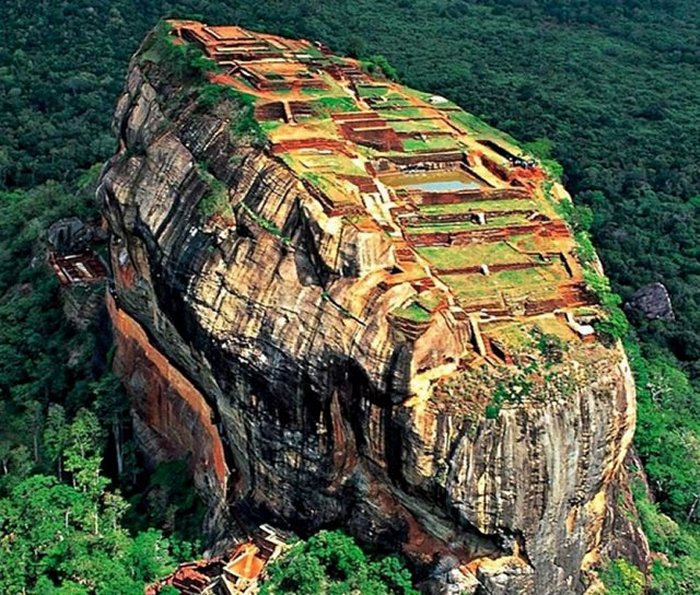
Sigiriya contains miniature water gardens and traditionmal water gardens considered to be are among the oldest in the world and their underground water ways are still functioning.
Sigiriya fortress features graffiti, frescoes, beautiful, landscaped gardens and fantastic 360-degree views. In fact, it is wrongly described as a fortress or castle but it is a perfectly planned multi-layered and complex royal city that covers several square meters in extent.
Miniature Water Gardens
According to archaeologists and historians, Sigiriya is a ‘unique combination of fifth century urban planning, hydraulic management, perfectly design landscaping, engineering, architecture, painting and sculpture.
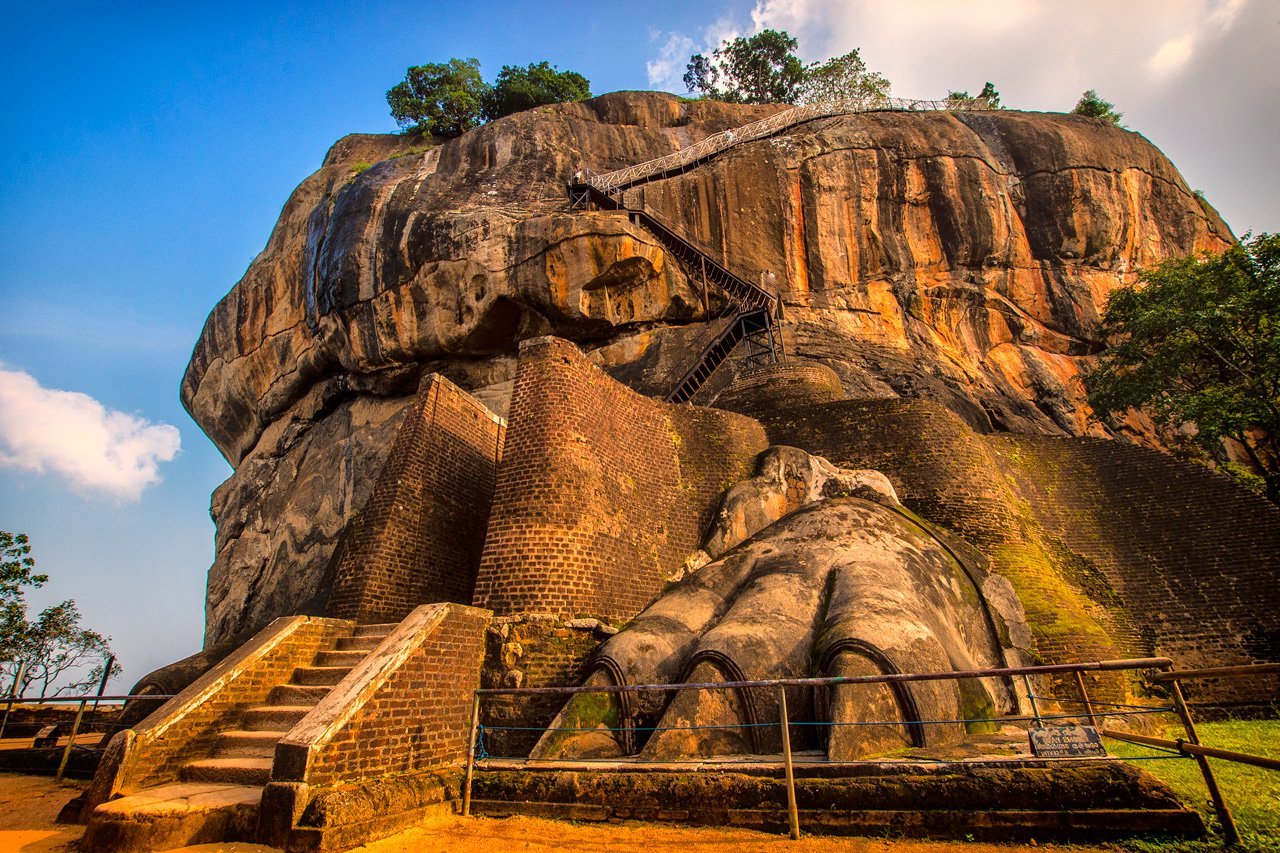
Today the Sigiriya complex is consisted of several parts and includes ramparts, moats, pleasure gardens, frescoes, mirror Wall. Lions Paw, summit, artificial lake along with inner and outer cities, a citadel that extends about 18 sq km and seven kilometers long dam.
The ‘Lion rock’ earned its name from the enormous lion which greeted visitors halfway up the rock on a small plateau.
See also:
Mysterious Mount Roraima Rising Over 8000 Feet Into The Clouds
Yungang Grottoes: Marvellous Example Of Ancient Buddhist Rock-Cut Architecture
Great Living Chola Temples: Outstanding Workmanship Of Chola Dynasty Builders Of South India
In ancient times, the same lion carved of rock warned enemies approaching the fortress.
Sigiriya contains miniature water gardens and traditional water gardens considered to be among the oldest in the world and their underground water ways are still functioning.
History Of Sigiriya
According to the ancient Sri Lankan chronicle the 'Culavamsa', this site was selected by King Kasyapa (473 - 495 CE) for his new capital. He is credited with the construction of the Sigiriya citadel and the surrounding city.

Sigiriya - Lion's Paw
He acquired the throne by overthrowing his father, and usurping his brother who had rightful heir to the throne, Moggallana, in a palace coup. Kasyapa imprisoned and later executed his father but later he lost his life in the battle.
He built his palace on the top of this rock and decorated its sides with colorful frescoes. On a small plateau about halfway up the side of this rock he built a gateway in the form of an enormous lion. The capital and the royal palace were abandoned after the king's death.
It was used as a Buddhist monastery until the 14th century, which is confirmed by the historical evidence but later it was lost for the jungle. During the 19th century, Buddhist monks again returned to the site and established a temple at Pidurangala.
Frescoes And Paintings Of Sigiriya
The most famous features of the Sigiriya complex are the 5th century paintings found
about the 100 meters above the ground’s level.
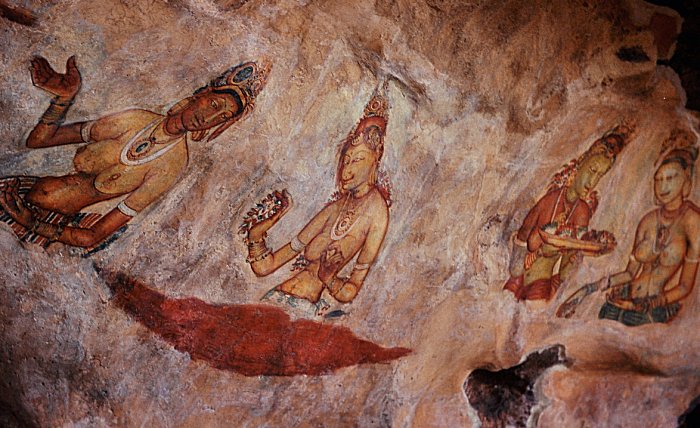
Artwork - Sigiriya. Schnobby/wikipedia
The technique used, is called ‘fresco’ which means to paint on the wet plaster. It is proved by a lady’s figure with three hands and another with three nipples. The painter could not erase the unsuitable hand and the extra nipple because he has painted it on a wet plaster.
However, there are several different interpretations of these maidens that simply can represent figures from the royal palace.
Mirror Wall In The Sigiriya Complex
It is said that originally this mostly unusual wall was so perfectly polished that the king could see himself whilst he walked alongside it. Made of brick masonry, the wall was covered in highly polished white plaster. This walled path continued to the summit through the lion’s mouth. The mirror wall was designed by skilled builders who used a technique that could combine natural rock, brick powder, kaolin, dolomite and oil of a bark of Dorana tree,commonly used for varnishing.
The Graffiti Tells Stories About Sigiriya
After Kasyapa's reign ended, the monastery with monks appeared again and people began to visit this
fascinating place writing poems about Sigiriya.
More than 1200 graffiti shed light on the society, literature and people who had a tradition of traveling to see the places other than on pilgrimage during the period from 6th to 13th century AD.
According to one graffiti, for instance, we learn that the queens at the time, have worn the silk from Beijing.
Lions Paw And Lion Staircase
One of the most dramatic features at Sigiriya is the great Lion Staircase, now only some ruins.
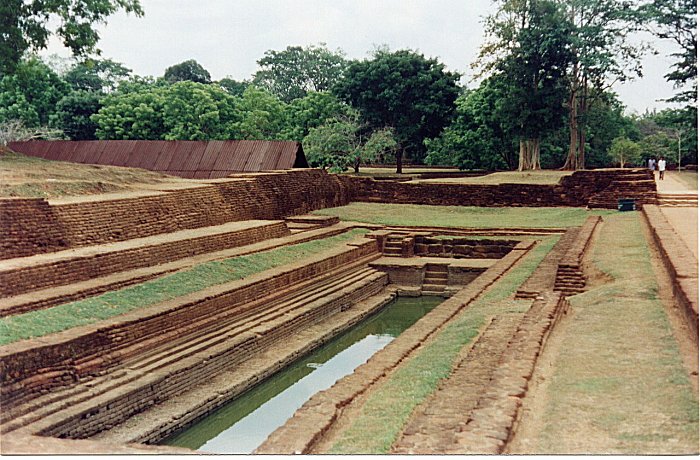
A pool in the garden complex: Sigiriya, Sri Lanka. Gardens at the foot of Sigiriya Rock. Copyright H.J.Moyes ([email protected]) October 2000 via wikipedia
On a small plateau approximately halfway up this rocky structure, the king ordered to build a gateway shaped as an enormous lion. There was once a sculpted lion's head above the legs and paws on both sides of the entrance, but the head collapsed years ago. The name of the place is derived from this structure —'Sihagiri', the Lion Rock. The lion - in its ruined state - is impressive even today. The graffiti describes the great lion and the entrance.
Both the Palace on the summit of the rock structure and a gateway in the form of an enormous lion was built on orders of the king; however, he did not stay at the palace, which has been used at ceremonial occasions, instead.
“...The Palace on the summit and the great lion presided over the surrounding countryside, is a powerful expression of both actual and symbolic royal authority and control over “landscape of power” radiating across the territory of the Sigiriya kingdom....” (Bandaranayaka. S.)
In "Sigiriya: City, Palace, and Royal Gardens," Senake Bandaranayake wrote that excavations revealed a suburban settlement. Eastern side of the rock was the" metropolis of the Sigiriya complex, where the bulk of the city’s population lived – nobles, officials, traders, craftsmen soldiers, servants and slaves...”
Sigiriya is one of the best preserved examples of ancient urban planning.
Written by – A. Sutherland - AncientPages.com Senior Staff Writer
Copyright © AncientPages.com All rights reserved. This material may not be published, broadcast, rewritten or redistributed in whole or part without the express written permission of AncientPages.com
Expand for referencesBandaranayake S. Sigiriya: City, Palace and Royal Gardens
More From Ancient Pages
-
 Surya: Hindu Sun God Who Illuminates The World, Our Lives And Disperses Darkness, Destroys Diseases, And Enemies
-
 King Geirrod Betrayed His Brother Agnar And Sent Him To Die But Justice Finally Prevailed
-
 Fisherman Pulls A Viking Sword From The River Cherwell, Oxford, UK
-
 Atomic Theory Was Invented 2,600 Years Ago By Acharya Kanad – A Genius Ahead Of His Time
-
 Ancient Maya Drug Containers – Scientists Identified What’s Inside
-
 Medieval Mythbusting – New Research Rewrites History Of Glastonbury Abbey
-
 Sandstone Head Of A Bodhisattva Discovered Near Ta Nei Temple
-
 Radiocarbon Dating Of Santorini Eruption And Egyptian Artifacts Shed New Light On Pharaoh Ahmose And The New Kingdom
-
 Evidence Of Frightening Rituals Practiced By Ancient Steppe Nomads In Siberia – Discovered
-
 Young Boy Finds Unique Micro-Mosaic Cross Medallion In Jerusalem
-
 What Did Bronze Age People Do With All That Bronze?
-
 Morgan Le Fay – Heroine, Goddess, Witch, Fay, Or A Sorceress In Arthurian Traditions
-
 Fate Of The Woman Whose Mysterious Doppelgänger Ruined Her Life
-
 Voynich Manuscript: Ancient Book Nobody Is Able To Read
-
 On This Day In History: Treaty of York Was Signed – On Sep 25, 1237
-
 Evidence Of Ancient Gigantic Tsunami That Struck Tel Dor Maritime City Mound, Israel
-
 Non-Invasive Radar Will Search King Tutankhamun’s Tomb For Nefertiti’s Hidden Crypt
-
 Massive Ancient Roman Water Basin In The City Of Gabii Was Hidden For Centuries
-
 Magnificent Bronze Age Female Burial At Tepe Chalow Reveals Secrets Of The Greater Khorasan Civilization
-
 Mysterious 2000-Year-Old Carved Vishap Stone Monuments Of Armenia

