
Ancient Cave Church Complex In Basarabi, Romania
A. Sutherland - AncientPages.com - In 1957, a complex of caves, crypts,. six chapels, and tombs dated to 9-10th century, was found near Murfatlar, a port on the Danube-Black Sea Canal, Constanta County, Romania.
Ancient cave monastery in Basarabi was dug into the chalky limestone hill at several, different levels, into the vertical walls of the ancient quarry. Between 1924–1965 and 1980–2007, the town Murfatlar (in Turkish, "generous man") was known as Basarabi and this name is still used in respect to ancient cave complex.

Inscriptions, drawings on the walls of Basarabi Caves
Most of the chamber-walls are covered with overlapping graffiti, including drawings and multilingual inscriptions carved on the walls in Old Slavic, some in Greek alphabet and some in Turkic runes and some in Romanian. There are also runic signs, which still remain a scientific mystery.
The Basarabi culture concentrated in Southeastern Europe, mainly in Romania and dated between 8th - 7th centuries BC. It was named after Basarabi, a village in Dolj County, south-western Romania, today, an administrative part of the Calafat municipality.
This culture is related to the Hallstatt culture of the Iron Age period, the Hallstatt A (12-11th BC) and B (10-8th BC) corresponds to the late Bronze Age, Hallstatt C (7th BC) to the early Iron Age, and Hallstatt D (6th BC) to the Iron Age.
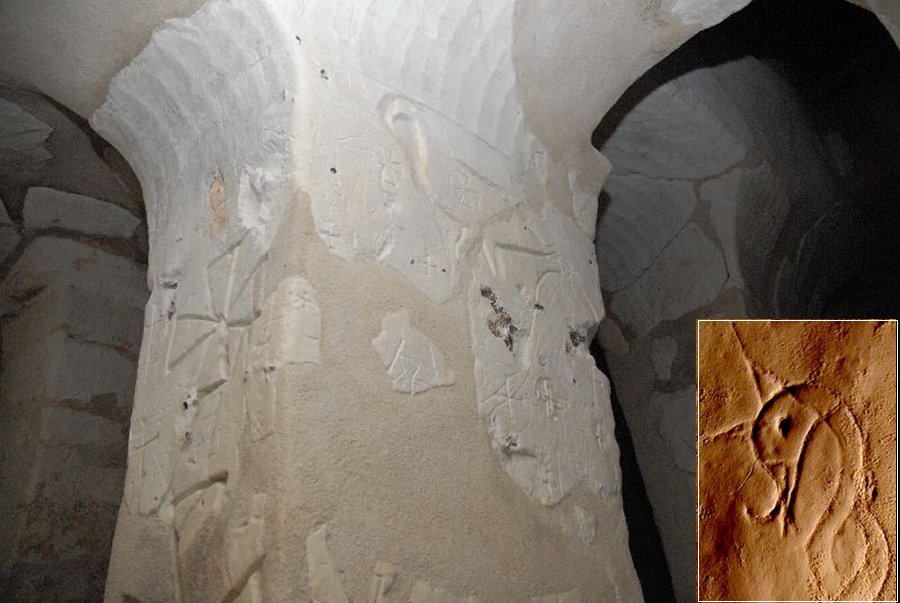
Basarabi ancient cave carvings
Like in some cultures of the region, the human settlements of the Basarabi culture, were usually open but sometimes also fortified, however, dwellings differed considerably within one culture.
They ranged from pit-dwellings and small huts to two-roomed rectangular houses, between 6 to 8 meters long and 3-4 meters wide.
Platforms which were frequently used in the Neolithic period, were not excavated, however, the living are of these people was equipped with a stamped clay floor.
In "Encyclopedia of Ancient Greece", Nigel Wilson writes: “the territory of modern-day Romania has been populated from the Palaeolithic period, but the country’s historical period begins in the 9th-8th centuries BC and is connected in southwestern Europe with the so-called Thracian Hallstatt period (c.600-550 BC), which corresponds to European Hallstatt C. Basarabi culture is considered the most representative of this new period within Romanian territory. The population was formed of mainly agricultural tribes living in fortified or open villages whose dwellings were constructed of timber….”
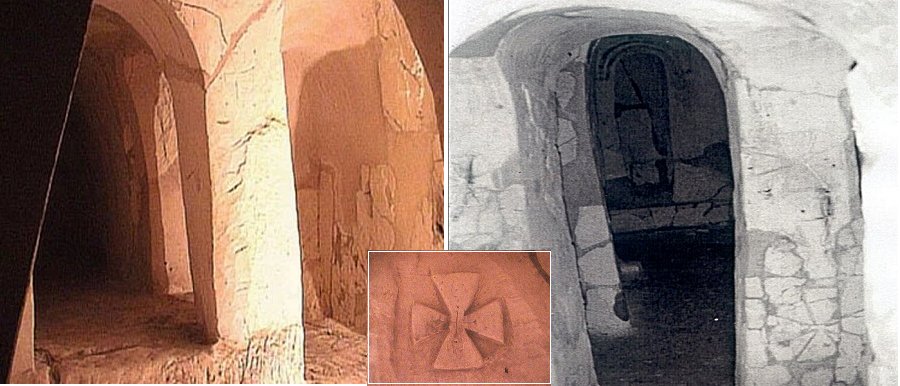
The caves of the Basarabi Church complex were discovered richly decorated with numerous drawings on the walls, depicting animals and men, riders, birds, and Christian symbols.
A large series of drawings is represented by mythical figures of monsters and dragons, along with halberds and an image of a Viking ship depicted on the walls, are all in favor of a northern origin.
During the years 1957-1962, an important monastic complex Basarabi, was discovered, near a big chalk quarry.
See also:
Mysterious Cucuteni-Trypillian Culture Burned Their Settlements For Unknown Reasons
Mysterious Underground Labyrinth With Secret Passages In Dobrogea
Spectacular Vardzia Cave Monastery – Huge Underground Complex Founded By The “Mountain Queen” Tamar
Researchers have linked these discoveries to the trade route between Scandinavian areas and Constantinople, known under the name “the route from the Varegs (= Vikings) to the Greek”.
However, they still have difficulty trying to decipher runic texts in Basarabi, due to their fragmentary preservation and the absence of many elements. It is not even known if they were written from left to right or from right to left.
For the time being, the runic writings remain undeciphered.
Written by – A. Sutherland - AncientPages.com Senior Staff Writer
Copyright © AncientPages.com All rights reserved. This material may not be published, broadcast, rewritten or redistributed in whole or part without the express written permission of AncientPages.com
Expand for referencesReferences:
Cambridge Ancient History (second addition, volume III)
More From Ancient Pages
-
 The Untold Story Of The Great Sphinx – One Of The Greatest – Part 1
-
 Mansehra Rock Edicts – Last Words Of Emperor Ashoka
-
 On This Day In History: Battle of Oosterweel Was Fought – On Mar 13, 1567
-
 Merkhet – An Ancient Egyptian Timekeeping Instrument
-
 3,000-Year-Old Ancient Egyptian Artifact Seized By US Agents In Memphis
-
 Minutes Did Not Exist During The Middle Ages
-
 Controversial Hollow Earth Theory – Scientific Facts Presented By Researchers – Part 1
-
 Why Couldn’t European Sailors Swim In The Past?
-
 LIDAR Discovers 18-Kilometer (11-Mile) Maya Road In The Yucatan Jungle
-
 Ancient Ziggurat Of Aqar Quf Dedicated To God Enlil
-
 On This Day In History: First European Sights The Ruins Of Ancient Maya City Of Copán – On Mar 8, 1576
-
 Humans Carry DNA From An Ancient, Unidentified Ancestor – Scientists Say
-
 Two Unique Antiquity-Dated Discoveries Have Been Made In The Ancient City of Agrigento, Sicily
-
 Gunung Padang – Remarkable Megalithic Site In Indonesia
-
 On This Day In History: Munich Agreement Was Signed – On Sep 30, 1938
-
 Well-Preserved Settlement Dated To 2,400 BC Unearthed At Tell Edfu, Egypt
-
 On This Day In History: Parachute Jump From 1,000 m Above Paris Is Recorded – On Oct 22, 1797
-
 One-Eyed Giant Polyphemus – Most Famous Of The Cyclops In Greek Mythology
-
 Malignant Serpent God Apophis: Symbol Of Chaos And Forces Of Darkness
-
 Unique Find In A French Crypt Offers The First Evidence Of European Familial Embalming Dating Back To The 16th Century

