
Frigg: Chief Norse Goddess Who Knew Secrets Of Humans’ Fates
A. Sutherland - AncientPages.com - Frigg is an early European goddess and a prominent mythological figure in Norse mythology.
In Norse beliefs, she was the personification of the sky, clouds, and the earth and the ruler of Asgard as the chief of the female goddesses representing the Norse pantheon of gods.
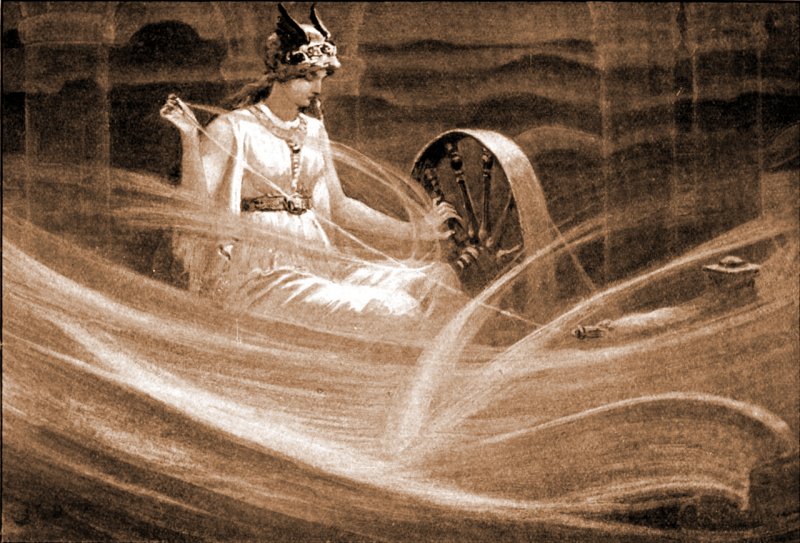
Frigga Spinning the Clouds. Guerber, H. A. (Hélène Adeline) (1909). Myths of the Norsemen from the Eddas and Sagas. Public Domain
Her name means "the beloved," "the friend," "the wife," and "dear."
She is the goddess of love, maternity, marriage, and the household.
Although Frigg was the goddess of family, motherhood, and protector of marriage, she was unfaithful to Odin several times, including his brothers.
She was the mother of Balder, the god of the sun and light, and Höder and Hermod. As the wife of Odin, she shared his throne, Hildskjalf, from which Odin could see all lands.
In a part of Prose Edda, "Gylfaginning," Snorri mentions the high seat of Odin, saying that "there is one abode called Hliðskjálf, and when Allfather sat in the high seat there, he looked out over the whole world and saw every man's acts, and knew all things which he saw."
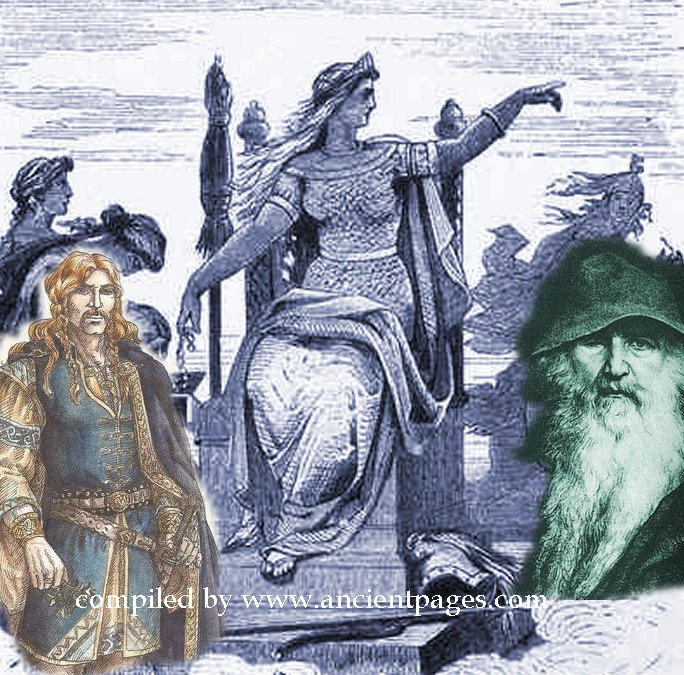
To Frigg belonged the headquarters of Fensalir, a palace of mists, where she, accompanied by her eleven handmaidens (also goddesses), used to sit at her jewel-covered spinning wheel to make strands of golden thread and create wonderful brightly colored clouds.
Her remarkable weaving abilities were highly appreciated.
Divine Maidens Of Frigg
As the queen of goddesses, Frigg had a group of divine females around her. The goddesses Lin, Fulla, and Gna, were closely associated with Frigg.
Peter A. Munch describes these three divine ladies:
"…Lin is set to guard those of humanity whom Frigg desires to preserve from harm. Fulla, a maiden with long flowing hair and a golden chaplet about her brow, carries Frigg's hand casket, keeps watch and ward over her shoes, and shares her secrets. Gna runs errands for Frigg through the various worlds, especially in matters requiring despatch, in which she rides the horse Hofvarpnir, who races through the air and over the waters."
The other maidens of Frigg were busy with other duties, which more or less were associated with different attributes of the chief goddess.

Frigga and the Beldame - Illustration by Harry George Theaker for Children's Stories from the Northern Legends by M. Dorothy Belgrave and Hilda Hart, 1920. Image credit: - http://www.germanicmythology.com/works/THEAKERART1920.html - Public Domain
One was a highly skilled healer; another could easily remove all obstacles disturbing love affairs, and yet another was responsible for punishing those who broke their trust and confidence.
Frigg's Appearance, Attributes, And Her Headquarters Fensalir
The goddess was a very handsome, tall lady. Her head was often decorated with plumes, and keys hung from a beautiful golden girdle around her waist. The keys symbolized the northern housewives Frigg protected and guarded, while the plumes symbolized feathery clouds in the sky.
As the personification of the sky, Frigg was often depicted wearing an oversized blue coat, symbolizing the sky, according to a myth. Like the goddess Freya, she was supposed to be the owner of a falconry robe that would allow her to change her character.
Frigg's main symbols include the full moon, the sky, the spinning wheel, spindle, mistletoe, and silver, many of which are shown in artistic representations of the goddess.
As to her abode, Fernsalir (Old Norse "Fen Halls"), the descriptions of the place vary. In one version, it was described as a beautiful place; in another, it was a gloomy place associated with the mists and darkness, and through this place, Frigg appears to have a link to Hel, ruler of the underworld and a daughter of Loki, the trickster.
Power Of Knowing People's Fate
Frigg possessed foreknowledge and could access the secrets of humans' fates. She was said to hold knowledge of people's continued fate through her husband Odin but could not reveal these secrets. However, according to Snorri's Prose Edda Prologue, both Frigg and Odin possessed the gift of prophecy.
Odin often consulted his wise wife on many issues, and although Frigg did not devote herself to divination, she knew a lot about the future.
As a weaver, she makes us think about the Greek Fates, also skilled weavers responsible for controlling time by measuring fiber length with the help of their spinning wheels.
There is also a resemblance between Frigg and the Slavic spirits of fate and judgment, the Sudice. Both were responsible for the futures and destinies of humanity. They judged and meted out fortune and fatality.
Frigg Was A Popular Goddess
Her name was popular among German and English tribes, and the cult of Frigg survived in ancient places in Sweden and Norway.
Most famous is a myth describing the death of Balder and Frigg's desperate attempts to protect him from death.
Frigg had to cry twice in the history of the world. She wept for her son Balder in her palace, Fensalir, for the first time while mourning her beloved son. In the same way, she will regret her husband, Odin, at Ragnarok (Ragnarök), the end of the world.
During his fight with the wolf Fenrir, he is consumed by the monster. The völva predicted it would occur during the last battle of gods with giants and other chaos monsters.
The Goddess Frigg Will Survive Ragnarok
Due to some of her domains, Frigg was sometimes associated with Freya, another popular goddess in Norse beliefs. Occasionally, several functions of these two goddesses are mixed. Some scholars suggested that Frigg and Freya once represented only one goddess, later divided into two characters.
Frigg is mentioned throughout the Poetic Edda, the Icelandic medieval manuscript known as the Codex Regius, in the poems Völuspá, Vafþrúðnismál, the prose of Grímnismál, Lokasenna, and Oddrúnargrátr. According to ancient beliefs, the English weekday name Friday comes from Old English Frigedæg, meaning 'day of Frig.'
This day was considered the best day to get married.
Updated on Sep 9, 2023
Written by – A. Sutherland AncientPages.com Staff Writer
Copyright © AncientPages.com All rights reserved. This material may not be published, broadcast, rewritten or redistributed in whole or part without the express written permission of AncientPages.com
Expand for referencesReferences:
Spence L. A Dictionary of Non-Classical Mythology
Munch P. A. Norse Mythology, Legends of Gods and Heroes
Bulfinch, T. Bulfinch's Mythology
More From Ancient Pages
-
 Unexpected And Surprising Results Of Ancient DNA Study – Who Were The First People In South America?
-
 Apollo Punished Rivals For Their Extraordinary Musical Skills
-
 On This Day In History: Mesoamerican Long Count Calendar Begins – On August 11, 3114 B.C
-
 Why Was Europe’s Oldest Battle Fought At Tollense Valley 3,000 Years Ago?
-
 Has A 12,000-Year-Old Underwater City Been Discovered Off The Coast Of Louisiana?
-
 The Phoenicians – And Their Great Experience As Sea Traders
-
 2nd Century Inscription Unearthed At Forum Of Ancient City Of Philippopolis, Bulgaria
-
 Norwegian Vikings Were Much More Violent Than Their Danish Counterparts, New Study Reveals
-
 Newly Unearthed Colossal Statue Probably Depicts King Psammetich I And Not Ramses II
-
 Evil God-Bird Anzu Who Stole The Tablet Of Destiny To Control Universe And Fates Of All
-
 142,000-Year-Old Shell Beads Found In A Cave Are The Oldest Known Evidence Of Human Communication
-
 On This Day in History: Brilliant U.S. Chess Champion F. J. Marshall Plays 105 Games Simultaneously – On Mar 21, 1916
-
 Has The Legendary Viking Stronghold Jomsborg Finally Been Found?
-
 Ancient Egyptian Temple, 30 Mummy Cards, 85 Tombs And Surveillance Points From The Era Of Ptolemy IIIs Discovered In Sohag
-
 MaizeCODE Sheds Light On How Corn Was Domesticated 9,000 Years Ago
-
 ‘Collata Quipu’ May Explain Messages Hidden In Mysterious Writing Of Inca
-
 Mystery Of Ancient Carved Shiva Lingas In India And Cambodia
-
 10 Most Bizarre Forms Of Ancient Taxes: Surprising And Funny
-
 On This Day In History: Amelia Earhart, Most Famous Female Pilot – Disappeared Over The Pacific Ocean – On July 2, 1937
-
 New Evidence Reveals That Humans Settled In Americas At Least 13,000 Years Ago

