
Waru Waru – Ancient Andean Irrigation System Brought Back To Life
Ellen Lloyd - AncientPages.com - Not all knowledge of our ancestors is lost forever and there is still much to be learned from ancient people and their methods to handle climate changes, for example. Using wisdom from the past, modern scientists can help poor communities to handle water related problems.
Ancient Farming Techniques Can Help Our Modern World
Thousands of years ago, our ancestors came up with efficient farming techniques that modern scientists are now investigating to mitigate climate change. One of the most interesting technologies of ancient time are underground irrigation canals known as “qanats”, developed by people in Persia about 3,000 years ago. The qanats transported water from a water wells to surface for irrigation and drinking as well and they could do it over long distances.
The Hohokam people were 'Masters of the Desert’. Their extensive irrigation canals served as the foundation of the modern canals used to irrigate crops in the valleys along the Salt and Gila rivers. The Aztecs built so-called chinampas to improve their agriculture. These were small, artificial islands created on a freshwater lake. The chinampas resembled floating gardens.

Chinampas: Artificial Islands Created By The Aztecs To Improve Agriculture - Image credit: Ez Gro Garden
Chinampas were used throughout the Valley of Mexico around the lake bed and were without doubt one of the reasons why Aztec’s farming became famous.
Knowledge Of Waru Waru Is Not Lost
Before the rise of the Inca Empire, Andean people developed an agricultural technique called Waru Waru. This technology, based on modification of the soil surface to facilitate water movement and storage helped people to cope with floods and droughts.
Combining raised beds with irrigation channels to prevent damage by soil erosion during floods, was an inexpensive way to improve crop yields and ease the punishing effects of farming at 12,500 feet above sea level on the Andean plains.
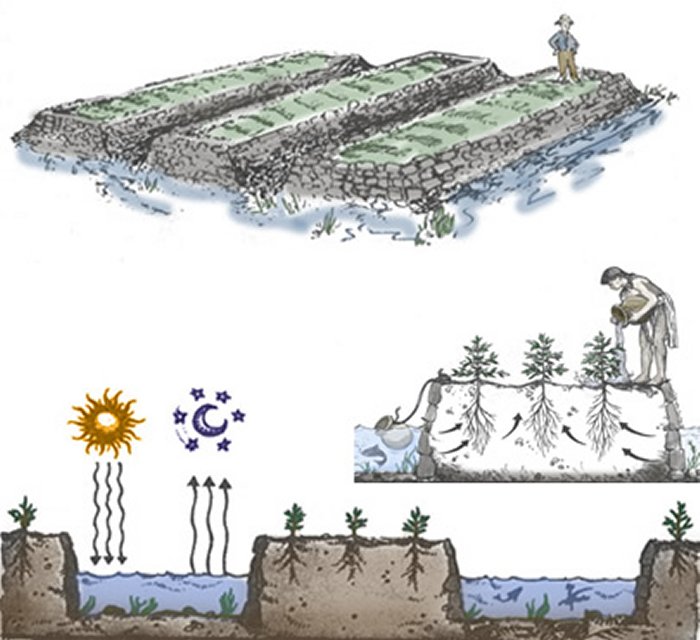
Image credit: Ez Gro Garden
Also known as suqakollos, the Waru Waru resembles an ornate garden maze from above. It’s a cleverly designed patterned system of raised cropland and water-filled trenches.
Around Lake Titicaca, as many as 250,000 acres show traces of Waru Warus. This suggests ancient inhabitants of the altiplano were successfully using this agriculture method to tackle the considerable environmental constraints of farming the area.
When more technically advanced irrigation technologies were discovered, Waru Waru was abandoned. However, in more recent years, the Waru Waru technology has been brought back to life in Bolivia and Peru. Scientists discovered that Waru Waru technology not only worked, but it tripled crop production.
See also:
Qanats: Ancient 3,000-Year-Old Underground Irrigation Canals Invented By People Of Persia
In 1981, Clark Erickson, of the University of Illinois, recognized the archaeological significance of Waru Waru. Erickson wondered whether this ancient system might not serve modern farmers and began to rebuild some of the raised fields. Using traditional Andean tools, local farmers planted an experimental field with potatoes, quinoa and canihua. Private development organizations and the Peruvian government rushed in to aid farmers.
According to Alipio Canahua, a program director for the international humanitarian agency CARE, “there was Waru Waru fever to reconstruct ancient technology back then.”
Locals in Cutini Capilla, an Aymara community on the western shore of Lake Titicaca between Puno and the ruins of the Tiwanaku capital said the Waru Warus have helped them to make the land useful again.
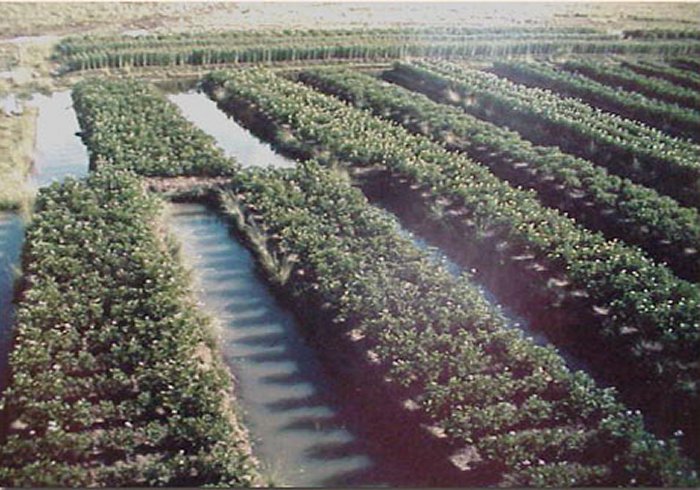
Waru Waru technology. Credit: irrigaciondelperu
Alipio Canahua, an agronomist working with the Food and Agriculture Organisation (FAO), says that the ancient agricultural system, which could date back 3,000 years, actually creates its own microclimate.
“It captures water when there are droughts and drains away water when there’s too much rain, meaning that it irrigates the crops all year round,” he says. “When it comes to temperature, we’ve measured a rise of three degrees centigrade in the immediate environment around it – this can save a significant percentage of the crops from being killed in frosts.”
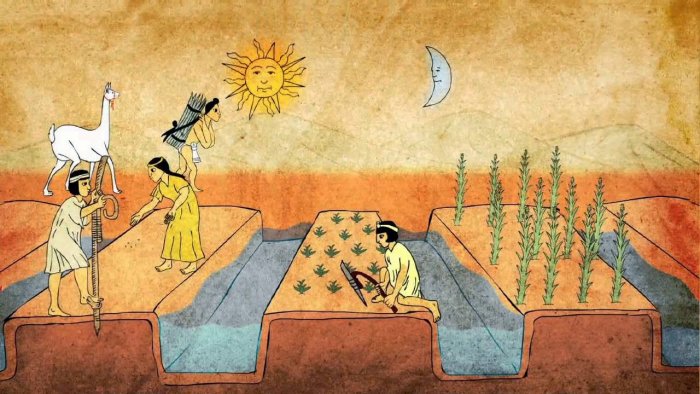
Credit: Blog de Historia General del Perú
The ancient Waru Waru technology has been brought back to life, but whether it survives depends on investments and financial support from the governments.
It is also impossible to make the suqakollos as big as pre-Hispanic people did because roads and boundaries between communal lands, have limited the space available.
Scientists think that the ancient Waru Waru technology could be used in conjunction with other ancient techniques such as interconnected irrigation lakes called "qochas" and the Inca-built terraces known as "andenes" for farming the steep Andean slopes.
Written by Ellen Lloyd – AncientPages.com
Copyright © AncientPages.com All rights reserved. This material may not be published, broadcast, rewritten or redistributed in whole or part without the express written permission of AncientPages.com
More From Ancient Pages
-
 Unique Gjermundbu Helmet – Why Has Only One Viking Age Helmet Been Found In Scandinavia?
-
 Groundbreaking Discovery Reveals High Cognitive Abilities In Humans Who Lived 170,000 Years Ago
-
 Origin Of The Genetic Code – Study
-
 5,000-Year-Old DNA Could Solve The Mystery Of Genetic Changes In Europe
-
 Raven Mocker And Cannibal Body Snatchers In Cherokee Mythology
-
 Luxor’s Heritage In Focus: Southern Chapels Of The Akh Menu Temple – Restored
-
 100,000-Year-Old Case Of Deafness Discovered In Fossilized Skull Of Hunter-Gatherer
-
 Mysterious Ancient Tracks In Rock, Strange Legend And Hidden Treasure – A Puzzle From Arkansas
-
 Long-Lost Wisconsin Ghost Ship F.J. King Finally Found
-
 On This Day In History: Galilei Galileo Demonstrates His First Telescope – August 25, 1609
-
 Subterranean Structure In Medieval Naryn-Kala Citadel: Was It The Christian Temple?
-
 Breakthrough – First Glimpse Into A 2,000-Year-Old Charred Herculaneum Scroll
-
 Early Humans Used Fire To Make Stone Tool – New Study
-
 Artifacts Unearthed In Mit-Rahina, South Of Giza, Egypt
-
 Enigmatic Footprints Reveal Humans Were In Spain 200,000 Years Earlier Than Previously Thought
-
 Leprechaun: One Of The Most Famous And Powerful Creatures Of The Irish Faerie Folk
-
 Silphium – Remarkable Ancient Herb That Mysteriously Vanished
-
 On This Day In History: Battle of Champion Hill Was Crucial Action Of Grant’s Vicksburg Campaign – On May 16, 1863
-
 MUL.APIN Tablets: Babylonian Knowledge Of Astronomy And Astrology Recorded In Cuneiform Writing
-
 On This Day In History: Execution Of Saints Crispin And Crispinian – On Oct 25, 286

