
Gordian Knot And How Alexander The Great Managed To Outmaneuver The Problem
A. Sutherland - AncientPages.com - The Gordian Knot is a metaphorical expression that means a complicated problem or deadlock when we have an unsolvable problem, which is our "impossible knot."
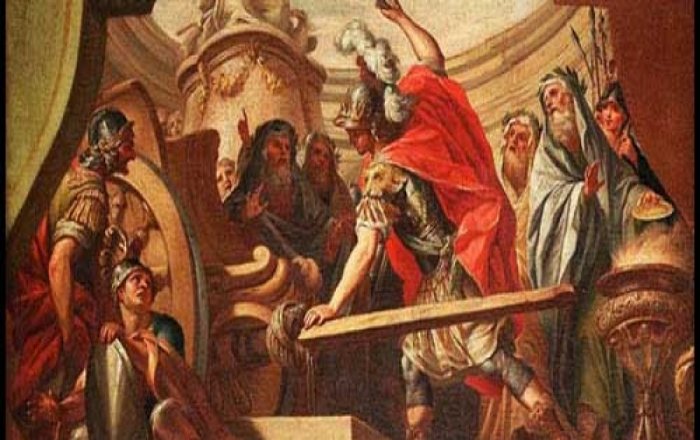
Alexander the Great slicing the Gordion knot with a sword-stroke. Credit: Public Domain
It began long ago when the Phrygians had no ruler and plunged into a civil war. An ancient prophecy of the oracle was announced at Telmissus (the ancient capital of Lycia).
It said that the new king would be the one who would enter the city in a simple ox-cart.
The first through the city's gates were Gordias, a poor peasant who came to the town with a cart drawn by an ox with his wife. He tied its yoke to a post with a highly sophisticated knot called the Gordian Knot. Gordias was declared king, and his grateful son, Midas, dedicated the ox-cart to the Phrygian god Sabazios (identified with Zeus).
Roman historian Quintus Curtius Rufus later described the knot as a masterwork. It comprised "several knots all so tightly entangled that it was impossible to see how they were fastened."
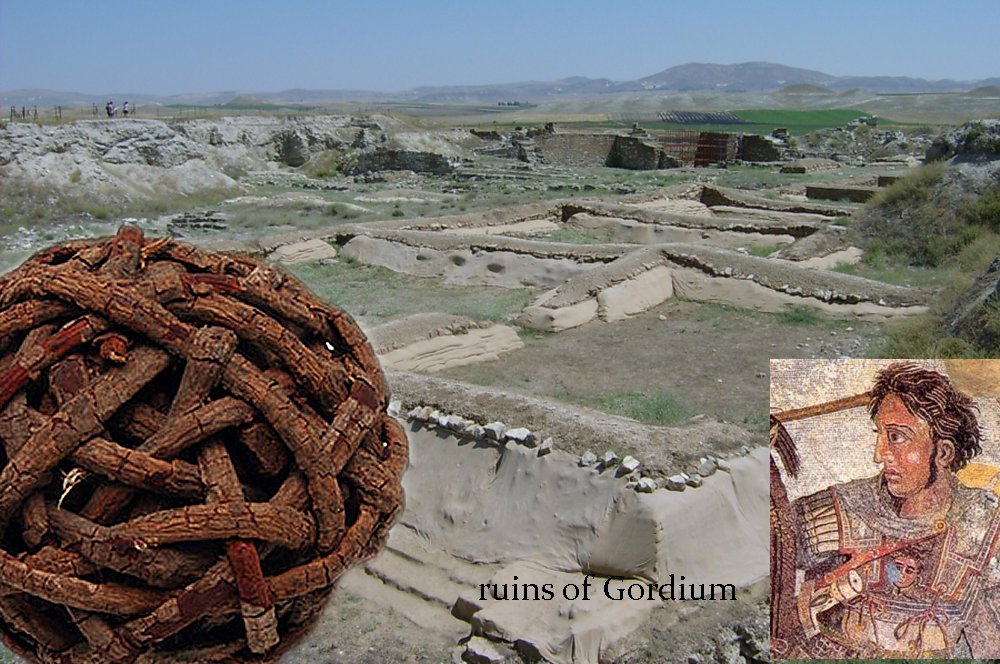
Gordias founded the city of Gordium, which became the Phrygian capital, and his ox-cart was preserved and remained in the royal palace. According to the oracle's prophecy, a man who untied the knot would receive power over Asia Minor or all of Asia.
In the 4th century BC, Alexander the Great reached Phrygia and Gordium, allegedly Midas's capital. After taking the city of Gordium, Alexander was shown the chariot of Gordias, founder of the old Phrygian monarchy, and was told about the prophecy.
Alexander wanted to untie the knot, but he had no idea how to do it, so he drew his sword and sliced it in half with a single stroke, or as another version says, he loosed the knot by pulling the linchpin from the yoke.
Aristobulus, an early historian, architect, and military engineer, as well as a close friend of Alexander) later claimed that untying the knot was easy for Alexander; he removed what they call the pole-pin, with which the yoke-knot was held together, and then drew back the yoke.
We will never know what really happened in the palace in Gordium and whether Alexander managed to untie the complex knot.
Norman F. Cantor, in his book "Alexander the Great Journey to the End of the Earth" writes:
"Shortly after one of Alexander's first victories, the Battle of Granicus, he learned that a few miles away, a certain King Gordias had left as a legacy a very difficult knot to untie. It was said (probably by Alexander's propagandists) that whoever untied the knot would conquer all of Asia. Sources disagree about what happened.
Some say that Alexander cleverly untied the knot, others that he simply unsheathed his sword and cut it. But one way or another, he untied or "cut the Gordian knot."
Fox relates the tale this way:" On the day before leaving Gordium, he went up to the acropolis meaning to try the chariot which he had saved for his farewell; friends gathered round to watch him, but hard though he pulled, the knot round the yoke remained stubbornly tight. When no end could be found, Alexander began to lose patience, for failure would not go down well with his men. Drawing his sword, he slashed the knot in half, producing the necessary end and correctly claiming that the knot was loosed, if not untied. The aged Aristobulus (one of Alexander's early historians)… later claimed that Alexander had pulled a pin out of the chariot link and drawn the yoke out sideways through the knot, but the sword cut has the weight of authority behind it and is preferable to an eighty-year-old historian's apology; either way, Alexander outmaneuvered, rather than unraveled, his problem.
He also managed to arouse an interest in what he had done."
"There were thunderclaps and flashes of lightning that very night," conveniently signifying that Zeus approved, so Alexander offered sacrifice to the "gods who had sent the signs and ratified his loosing of the knot..." (Robin Lane Fox, Alexander the Great)

Tough, resolute, fearless. Alexander was a born warrior and a ruler of passionate ambition who understood the intense adventure of conquest and of the unknown. When he died in 323 B.C.E. at age thirty-two, his vast empire comprised more than two million square miles, spanning from Greece to India. His achievements were unparalleled—he had excelled as a leader to his men, founded eighteen new cities, and stamped the face of Greek culture on the ancient East. The myth he created is as potent today as it was in the ancient world. Robin Lane Fox's superb account searches through the mass of conflicting evidence and legend to focus on Alexander as a man of his own time. Combining historical scholarship and acute psychological insight, it brings this colossal figure vividly to life.." Read more
Alexander later went on to conquer Asia as far as the Indus and the regions of the Oxus, a major river in Central Asia. The prophecy was fulfilled.
Written by – A. Sutherland AncientPages.com Staff Writer
First version of this article was published on July 20, 2020
Copyright © AncientPages.com All rights reserved. This material may not be published, broadcast, rewritten or redistributed in whole or part without the express written permission of AncientPages.com
More From Ancient Pages
-
 Mysterious Killke Culture Of Peru: Did They Construct Sacsayhuaman?
-
 Archaeologists Shed Light On The Lives Of Stone Age Hunter-Gatherers In Britain
-
 Ancient City Of Aizanoi: Statue Heads Of Greek Gods Unearthed In Excavations
-
 Rare 3,000-Year-Old Weavings Discovered In Alaska
-
 Mystery Of Nazca’s Controversial Three-Fingered Mummies Continues – Attempt To Confiscate The Ancient Remains!
-
 Mysterious Disappearance of Scythians Still Remains Unsolved
-
 America’s Ancient “Mystery Stone” Remains An Unexplained Puzzle
-
 Looted ‘Pietas Domini’ Gothic Altar Dated To 1435 AD Returns From Germany To Poland
-
 Gold Coins Found In The Ancient City Of Notion Tell A Story Of Misfortune
-
 Famous Viking Sigurd Snake-In-The-Eye, Son Of Ragnar Lodbrok And The Mark Of Fafnir Prophecy
-
 Startling Roman-Looking Sandal Discovered Buried Deep Beneath The Snow In Norwegian Mountains
-
 What Was The Role Of The Priests And Priestesses In Ancient Greece?
-
 Rise Of League Of Mayapán And The Last Great Maya Capital
-
 Huge Gallo-Roman Amphitheater Of Saintes Will Be Saved For Future Generations – New Project Started
-
 The Boomerang Was Used 20,000 Years Ago By Stone Age People
-
 Unique Finds Discovered In Oman – Rub’al-Chali Desert Reveals Its Secrets
-
 Sirius Mystery – Scientific Evidence Of Alien Contact 5,000 Years Ago – Book Review
-
 Zoroaster’s Doomsday Prophecy About Comet Gochihr And Its Similarity With The Apocalypse Of John In The Book Of Revelation
-
 Archaeologists Refute Claims That A Comet Destroyed Hopewell Culture
-
 Rock-Hewn Burial Shafts And 38 Symbolic Pots Discovered In Abusir Necropolis, Egypt

