
Sun Chariot – Powerful Symbol Of Bronze Age Cosmology
A. Sutherland - AncientPages.com - The Sun Chariot - now in the collection of the National Museum of Denmark in Copenhagen - was found in September 1902 in a peat bog on the Trundholm moor in northwestern Zealand (Sjælland) - most populated island in Denmark.
The Sun Chariot - a beautiful example of prehistoric Northern European sculpture was made in the Early Bronze Age around 1400 BC.
The artifact's elegant spiral ornamentation that graces the golden sun disc reveals its Nordic origin.
The Sun Chariot consists of the solar disk, the axle, and four wheels with spokes and supports the idea that the sun was drawn on its eternal journey by a divine horse.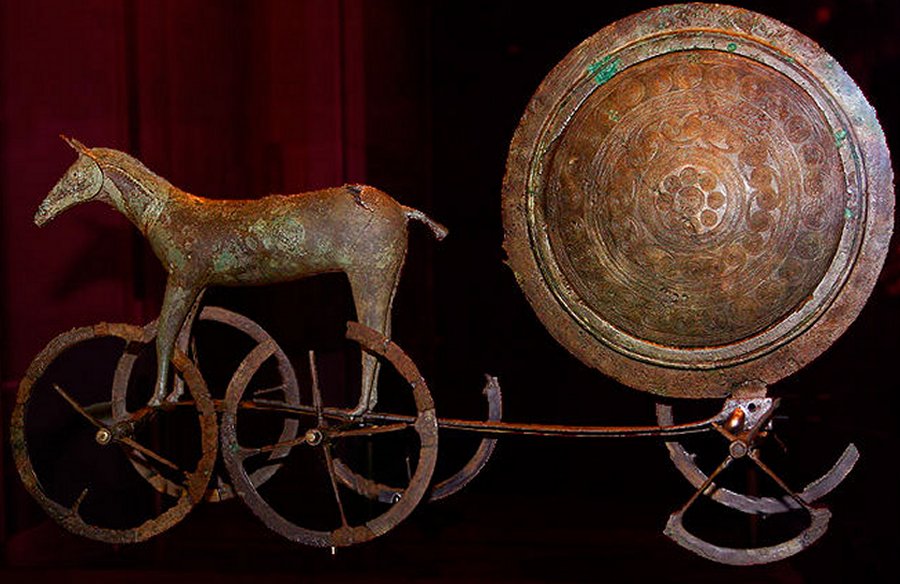
It is uncertain if the sun was imagined as being the chariot itself, or as riding in a chariot. Credits: natmus.dk
The bronze statue symbolizes the motion of the sun.
However, it is uncertain if the sun was imagined as being the chariot itself, or as riding in a chariot.
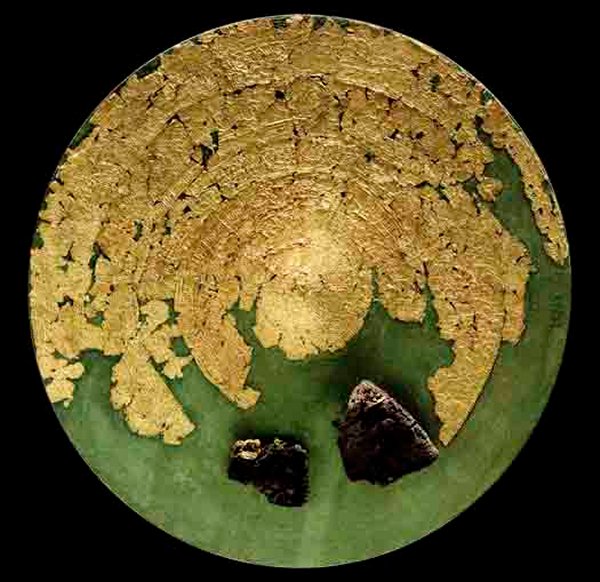
The Sun Chariot from Trundholm Mose was probably not the only one of its kind. Parts of a golden sun disc are amongst the finds from Jægersborg Hegn in northern Zealand. Perhaps it was originally part of a sun chariot?
The existence of a model of a horse-drawn vehicle on spoked wheels in Northern Europe at such an early time is very unusual, as the earliest known actual chariots (as opposed to ox-drawn carts without spokes) in Europe are from the Iron Age, dating from c. the 6th century BC.
The disk has a diameter of ca. 25 cm, and is gilded on only one side, the right-hand one relative to the horse.
What was the original function of ancient bronze disks with ornamentations? Could they had been ancient calendars?
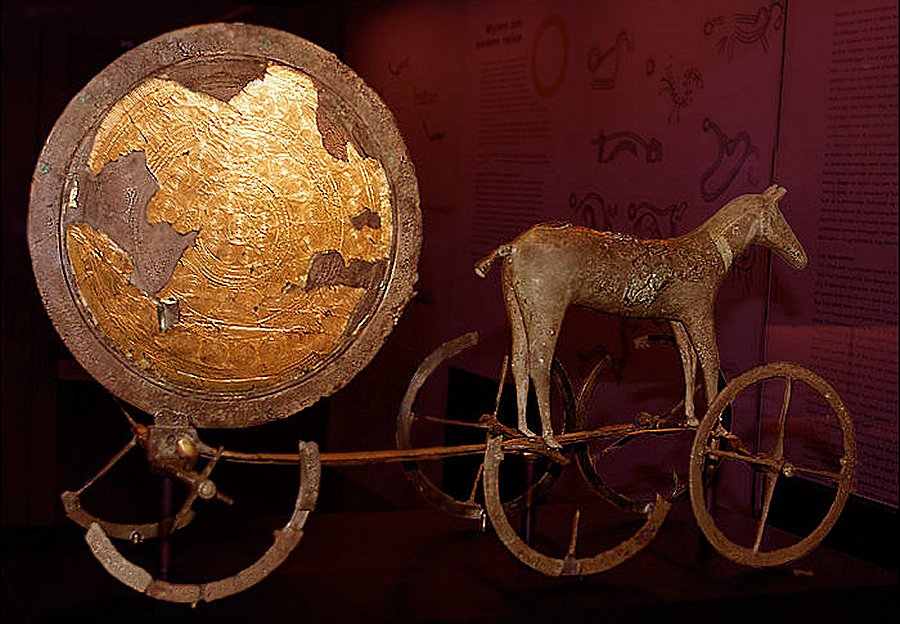
The Sun Chariot was made in Denmark, most likely in northern or northwestern Zealand, not far from its finding place in Trundholm Mose. The image of the horse pulling the sun across the sky was familiar to most Scandinavians in the Bronze Age, but the complicated spirals seen on the disc of the Sun Chariot are very characteristic of the Danish area. The most beautiful and well-made spiral patterns are found on women's belt ornaments in northern Zealand - a fine example is the belt plate from Langstrup. Credits: natmus.dk
The Sun was the most powerful symbol of the Bronze Age cosmology in Denmark so the two sides of the disk are believed to be representations of the sun.
See also:
Eye Of Providence – Powerful, Secret Symbol With Deep Meaning
Ancient Symbol Hamsa: It’s Meaning And History Explained
This has been interpreted as an indication of the belief that the Sun is drawn across the heavens from East to West during the day, showing its bright side - the gilded one. During the night, it returns from West to East, showing his “dark side” to the Earth.
Looking at the disk we see decorations that are composed from several spirals, concentric circles and bands with zigzags.
What do they all mean?
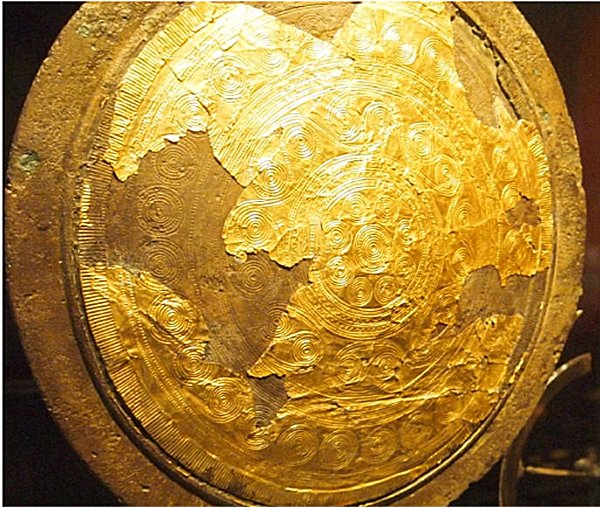
The gilded solar face of the disk. Note the “rays” at the rim of the golden disk (Credit, adapted from a picture taken at the National Museum, Copenhagen Denmark, by Kim Bach)
The Sun chariot remains one of the most intriguing Bronze Age artifacts discovered in Denmark.
Written by – A. Sutherland AncientPages.com Staff Writer
Copyright © AncientPages.com All rights reserved. This material may not be published, broadcast, rewritten or redistributed in whole or part without the express written permission of AncientPages.com
More From Ancient Pages
-
 Stone Age Statues Were Taken To Britain For Restoration In 1990 – Never Returned Home To Jordan
-
 Mysterious Sumerian Queen Puabi And Her Magnificent Underground Burial Complex – Many Followed Her To Afterlife
-
 Perperikon, Tomb Of Orpheus And A Small Baffling Stone – Unraveling A Puzzling Connection That May Solve A Mythological Riddle
-
 Spectacular Discovery Of Ancient Tombs Beneath Maya Pyramids Can Unravel The Mystery Of The Snake Kings
-
 Lamplighters In London: An Important Job In The Victorian Era
-
 Massive Underground Anomaly – Iron Ages Temples And Seat Of Legendary Ulster Kings Discovered At Navan Fort?
-
 World’s First Recreated Ancient Egyptian Garden Is Now Open To The Public
-
 On This Day In History: Francis Drake Was Knighted After He Completed A Circumnavigation Of The World – On Apr 4, 1581
-
 Mysterious Ancient Stone Structures Discovered In Illinois Remain Unexplained – Archaeologists Say
-
 Unsolved Old Cherokee Mystery In The Great Smoky Mountains
-
 The Untold History Of The Horse In The American Plains Revealed
-
 Remarkable Neolithic Life-Sized Camel Engravings Discovered In The Nefud Desert
-
 Calakmul Was Powerful Ancient Maya Seat Of The Snake Kingdom
-
 Satellite Images Revealed Lost Ancient Irrigation System In Desert-Like Region Of China
-
 Great Living Chola Temples: Outstanding Workmanship Of Chola Dynasty Builders Of South India
-
 Guide To The Classics: On The Art Of Physical Exercise, A 16th Century Account Of Ancient Sports And Workouts
-
 Unusual Medieval Knife Used Like An Eraser Discovered In Poland
-
 Ice Age Cycles Played A Key Role In Early Human Interbreeding
-
 Vast Paleogenetic Study Reveals Insights On Migration, Farming And Language Development Across The Southern Arc
-
 Mystery Of Monte d’Accoddi: Was It An Ancient Step Pyramid, Altar Or Astronomical Observatory?

