
Is Ipuwer Papyrus A Report Of An Ancient Catastrophe?
A. Sutherland - AncientPages.com - Ipuwer, an ancient Egyptian sage, was the author of a hieratic manuscript known as "Ipuwer Papyrus" (or Papyrus Leiden 344", even known as "The Admonitions of Ipuwer").

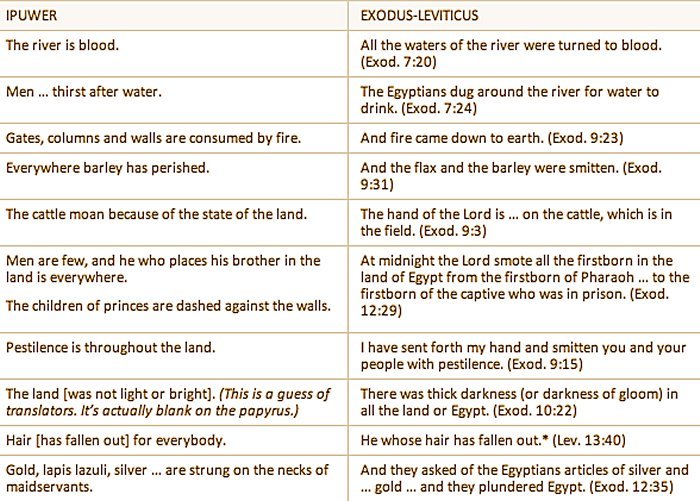
Ipuwer Papyrus could be an Egyptian version or recollection of the traumatic events described from Exodus 7 through Exodus 12.
Found incomplete and in poor condition, the document was obtained by a wealthy merchant and antiquarian, Giovanni Anastasi, and sold to the Leiden Museum in the Netherlands in 1828.
Ipuwer Papyrus Describes Much Earlier Events
The exact date of the Papyrus is still being determined. Its surviving copy was made during the New Kingdom (ca. 1550-1070 BC), but the text is much older and probably dates back to the Middle Kingdom and the Twelfth Dynasty (1985-1773 BC).
Ipuwer, who lived during the Middle Kingdom, criticizes the events that happened four centuries earlier, during the First Intermediate Period, after the end of the Old Kingdom.
The sage tells about plagues, death, mysterious natural phenomena, and famine, and that "the fire and ashes destroyed the earth "fell straight from the sky," wrongdoing is everywhere, and … there is no man of yesterday…

He warns the current rulers of Egypt of divine revenge, such as what happened earlier, if they abuse their power.
"All the waters that were in the river were turned to blood," Moses had written. "The river is blood…" Ipuwer concurred.
These catastrophic, lawless years with no powerful king who would restore order and a general impoverishment in Egypt lasted about 230 years.
However, experts believe Ipuwer mixed several events similar to the plagues in the Book of Exodus. As Israelites left Egypt, the Bible says that God led them with a pillar of smoke by day and a pillar of fire by night (Exodus 13:21)
Ipuwer 7:1 says: "Behold, the fire has mounted on high. Its burning goes forth against the enemies of the land".
"Trees Are Destroyed" And "No Fruit Nor Herbs Are Found..."
Alan H. Gardiner, a British Egyptologist, published a complete translation entitled "The Admonitions of an Egyptian Sage from a Hieratic Papyrus in Leiden."
He wrote that the document recorded a genuine historical catastrophe when Egypt was in distress and violence.
Different Theories Regarding The Ipuwer Papyrus
According to Gardiner, "it is no merely local disturbance that is here described, but a great and overwhelming national disaster, and the sage Ipuwer "directed his writing to the king as a complaint that the national catastrophe was in part caused by the king's failure to act and deal with the crisis…" (Grant R. Jeffrey, "Unveiling Mysteries of the Bible").
According to some, the document provides evidence for a plague of "ice and fire mingled together," the "seventh plague of hail" was volcanic hail induced by Santorini, which is chronologically incorrect.
According to Dr. James K Hoffmeier, an American Old Testament scholar, there are many similarities between the catastrophes described in the Ipuwer Papyrus and the biblical narrative of the Plagues of Egypt.
Are these records of precisely the same events? It is unlikely since the probable date of the composition of the Papyrus, 1850 BC and 1600 BC, precedes the date of the Exodus by centuries.
Immanuel Velikovsky believed that it was more than a significant natural disaster. He thought he had found an Egyptian version of the plagues described by Moses in the Old Testament Book of Exodus.
"All the waters in the river were turned to blood," Moses had written. "The river is blood," Ipuwer says.
Is the Ipuwer Papyrus a factual report of an ancient catastrophe?
The Egyptian Ipuwer made an accurate report of the catastrophe on his Papyrus.
According to Dr. James K Hoffmeier, an American Old Testament scholar, there are many similarities between the catastrophes described in the Ipuwer Papyrus and the biblical narrative of the Plagues of Egypt.
Are these records of precisely the same events?
It is unlikely since the probable date of the composition of the Papyrus, 1850 BC and 1600 BC, precedes the date of the Exodus by centuries. Immanuel Velikovsky believed that it was more than a significant natural disaster. He thought he had found an Egyptian version of the plagues described by Moses in the Old Testament Book of Exodus.
"All the waters that were in the river were turned to blood," Moses had written. "The river is blood," Ipuwer says.
Is The Ipuwer Papyrus A Real Report Of An Ancient Catastrophe?
The Egyptian Ipuwer made a factual report of the catastrophe on his Papyrus.
The editor of the Book of Exodus noted that the presence of a red pigment in the Nile caused the death of the fish, followed by their decomposition.
He wrote that "the river became infected ... and all the Egyptians dug the ground near the Nile to find drinking water, for they could not drink that of the river…."
"Men are afraid to taste the water. Humans are thirsty for water. It's our water! It's our happiness! What can we do? Everything is in ruins. " The skin of men and animals was irritated by the dust which caused pustules, sickness, and the death of the cattle, "a terrible plague." The wild beasts, frightened by the omens of heaven, approached the villages and the cities.

The Ipuwer Papyrus. Image credit: Biblical Foundations
Velikovsky states in his book "Worlds in Collision": "I intend to establish that in the middle of the second millennium BC, our Earth suffered one of the greatest cataclysms in its history. A celestial body just recently entered the solar system - a new comet - approached very near the Earth. The story of this cataclysm can be reconstructed from the testimony of a large number of documents."
One of the first visible signs of this encounter was the red color of the surface of the Earth, under the influence of fine dust of rust-colored pigments. This pigment in the seas, lakes, and rivers gave the water the color of blood.
Under the effect of these particles or some other soluble pigment, the world became red. Popol Vuh, the Quiché Manuscript of the Maya, says that in the Western Hemisphere, in times of a great cataclysm where the Earth trembled, and the movement of the Sun stopped, the water of the rivers became red and seemed transformed into blood.
The Ipuwer Papyrus is stored at the Dutch National Museum of Antiquities in Leiden, Netherlands, and it remains a mystery.
Written by – A. Sutherland AncientPages.com Staff Writer
Updated on February 25, 2024
Copyright © AncientPages.com All rights reserved. This material may not be published, broadcast, rewritten or redistributed in whole or part without the express written permission of AncientPages.com
Expand for referencesReferences:
Jeffrey G. R. Unveiling Mysteries of the Bible
Freund R. A. Digging Through the Bible: Modern Archaeology and the Ancient Bible
More From Ancient Pages
-
 Mysterious And Abnormally Large Burials Found Near The Black Fortress In Armenia – Who Was Buried There?
-
 Ancient Copper Ingots Are Unlocking Iron Age Secrets
-
 Neglected Ancient Artifacts That Could Re-Write History – Evidence Of Surprising Advanced Ancient Technology That Shouldn’t Exist
-
 Incredible Ancient Extinct World Of Unknown Organisms Discovered
-
 Secret Knowledge Revealed: Mastermind Imhotep’s Connection To The Mysterious Shemsu Hor – The Followers of Horus
-
 Enigmatic Bronze Age Fulacht Fiadh: ‘Kitchens’ Of The Legendary Irish Warriors
-
 Controversial Theory Suggests Ancient Egyptians Were Founders Of Chinese Civilization
-
 More Than 1000 Bones Of Extinct Predators From 240 Million Years Ago – Found In Upper Silesia, Poland
-
 Mysterious Death Of Cambyses II – Natural, Suicide Or Assassination By Darius I The Great?
-
 Ancient Temple Dedicated To Aztec God Xipe Totec Discovered In Mexico Reveals A Gruesome Story
-
 Nammu: Sumerian Goddess Who Got The Idea To Create Mankind In The Image Of Gods
-
 Nemesis: Winged Goddess Of Justice And Revenge
-
 Mysterious Great Underground City In The Jungle Inhabited By The Old Ones And Guarded By White-Skinned Indians
-
 Archaeologists Focus On Greek Poet Aratus’ Memorial Tomb And Ruins Of Soli Pompeiopolis
-
 Surprising Evidence Of Prehistoric Human Activity In Falkland Islands – Europeans Were Not The First Settlers
-
 Why Napoleon’s Invasion Of Russia Was A Fiasco
-
 Sobek: A 2,500-Year-Old Mummified Nile Crocodile – On Display At The British Museum
-
 How Large Was The ‘Giant’ Dunkleosteus Terrelli – Prehistoric King Of The Oceans?
-
 Ancient Necropolis With Lead Coffins Sheds Light On Early Christian Funeral Practices
-
 Researchers Find Oldest Evidence Of Human-Caused Lead Contamination In Aegean Region

