
Intriguing Sumerian Clay Tokens – An Ancient ‘Book Keeping’ System Used Long After Writing Appeared
AncientPages.com - About 5,000 years ago, people in Mesopotamia used intriguing clay tokens of multiple shapes to count and communicate.
People recorded information about their agricultural goods--including domestic animals and plants and to do so they used small clay tokens that were of different size and shape. Interestingly, archaeologists have discovered clay tokens were used long after writing was invented.
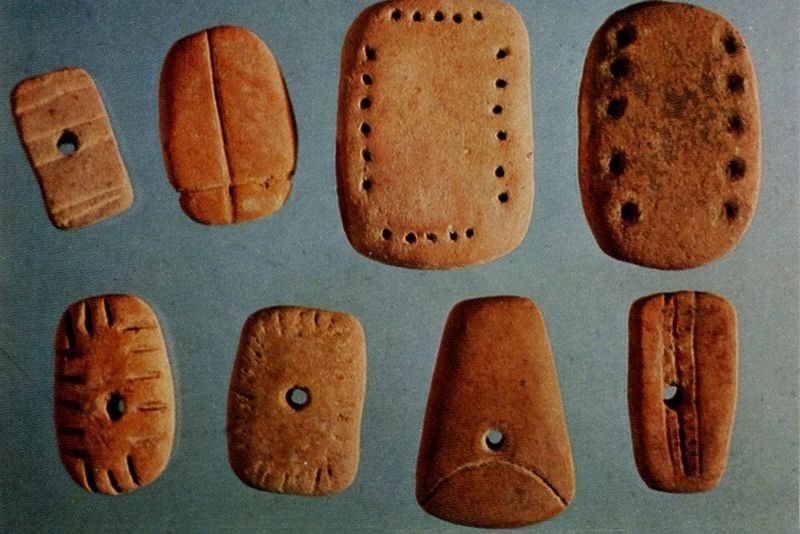
Sumerian clay tokens - Image credit: Denise Schmandt-Besserat
Sumerian clay tokens were often shaped like cones, spheres, disks, cylinders, tetrahedrons and ovoids and their size could vary from 0.5 to 1.25 inches.
Clay Tokens Could Be Used No Matter Of What Language You Spoke
The first tokens appeared in the Near East 7500 B.C. and they were made in the image of the goods they represented. For example, a cone abstracted a measure of grain.
Ovoids were jars of oil, cylinders a sheep or goat and tetrahedrons a person-day of work.
Sumerians used the tokens to count in a different way that we do today. We use abstract numbers, which means that our numbers “one,” “two,” “three,” are independent of the item counted and therefore universally applicable.
It was not so at the time when tokens were used. Between 7500-3100 BC, counting was restricted to selected units of goods, mostly measures of grain, jars of oil, animals and units of labor, based on time and task.
Moreover, each category of item was counted with its own counter, reflecting the fact that counting was “concrete,” meaning that each category of item was counted with a special numeration or special number words specific to that particular item.
See also:
‘Collata Quipu’ May Explain Messages Hidden In Mysterious Writing Of Inca
Controversial Tartaria Tablets: The First Writing System In The World?
The tokens were not difficult to produce. They were made of clay and incised with lines or dots or embellished with pellets of clay. These were then sun-dried or baked in a hearth.
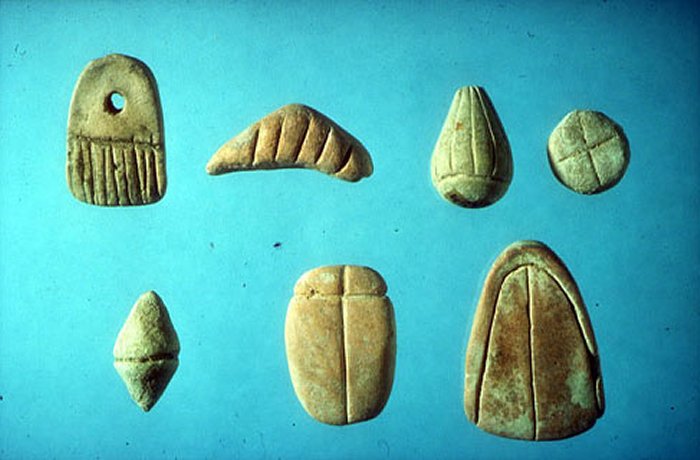
Plain tokens from Jarmo, Iraq, ca. 6500 BC.
One great advantage with clay tokens was that they were non-lingual. It was an easy way to communicate because no matter what language you spoke, both parties understood that a cone meant a measure of grain.
Clay Tokens Were Used Even After The Cuneiform Script Appeared
It was previously thought that clay tokens were no longer used about 3,000 B.C because they were replaced by the cuneiform script, a more elaborate writing system.
Cuneiform tablets were one of the earliest systems of writing invented by the Sumerians. However, while excavating at Ziyaret Tepe, southeast Turkey, archaeologists uncovered a large number of clay tokens that were used as records of trade.
Scientists say clay tokens were integral to administrative functions right across the Assyrian empire – millennia after this system was believed to have vanished. Clay tokens were part of a prehistoric ‘book keeping’ system that continued long after invention of writing.
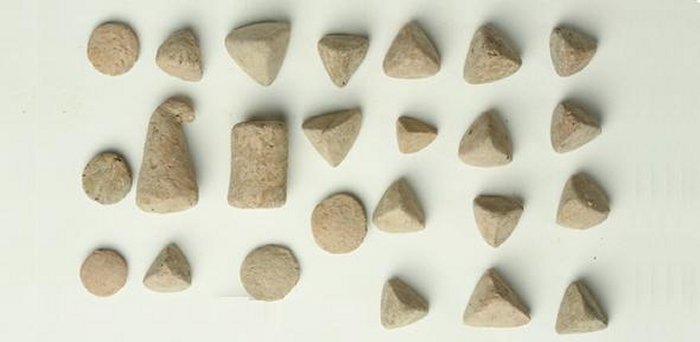
These clay tokens were found at a dig site in Turkey. Archaeologists think they were used as part of ancient system of record-keeping. Credit: Ziyaret Tepe Archaeological Project
Archaeologists say that while cuneiform writing was a more advanced accounting technology, by combining it with the flexibility of the tokens the ancient Assyrians created a record-keeping system of greater sophistication.
It should be added that Sumerians were not entirely the first to use a token system About 20,000 years ago, Upper Paleolithic people left marks and signs on walls and sticks to communicate. What is unique about clay tokens is that these artifacts represent the first significant step towards communication how storage and retrieval should be handled.
Copyright © AncientPages.com All rights reserved. This material may not be published, broadcast, rewritten or redistributed in whole or part without the express written permission of AncientPages.com
More From Ancient Pages
-
 Lake Mendota’s Submerged Canoes Predate The Egyptian Giza Pyramids – Why Are These Vessels Underwater?
-
 Creepy Story Of Lucida Mansi Who Was Obsessed With Her Beauty
-
 Still Intact 460-Year-Old Bow Found Underwater In Alaska Baffles Scientists – Where Did It Come From?
-
 Before The Pharaohs: The Evidence For Advanced Civilization In Egypt’s Mysterious Prehistory
-
 Yak Milk Consumption Among Mongol Empire Elites – New Study
-
 Pacific God A’a: Fascinating Polynesian Sculpture Designed To Carry A Human Skull And Bones
-
 Hades – ‘The Unseen’ God Of The Dead, Fertility, Wealth And Earth’s Minerals
-
 5 Traces Of Ancient Ancestors That Still Exist In All Human Bodies Today
-
 Māori Connections To Antarctica May Go As Far Back As 7th Century
-
 Luxor – Ever-Lasting Legacy Of The Ancient Egyptian Civilization And The Pharaohs
-
 Incredible 5,000-Year-Old Temple Complex In Orkney Could Re-Write History Of Scotland
-
 Ancient DNA Study Reveals Surprise About Britain’s Bronze Age – What Happened On The Orkney Islands?
-
 Ancient Urartu Settlement, Water Tunnel And Rock Tombs Found In Erzurum, Eastern Turkey
-
 Traces Of Advanced Beings Who Walked Earth Millions Of Years Ago: Controversial Ancient History Examined
-
 Underwater Archaeologists Explore The Secrets Of Loch Achtily Crannog – Will They Find A Rare Medieval Settlement?
-
 Are The Mysterious ‘Ubeidiya Limestone Spheroids Of Early Hominins Evidence Of Intentional Symmetric Geometry?
-
 Ancient Maps Reveal What Will Happen With Our Climate In The Future – Scientists Say
-
 Gold Earring Found In Ruins Of Ancient Roman Colony Deultum In Bulgaria
-
 A 900-Year-Old Crusader Sword Discovered Off The HaCarmel Coast, Israel
-
 Dark History Of Pömmelte, The German Stonehenge – What Can The Nebra Sky Disc And Archaeology Reveal?

