
Aristotle: First Book Collector Who Assembled The First Great Library Of Antiquity
A. Sutherland - AncientPages.com - Aristotle of Stagira (c. 384 BC - 322 BC) founded his own school, called High School, in the year 335 BC.
It was located just outside Athens in the vicinity of a beautiful grove dedicated to the god Apollo Lyceus. This prominent school, certainly comparable to our modern universities, became known as the Lyceum, an education and research center.
!["That most enduring of romantic images, Aristotle tutoring the future conqueror Alexander".[147] Illustration by Charles Laplante [fr], 1866](https://www.ancientpages.com/wp-content/uploads/2017/06/aristotlealexander1.jpg)
"That most enduring of romantic images, Aristotle tutoring the future conqueror Alexander". Illustration by Charles Laplante, 1866. Public Domain
It was also known as a 'Peripatetic School' (Greek word peripatos, means stroll) as it is believed that Aristotle liked to walk with his student along the school’s walkways, discussing philosophy and the principles of mathematics.
Aristotle’s great school also played a crucial role as a library and museum. Supported by a large monetary gift of 800 talents from Alexander the Great, Aristotle organized his impressive collection of plant and animal specimens and collected diverse manuscripts and maps of great value.
Aristotle also encouraged the school’s teachers to gather information regarding medicine, mathematics, physics, botany, philosophy, astronomy, rhetoric ethics, theology, cosmology, and other areas of science. Members of his Lyceum were busy conducting research on a wide range of subjects.
This great thinker has prepared enormous material as a basis for lectures. Aristotle is considered the first book collector to assemble the first great library of antiquity.
Later, passed into the hands of the philosopher Neleus of Skepsis, and the library lost its connection with the School. The books did not return to its original place but were scattered. His intellectual legacy is enormous and contains scientific lectures and literary and scientific works, as evidenced by 143 works in 400 books, not counting letters and poetry.
Before his death in 322 BC, Aristotle handed over a library along with his own manuscript legacy to his Theophrastus of Eresos (c. 371–287 BC), who was his successor, Aristotle’s close colleague, philosopher and successor at the Lyceum, who wrote many treatises, in all areas of philosophy, in order to support, improve, expand, and develop the Aristotelian system.
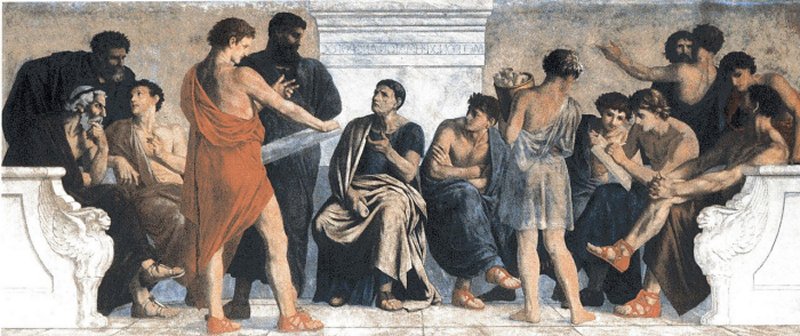
The School of Aristotle. Fresco by Gustav-Adolph Spangenberg, circa 1883-1888. — source - Public Domain
Until the death of Theophrastus in 287 BC, Aristotle's famous lectures were the basis of teaching in the school.
As Edith Hall, a British scholar of classics, wrote, “the papyrus on which most ancient Greek and Latin books were recorded, as an organic material, was extremely vulnerable to rotting and wear and tear”…and “two generations later the collection of rolls ended up in the hands of some “ordinary people” of Scepsis in Asia Minor, who did not know how to store its precious contents…”
According to one version, Neleus od Scepsis, a pupil of Theophrastus, kept the original manuscripts of both philosophers but sold other books from the library to Ptolemy II, the ruler of Egypt who was at that time occupied with the creation of his own great library at Alexandria.
Later the library of the Stagira got into the hands of people who kept books in very bad conditions because Neleus’ descendants, who inherited the priceless works had no idea how to store them. They only wanted to protect the writings from being stolen. Kept for a very long time in the dark basement, the manuscripts were damaged.
Aristotle’s work was not in the form of ordinary books but only notes and manuscripts, and yet, his surviving writings were incredibly influential.
More than 2300 years after his death, Aristotle remains one of the most influential people ever. He contributed to almost every field of human knowledge then in existence, and he was the founder of many new fields of science.
Updated on January 29, 2023
Written by – A. Sutherland - AncientPages.com Senior Staff Writer
Copyright © AncientPages.com All rights reserved. This material may not be published, broadcast, rewritten or redistributed in whole or part without the express written permission of AncientPages.com
Expand for referencesReferences:
Lancour H. Daily Jay E. Encyclopedia of Library and Information Science: Volume 24
Baker R.F. Baker III, C. F. Ancient Greeks: Creating the Classical Tradition
Stanford Encyclopedia of Philosophy
More From Ancient Pages
-
 4,000-Year-Old Textile Mill Discovered At Beycesultan Mound In Western Turkey
-
 Impressive Kaymakli Underground City – An Ancient Hiding Place
-
 Major Discovery Of Ancient Roman Temple – Largest Evidence Ever Of The Imperial Cult
-
 Sogdian Temple Of Jartepa II On Caravan Road Of The Silk Road
-
 Ten Inscriptions Related To Sargon Unearthed At Ancient Assyrian Site In Iraq’s Kurdistan Region
-
 Megalith Tombs Were Family Graves In Stone Age Europe
-
 Controversial Prehistoric Bronze Gears Of Peru
-
 Missing Lines From Epic Of Gilgamesh Shed New Light On Humbaba
-
 Cedar – Sacred Tree With Medicine Power In Native American Beliefs
-
 Secret Ancient Knowledge Of Portals Leading To Unknown Realms – Mysteries Of The Past And Present – Part 2
-
 Amrita: Potion Of Immortality Consumed By Gods To Make Them Strong And Immortal
-
 Saraswati – Hindu Goddess Of Knowledge, Learning And Vedic Symbol Of Speech, Vach
-
 Legendary Johnny Appleseed Who Planted Apple Trees Across North America
-
 Cupbearer Was Privy To Conversations And Political Secrets Hidden Behind Closed Doors
-
 Ancient Pathogens Released From Melting Ice Could Wreak Havoc On The World – New Analysis Reveals
-
 Famine And Disease Drove The Evolution Of Lactose Tolerance In Europe
-
 Secrets Of Quipu – Ancient Inca Message Decoded By Student
-
 Ancient Mystery Of The Tomb Of Tiryns – Burial Place For An Unknown Mycenaean Hero?
-
 One Of Egypt’s Oldest Christian Churches Discovered By Polish Archaeologists
-
 Pancho Villa: Mexico’s Robin Hood – A Ruthless Bandit Or A Hero?


