
Beautiful Ancient City Of Pisac In The Sacred Valley, Peru – Incredible Inca Ruins
Ellen Lloyd - AncientPages.com - Ancient city of Pisac in the Sacred Valley, Peru is not as famous as Machu Picchu, but it’s a remarkable place that is not only beautiful but also rich in history and legend.

Structures in the urban sector of the Inca complex at Pisac. Image credit: Leon Petrosyan - CC BY-SA 3.0
Known for its Incan ruins, the city of Pisac, located about 19 miles northeast of Cusco lies atop a hill at the entrance to the valley. The view is fantastic, and it seems that no matter where you stand, you can admire remarkable agriculture terraces that are still in use today.
It is said that in ancient times, the city was guarded at night by pumas.
Why Did Inca Build The City Of Pisac?
Why Pisac was built is not entirely clear. According to the scholar Kim MacQuarrie, Pachacuti erected a number of royal estates to memorialize victories over other ethnic groups. Among these royal estates are Písac (victory over the Cuyos), Ollantaytambo (victory over the Tambos), and Machu Picchu (conquest of the Vilcabamba Valley).
However, there are also historians who suggest Písac was established to protect Cusco from possible attacks from the outside.
The ruins are separated along the ridge into four groups known as P'isaqa, Inti Watana, Qalla Q'asa, and Kinchiraqay. In Quechua, Pisac means “partridge”. Inca tradition dictated building cities in the shape of birds and animals, and as such, Pisac is partridge shaped.
Partridge-shaped structures are related to the spirituality and values that the Incas believed that each human being should develop.
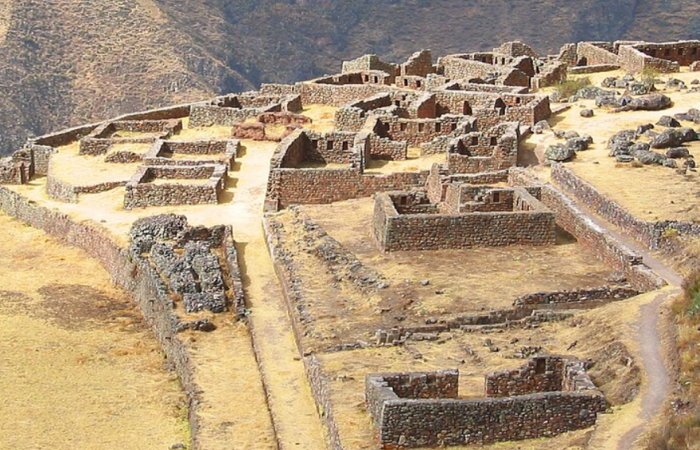
The Pisaq'a residential area in the Inca complex. Image credit: Bcasterline - Public Domain
There are twenty lookout towers of different sizes placed strategically throughout the ruins. Some are massive watchtowers that are placed so that messages could be shouted from one to the other, and there are other towers that were used to store water for the elaborate irrigation system.
The ruins in Pisac contain a group of thirty independent but uniform enclosures, which were probably used as apartments.
Legend Of Princess Inquill (Inkill) Chumpi And The Stone Figure
There are several ancient legends about this beautiful place in the Andean Mountains. One legend tells that a princess called Inkill Chumpi (princess of the Florida belt) owned the entire city. She would marry someone who could build a bridge over the Wilkamayu River (Vilcanota) in a single day.
After learning about this, many young men tried to accomplish what seemed like an impossible task. Asto Rimac, who was a secret lover of the princess owned the lands to the east. When Asto Rimac was started building the bridge, Princess Inkill Chumpi went to invoke the Apus (mountain spirits) to help him.
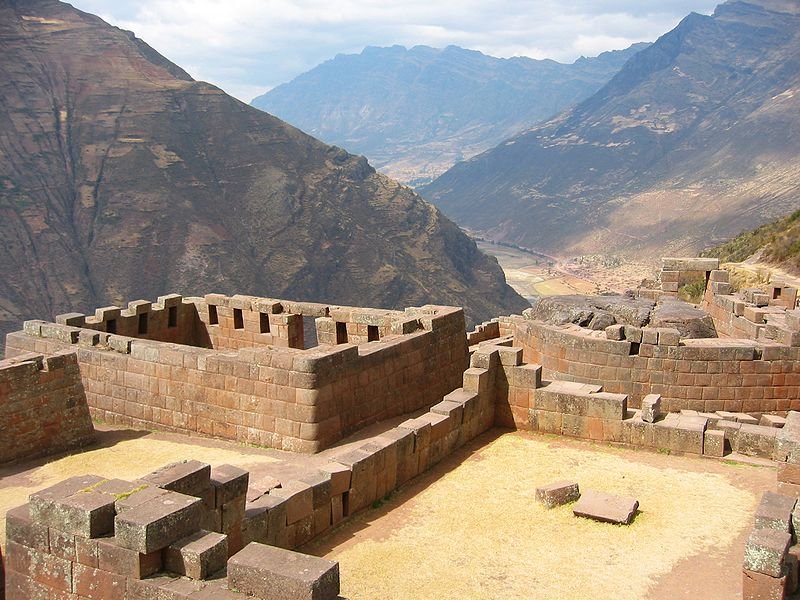 View of the Sacred Valley, Peru, from the Sun Temple (foreground) at Písac. Image credit: Bcasterline - Public Domain
The spirits agreed to help him, but only if she didn’t look at the bridge until it was ready. Just before the bridge was finished, the princess began to hear loud thunders and gave in to the temptation to see what happened and turn to observe; At that moment, the Urubamba river swallowed Asto Rimac, and she was turned to stone, standing, looking towards the valley of Pisac. In the place until today can be seen as the figure of stone.
It is unknown when Inca Písac was built. There are no traces suggesting that Písac was inhabited by any pre-Inca civilization, so it was most likely built no earlier than 1440.
Francisco Pizarro and the Spanish conquerors destroyed Inca Písac in the early 1530s. The modern town of Písac was built in the valley by Viceroy Toledo during the 1570s.
Written by Ellen Lloyd – AncientPages.com
Updated on Oct 14, 2024
Copyright © AncientPages.com All rights reserved. This material may not be published, broadcast, rewritten or redistributed in whole or part without the express written permission of AncientPages.com
Expand for referencesMore From Ancient Pages
-
 Hatra: Ancient Powerful Caravan City That Could Withstand Invading Roman Armies
-
 Baltinglass Hills: Prehistoric Irish Monuments May Have Served As Pathways For The Deceased – New Evidence
-
 Who Or What Is Behind These Unexplained Lights Following People Over Long Distances?
-
 New Type Of Early Previously Unknown Human Discovered In Israel
-
 Echidna – Mother Of All Monsters – A Cave-Dwelling Female Hybrid Creature In Greek Mythology
-
 1,800-Year-Old Statue Of A Water Nymph Found Underground In The Ancient City Of Amastris
-
 Greek God Asclepius And Ancient Healing Center ‘Asclepion Of Pergamum’
-
 Mystery Of Ancient Language PIE From Which Half Of All Languages Originate
-
 Was Princess Tadukhipa Of The Mitanni Kingdom Queen Nefertiti?
-
 Underwater Excavations: Greek And Danish Archaeologists Research Ancient Harbor Town Lechaion
-
 Deciphered Ancient Tablet May Depict Biblical Tower Of Babel – New Evidence
-
 Mystery Of The Real Sword: How Did A Meter Long Sword End Up In Solid Rock?
-
 Fragments Of 6,500-Year-Old Figurine Of ‘Venus of Egerszeg’ – Unearthed
-
 Artificial Intelligence (AI) Unravels Secrets Of 22,000 Ancient Cuneiform Tablets
-
 The Word Freelancer Originates From Medieval Mercenary Knights
-
 Mysterious Maya Snake Kings And Their Powerful Kingdom In The Jungle Reveal More Ancient Secrets
-
 Khonsu: Enigmatic Egyptian Moon God, Healer, Protector And His Dark Side
-
 Ancient Secrets Of The Nine Unknown Men: Guardians Of Forbidden Knowledge Hidden From Humanity
-
 Historians Search For A Frightening Ancient Underground Secret In One Of Tampa Bay’s Cities
-
 Ancient People Handled Sun Exposure Better Than Modern People – An Anthropologist Explains Why

