
How Greenland Got The ‘Wrong’ Name Thanks To Viking Erik The Red
Ellen Lloyd - AncientPages.com - Greenland is beautiful, but the massive island is not very green.
Located between the Arctic and Atlantic Oceans, east of the Canadian Arctic Archipelago, Greenland is mostly covered with ice.
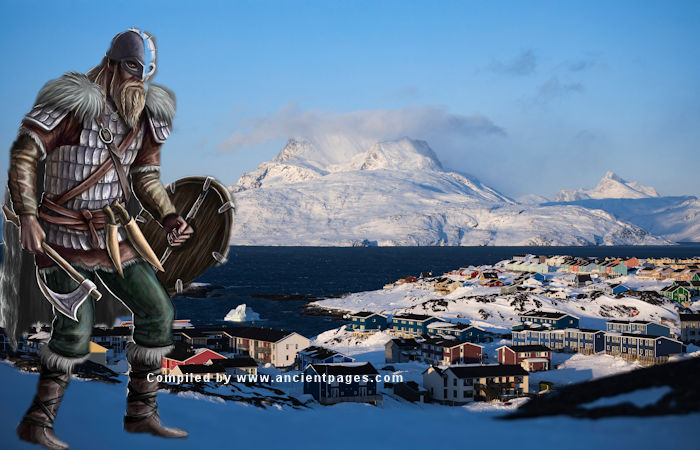
The island was named after the Viking Erik the Red, who colonized Greenland. He had a good reason to call the island Greenland.
Greenland is the world's largest island. It is famous for its colossal icebergs, magical midnight sun, amazing displays of the Northern Lights, and beautiful fauna and flora. Ice sheets cover about 84% of Greenland's landmass. However, Southern Greenland lives up to its name as it is truly a green land.

Greenland is famous for its huge icebergs. Credit: EHRENBERG Kommunikation - CC BY-SA 2.0
Temperatures vary enormously, depending on the location and time of year. One can expect an average temperature in Upernavik of minus 20 degrees in February to about 10 degrees in the towns throughout the summer.
Owing to the low humidity in Greenland, summer temperatures will often feel warmer than you might otherwise expect.
Greenland was discovered by the famous Viking Erik the Red. He colonized the island, built a house on a place later called Brattalid, and served as Greenland’s “capital” for many years.
However, the Vikings were not the first people to live in Greenland. The island had been inhabited in prehistoric times by several Paleo-Eskimo cultures.
From around 2500 BC to 800 BC, southern and western Greenland were inhabited by the Saqqaq culture. Around 800 BC, the Saqqaq culture disappeared, and the Early Dorset culture emerged in western Greenland and the Independence II culture in northern Greenland.
Erik the red changed the history of this beautiful island. The harsh climate on Greenland made life difficult, but Erik the Red was determined and convinced that he could set up a colony.
He started recruiting settlers, but he knew that it would be very difficult to convince Vikings to settle in such a remote and cold place. So, Erik, the Red, cheated and told a lie to attract settlers.
He called the island Greenland and said there were plenty of good fishing reservoirs.

Beautiful Northern Lights over Greenland. Image credit: Mads Pihl, Visit Greenland, CC BY-NC-SA 4.0
More than five hundred Icelanders agreed to follow him to Greenland, but it was a very dangerous trip, and many died on the way. Only 14 of 25 Viking ships crossed the ice-cold and dangerous waters.
The survivors established several colonies across Greenland and lived as fishermen, hunters, and farmers. The Viking settlers shared the island with the late Dorset culture inhabitants who occupied the northern and western parts and later with the Thule culture that entered from the north.
Erik the Red had achieved his goal and never left Greenland again!
The name of the country in Greenlandic (Kalaallisut) is Kalaallit Nunaat which translates as "land of the Kalaallit").
The Kalaallit are the indigenous Greenlandic Inuit people who inhabit the country's western region.
Updated on January 1, 2023
Written by - Ellen Lloyd AncientPages.com
Copyright © AncientPages.com All rights reserved. This material may not be published, broadcast, rewritten or redistributed in whole or part without the express written permission of AncientPages.com
Expand for referencesMore From Ancient Pages
-
 Zagros Mountains: Home To Tribes, Kingdoms And Empires For Thousands Of Years
-
 Ancient Wall Of Lolei Temple Built In 893 BC Unearthed In Siem Reap, Cambodia
-
 Remarkable Ancient Treasure Found By Man In Ohio Who Refuses To Reveal The Location
-
 Long-Lost Anglo-Saxon Monastery Ruled By Queen Cynethryth Of Mercia Discovered By Archaeologists
-
 Underground Man-Made Longyou Grottoes Remain An Ancient Unsolved Mystery
-
 Warrior Uesugi Kenshin And His Nagamaki Special Guards
-
 1,800-Year-Old Richly Painted Tomb Unearthed In Northern Jordan
-
 The Word Freelancer Originates From Medieval Mercenary Knights
-
 2,700 Year Old Equestrian Armor In Assyrian-Style Leather Evidence Of Technology Transfer In Antiquity
-
 Unraveling The Secret History Of King Arthur And Robin Hood
-
 Pharaonic Water Wells Discovered For The First Time Near ‘Horus Road’ In Sinai, Egypt
-
 Fossil Tooth Analysis Sheds More Light On Earliest Humans From Southern Africa
-
 The Incas Used Stringy Objects Called ‘Quipus’ To Record Data – We Just Got A Step Closer To Understanding Them
-
 Inscribed Fragments Of Stone Slabs Unearthed In Matariya, Ancient Heliopolis
-
 Breakthrough – First Glimpse Into A 2,000-Year-Old Charred Herculaneum Scroll
-
 Enigma Of 3,000-Year-Old Sculpted Head Of Biblical King Discovered In Israel
-
 John Hawkwood ‘John Sharp’: Feared, English Mercenary And His White Company In 14th Century Italy
-
 Whose Ancient Burials Are Hidden Inside The Vatican City’s Walls?
-
 Intriguing Hoard Of Bronze Age Bracelets From Brittany, France Remains An Archaeological Puzzle
-
 Are Priceless Ancient Gold Tablets Of The Serpent People Hidden Underground In Los Angeles?

