
Ganesha: Elephant-Headed God Of Knowledge, Learning, Literature And Scribe Of The Mahabharata
A. Sutherland - AncientPages.com - It is commonly believed that the Elephant God, Ganesha (Ganesh, in Hindi word) means success and wealth; therefore people place a statue or a figurine of the Ganesha, in his store, or another place of their business.
Ganesha is one of the best-known and loved deities in the Hindu pantheon of gods and indeed is the most recognized of the Hindu gods outside of India.

Lord Ganesha. Image credit: Jayananda sagar - CC BY-SA 3.0
He is the Lord of Good Fortune, the Lord of Beginnings, and the Remover of Obstacles and evils people meet in their lives, but he can also place obstacles in the path of those who need to be checked. He is also considered the destroyer of pride, selfishness, vanity.
Ganesha protects homes and cars. People often place a Ganesha statue or medallion on the front dash of their cars. Ganesha is also associated with learning and study, scribes, schools, and wisdom.
It is he who transcribed the Mahabharata while the poet Vyasa recited it. The elephant-headed son of Parvati and Shiva, Ganesha (Ganapati) with a bulky belly and four hands, is the subject of many myths.
One myth in the Shiva Purana explains his elephant-head, it is said that he was created by his mother Parvati ( daughter of the mountain) using earth, which she molded into the shape of a boy.
One day, while Shiva was away, Parvati wanted to take a bath but there was no one to guard the door. So she formed a little boy from clay and breathed life into him. She instructed him to guard the entrance to her bathroom, while she bathed.
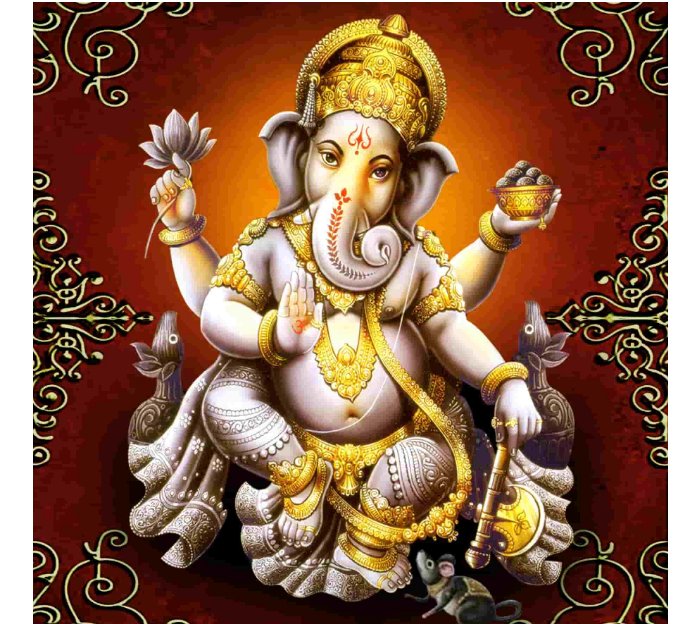
Ganesha - the God of Powers, Abilities, wisdom, knowledge, intelligence, arts, and Skill Ganesha possesses the traditional bodily attributes of the Hindu gods, which includes superhuman strength, superhuman stamina, endurance, resistance to harm, and enchanted longevity. Image credit: Pradeep Kumar Sharma - CC BY-SA 4.0
Unexpectedly Shiva returned and was furious that the boy at the door would not let him in to see his wife. In his rage, he cut off the boy’s head. Parvati came rushing out and was horrified by what Shiva had done. She told him that this was their son. Shiva ordered a new head to be found for the boy and, as the first animal available was an elephant, so Ganesha gained a new head and became the most unique of the Hindu gods.
The boy was short and fat with a red face, but in some deeper sense, he was very beautiful. He was named Ganesh, “Lord of his father’s ganas” (“hosts”) and a small mouse often showed on his depictions, became his vahana (vehicle) to ride on.
Ganesha is portrayed as standing, sitting, dancing, or crawling as a child, or even sitting on his mother's knee.
His image is found everywhere, in many different forms. Ganesh is widely worshiped in all parts of India, regardless of people’s spiritual affiliations and his characteristics and the attributes that have evolved over the centuries of Indian history.
Written by – A. Sutherland AncientPages.com Staff Writer
Copyright © AncientPages.com All rights reserved. This material may not be published, broadcast, rewritten or redistributed in whole or part without the express written permission of AncientPages.com
Expand for referencesMore From Ancient Pages
-
 Undiscovered Neanderthal Artifacts From The Ice Age Are Submerged Below The Waves Of The English Channel
-
 Viking Ship Found With Unexpected Goods For Unclear Purpose Puzzles Scientists
-
 Baffling Unexplained Encounters With Tiny Mysterious Creatures Feeding On Energy
-
 Shining Ones, Archimedes Death Ray And Mystery Of Vitrified Forts In Scotland
-
 Newly Described Species Of Dome-Headed Dinosaur May Have Sported Bristly Headgear
-
 Hoards Of Viking Coins Discovered On The Island Of Saaremaa
-
 Geomagnetic Fields Reveal The Truth Behind Biblical Narratives
-
 2,000-Year-Old Ruins In Mary Magdalene’s Town Of Magdala On The Shore Of The Sea Of Galilee
-
 Mysterious Bones May Re-Write History Of North America – Humans Were Present On The Continent 10 Times Earlier
-
 Jars With 2,600-Year-Old Vanilla Remnants Discovered In The City Of David
-
 Secret Dwelling Place Of Reptilian And Dragon-Like Creatures In Europe
-
 Glass Technology Was Known In Sahara Centuries Before The Arrival Of Europeans
-
 Sumerian Clay Brick With Inscription In Honor Of God Enki Returns To Iraq
-
 John Dee’s Magical Mirror Used To Contact Spirits Can Be Traced To The Aztecs
-
 Archaeological Mystery – Why Has Only One Such Puzzling Ancient Object Been Found In Norway?
-
 Germany’s Stonehenge Pömmelte Reveals More Secrets – 140 Wooden Houses And 78 Silos Found
-
 Why Is Roulette Called The Devil’s Game?
-
 Did The Inca Use The Quipu To Collect Taxes?
-
 Green Comet Last Seen By The Neanderthals 50,000 Years Ago May Be Visible To The Naked Eye This Week
-
 Has The Mysterious Ancient Underground Labyrinth Of Mitla Finally Been Found?

