
Oseberg Ship: Amazingly Well-Preserved Viking Burial Ship
A. Sutherland - AncientPages.com - The Vikings' ships were the European Dark Ages' most outstanding technical and artistic achievement. Without these great ships, the Viking Age would never occur, and at the same time, the success of the Vikings would never have been as far-stretched.

The Oseberg ship - Viking Ship Museum, Norway
Unfortunately, archaeologists have discovered very few remains of Viking ships. One Viking ship that can provide information about Viking burial customs, traditions, the importance of certain artifacts, and Viking technology is the Oseberg Ship. It was discovered at Oseberg, Norway, in 1904 by Knut Rom, a local farmer.
The Oseberg Ship is an astonishingly well-preserved Viking ship. It has been labeled as one of the finest finds of the Viking Age.
It was unearthed in a very damp burial mound, which is why the ship survived almost intact.
Naturally, a remarkable discovery like this one drew great interest from the public. It became necessary to secure the dig with a fence, signs, and a guard to ensure that nobody disturbed the work or got too close to the remains.
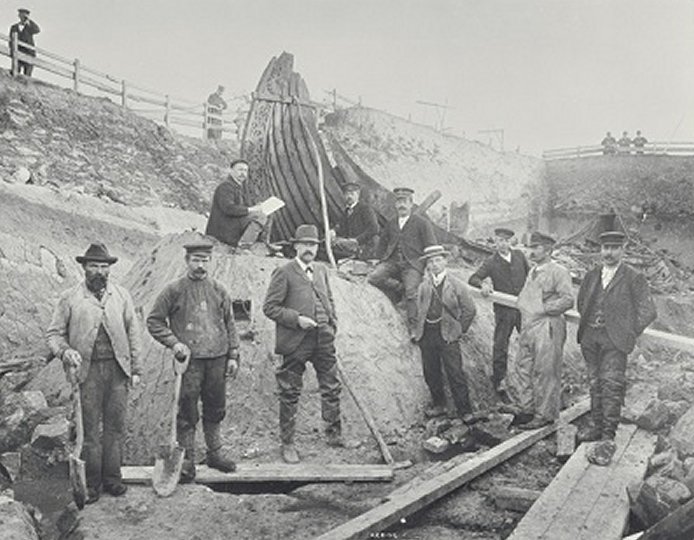
Excavation of Oseberg ship in 1904 - Photo: Museum of Cultural History (Photographer: Væring)
The excavation took less than three months, but it took 21 years to prepare and restore the ship and most of the finds. The vessel was dried out very slowly before being put together.
The Oseberg Viking ship measured 21.40m long by 5.10m wide. It was constructed primarily out of oak planks, and the vessel's bow and stern were covered in elaborate carvings while it contained 15 pairs of oar holes, which meant up to 30 men could row the ship as required.
The Oseberg ship was a burial ship for two Viking women who died in 834. A burial chamber was dug right behind the ship's mast. The walls were decorated with fantastic woven tapestries, and the dead women lay on a raised bed.
The women had many burial gifts, including personal items such as clothes, shoes, and combs, ship equipment, kitchen equipment, farm equipment, three ornate sledges, five carved animal heads, five beds, and two tents. There were fifteen horses, six dogs, and two small cows.
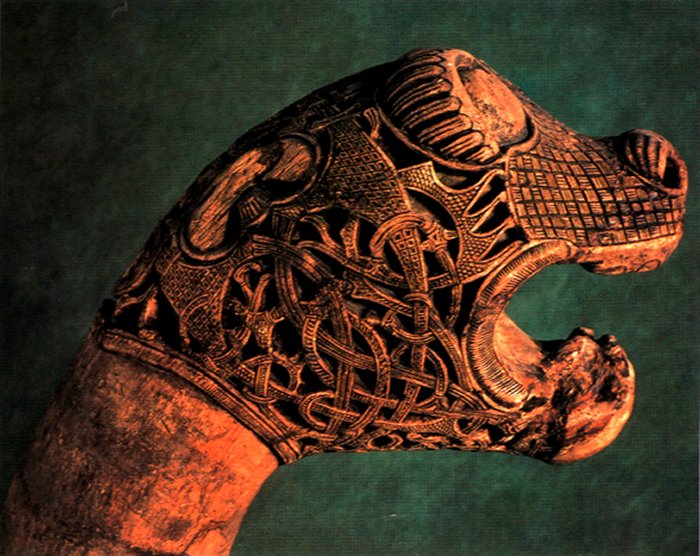
Animal head post from the Oseberg ship burial. source
Investigation of the skeletons showed that the older woman was about 70 to 80 when she died, probably of cancer. The other woman was younger, a little over 50. The cause of her death is unknown.
The identity of the two women remains a mystery. Some have speculated that one of the women may be Queen Åsa, the grandmother of Norway's first king, although this remains unproven.
To have received a prominent burial like this one, they must have held a unique position in the community.

Oseberg bucket (© Museum of Cultural History, University of Oslo, Norway)
Were they political or religious leaders?
Who was the most prominent person in the grave? Was one a sacrifice to accompany the other into the kingdom of the dead? Were they related? Where did they come from? These are questions we cannot answer.

Detail from the Oseberg ship. Image credit: Karamell - CC BY-SA 2.5
For whoever built the Oseberg ship, it must have been crucial to make it a particularly handsome vessel. They used great resources to have the boat decorated.
Beautiful animal ornaments cover the keel below the waterline and up along the bow post. Such a richly decorated ship must indeed have been reserved for particular members of the aristocracy.
The grave was disturbed in antiquity, and any precious metals that may have been present were stolen, but other ancient treasures were still left.

The so-called "Buddha bucket" (Buddha-bøtte), a brass and cloisonné enamel ornament of a bucket (pail) handle in the shape of a figure sitting with crossed legs. Image credit: - CC BY-SA 3.0
Several remarkable artifacts were found, such as the famous Oseberg 'Buddha' sitting in the lotus position.
The bucket was made from yew wood, held together with brass strips. The handle is attached to two anthropomorphic figures compared to depictions of the Buddha in the lotus posture, although any connection is most uncertain.
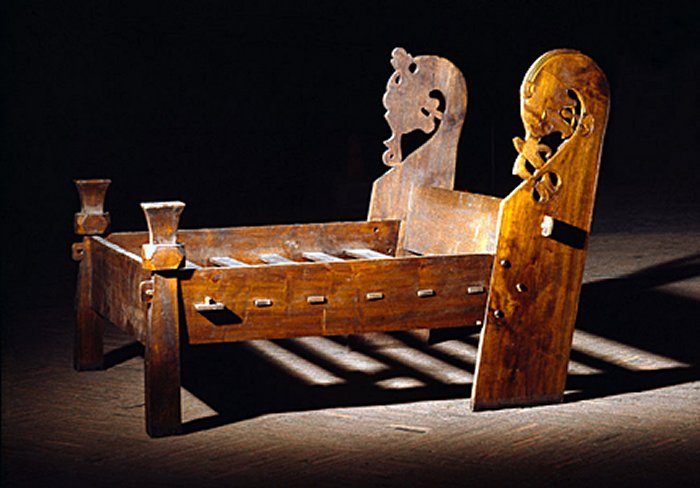
The Oseberg bed. One of 3 beds found on the ship (© Museum of Cultural History, University of Oslo, Norway)

Model of Oseberg Ship in Maritime Museum in Stockholm, Sweden. Image credit: Karolina Kristensson - CC BY-SA 3.0
More relevant is the connection between the patterned enamel torso and similar human figures in the Gospel books of the Insular art of the British Isles, such as the Book of Durrow.
The grave robbers left behind a remarkable collection of wooden and textile artifacts. These included four elaborately decorated sleighs, a richly carved four-wheel wooden cart, three beds, and a number of wooden chests. More mundane items, such as agricultural and household tools, were also found.
The Oseberg ship and its priceless ancient artifacts are displayed at the Viking Ship Museum in Oslo, Norway.
Written by – A. Sutherland - AncientPages.com Senior Staff Writer
Updated on January 18, 2024
Copyright © AncientPages.com All rights reserved. This material may not be published, broadcast, rewritten or redistributed in whole or part without the express written permission of AncientPages.com
Expand for referencesReferences:
Universitet i Oslo, Kulturhistorisk museum
B. Petersson, Föreställningar om det förflutna: Arkeologi och rekonstruktion
Oseberg, Sem, Vestfold, Noege. (800-850). Skandinavisk. Universitets Oldsaksamling, Oslo.
More From Ancient Pages
-
 Faces Of Queen Nefertiti And King Akhenaten Reconstructed Using Artificial Intelligence
-
 7,000-Year-Old Underwater Road Discovered In Adriatic Sea Off Korcula Island
-
 Ancient DNA Reveals Unknown Genetic Exchanges Between North And South America
-
 Biblical Vineyard Of Naboth Existed And Has Been Found
-
 On This Day In History: Martin Luther Was Excommunicated From The Catholic Church – On Jan 3, 1521
-
 Daily Life Of A Lady In Waiting – A Dangerous Profession Sometimes
-
 Rare Hidden Copy Of Shakespeare Sonnet 116 Discovered In A 17th-Century Poetry Collection
-
 Miniature Magical Stela Of God Horus-Child Standing On Crocodiles Protected Against Wild And Poisonous Creatures
-
 Evidence For Milk, Meat, And Plants In Prehistoric Kenya And Tanzania
-
 What Can The Fate Of Ancient Cities Teach Us About Surviving Climate Change
-
 Spectacular Chand Baori Stepwell Of India That Resembles Reversed Pyramid
-
 Riddle Of The Hanging Gardens Of Babylon – Highly Advanced Technologies – Part 2
-
 ‘Spectacular’ New Find: Roman Military Camps In Desert Found By Archaeologists Using Google Earth
-
 10 Types Of Ancient Crosses In Different Cultures Explained
-
 Amazing Underground Ancient Roman City Discovered In Italy
-
 Neolithic Farmers Invented Methods To Fight Pests 8,000 Years Ago
-
 Why Was Europe’s Oldest Battle Fought At Tollense Valley 3,000 Years Ago?
-
 First Carbon-Based Paleolithic Paintings Found In Font-De-Gaume Cave, France Could Be 19,000 Years Old
-
 Evidence Europeans Used Slash-And-Burn Methods 9,500 Years Ago For Agriculture Purposes
-
 Colors On These Ancient Pots Hint At The Power Of An Empire

