
Sharkalishharri Cylinder Seal From The Fifth King Akkad Dynasty
A. Sutherland - AncientPages.com - The Sharkalishharri cylinder seal, like many other similar objects from the Uruk period, is an impressive example of the technical performance and the complex motives presented on it.
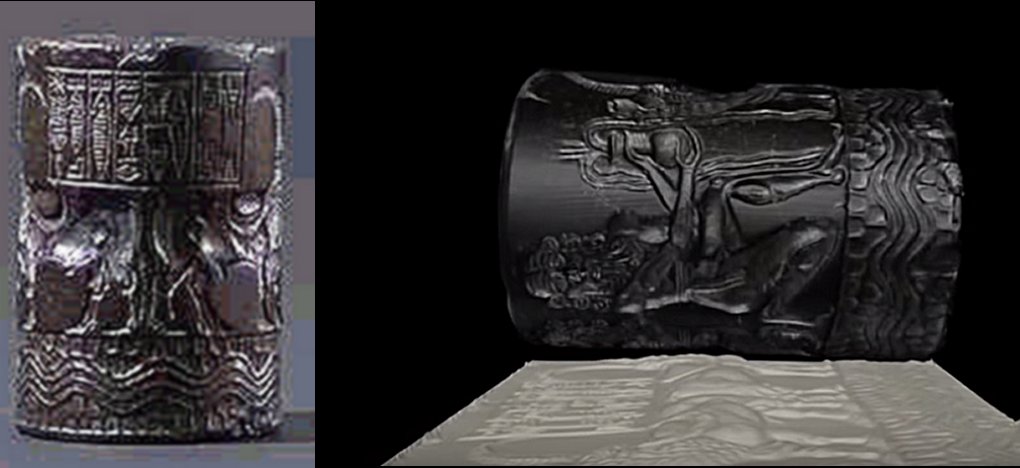 Cylinder-seal of Sharkalisharri, Akkadian period (23rd century BC), Mesopotamia – made of chlorite. Credits: Louvre Musée
The cylindrical seals that appeared at the end of the Uruk period (c.3500-3100 BC) began to be used to seal the first written documents.
This chlorite cylinder seal from about 2300 BC reveals the 5th King of Akkad and other scenes. The inscription reads, "the divine Sharkalisharri, king of Akkad, Ibni-sharrum, the scribe, is his servant."
Sharkalishharri (Shar-Kali-Sharri) was the king of the Akkadian dynasty, the son and successor of Naram-Sin, who reigned from C. 2217-2193 BC. He took over the Akkadian Empire after the 37-year reign of his father, Naram-Sin. At that time, his people were harassed by the constant invasions of the Guti (also known as Gutians or Guteans. These people specialized in the war of the driveway.
During his 25-year reign that lasted until 2193 BC, Sharkalishharri did not have any success during the invasions of the Guti people.
This type of struggle was due to the geographical location of the place of settlement of the Guti people - the Zagros Mountains. Their main target was the large herds of Akkadian cattle.
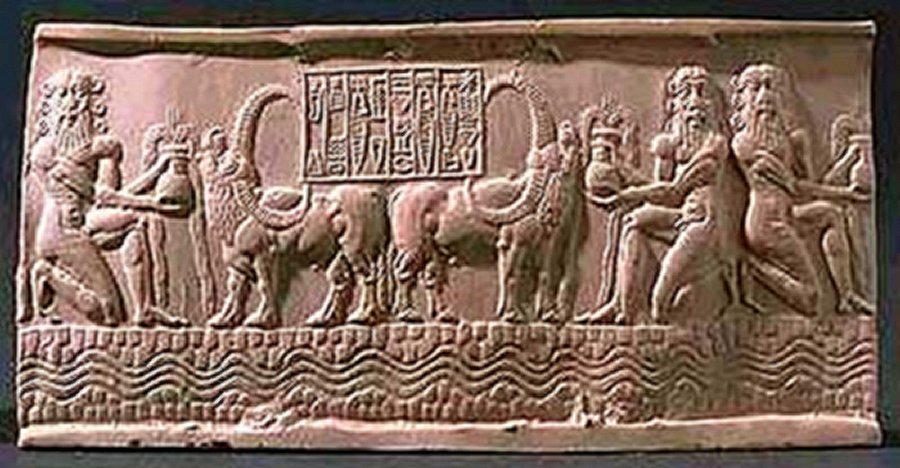 The impression of the Sharkalisharri cylinder seal, ca. 2183- 2159 BC during Akkadian, reign of Shar-kali-sharri. Mesopotamia. Cuneiform inscription in Old Akkadian. Credits: Louvre Musée
The cylinder seal is tiny (only 3.9 cm high, (1 1/2 in.); 2.6 cm in diameter (1 in.), still, it carries an important message because it's a unique signature of its owner, the divine protection or
Filling motifs – figures or objects depicted in the spaces around the main scene – are another common feature of cylinder seals.
The print left by the rolling of these miniature bas-reliefs on the soft clay of the tablet reveals a rich iconography that varies with the different epochs.
Thus the dynasty of Akkad (2340-2200 BC), stone-cutters displayed a certain tendency for mythological scenes. The seal depicts two naked figures (heroes) looking straight at us and holding two jars, and between the individuals, there are standing two water buffalos carrying the inscription.
Cylinder seals were usually made of stone. They were engraved and specially designed to be rolled into clay to leave impressions. The engraved images, and usually text, were carved in reverse so that they faced the correct direction when rolled out onto clay. Engraved cylinder seals were very popular and frequently used in the ancient Near Eastern world.
Their earliest examples used mainly magical, geometric, or animal patterns. Later seals incorporated the owner's name and depicted a variety of motifs. Both their use and fashioning were widely adopted by surrounding civilizations, including Egypt and the Indus valley.
It had several functions, such as a protective amulet function regarding persons and property, authentication of written and significant text and contracts, or as an identity mark of the sender to prevent tampering with containers and sealed doors which were often worn on a necklace or a pin.
The loss of a cylinder seal had serious consequences.
Written by – A. Sutherland AncientPages.com Staff Writer
Updated on October 8, 2022
Copyright © AncientPages.com All rights reserved. This material may not be published, broadcast, rewritten or redistributed in whole or part without the express written permission of AncientPages.com
Expand for referencesMore From Ancient Pages
-
 On This Day In History: Mathematician And Astronomer Simon Marius Independently Rediscovered Andromeda Galaxy – On Dec 15, 1612
-
 Enigmatic Bronze Age Fulacht Fiadh: ‘Kitchens’ Of The Legendary Irish Warriors
-
 Mysterious Water Source Belonging To The Goddess Of The Cold Kingdom Of Evil Remains An Archaeological Puzzle
-
 Neanderthals: The Oldest Art In The World Wasn’t Made By Humans
-
 Rare Viking Treasure Made By A Highly Skilled Goldsmith Found On The Isle of Man
-
 Ancient Clay Seals That Could Re-Write Hittite History Discovered In Kayalıpınar, Turkey
-
 Florida’s Ancient Underwater Burial Site Much Older Than Previously Thought
-
 Why Did Vikings Carry Decorative Swords That Were Useless In Combat?
-
 Magnificent Interior Of The Djoser Pyramid Revealed In Stunning Images And Video
-
 Enigma Of The Missing Pyramid Bodies – Ancient Egyptian Mystery Remains Unsolved
-
 Rare Lost Pictish Stone With Strange Mythical Beasts Goes On Display For The First Time
-
 120,000-Year-Old Bone Etchings – Evidence Of The Earliest-Known Use Of Symbols
-
 Mystery Of The Avars Who Conquered The Roman Empire Solved By Scientists
-
 Birch Bark Tar Production Techniques Offer Evidence Neanderthals Had Cognitive Skills Similar To Modern Thinking
-
 1,500-Year-Old Christian Reliquary Found In An Unknown Church In Irschen, Austria
-
 2,000-Year-Old Stringed Instrument Found In Vietnam
-
 Incredible Shipwreck With Fascinating Cargo Found 1,200 Years After Sinking In Holy Land
-
 Vikings Brewed Beer With Heated Stones – Old Tradition Popular In Germany, Finland And Baltic States
-
 Llanbadoc Discovery: Late Medieval Artifact And The Battle Of Usk
-
 Enigmatic ‘Stone Sleepers’ – Megalithic Tombstones ‘Stecci’ In The Western Balkans

