Jan Bartek - AncientPages.com - Previous studies show Neanderthals invented or developed birch tar making technique independently from Homo sapiens.
Studying prehistoric production processes of birch bark tar using computational modeling reveals the kinds of cognition that were required for the materials produced by Neanderthal and early modern humans.

Credit: Adobe Stock - Karrrtinki
Researchers of Team Langejans in the Materials Science and Engineering (MSE) department, of Delft University of Technology, published two papers on one of the world's oldest transformative technologies in Scientific Reports.
Measuring complexity
Birch bark tar is the first time we see evidence of creating a new material, said Dr. Paul Kozowyk, lead author on one of the papers. Examining the methods used to create the tar is an important step in understanding the behaviors and technical cognition required by the Neanderthals.
Using Petri net models, a formal modeling language, Dr. Sebastian Fajardo led a study looking at various production methods, using metrics from existing literature to measure complexity.
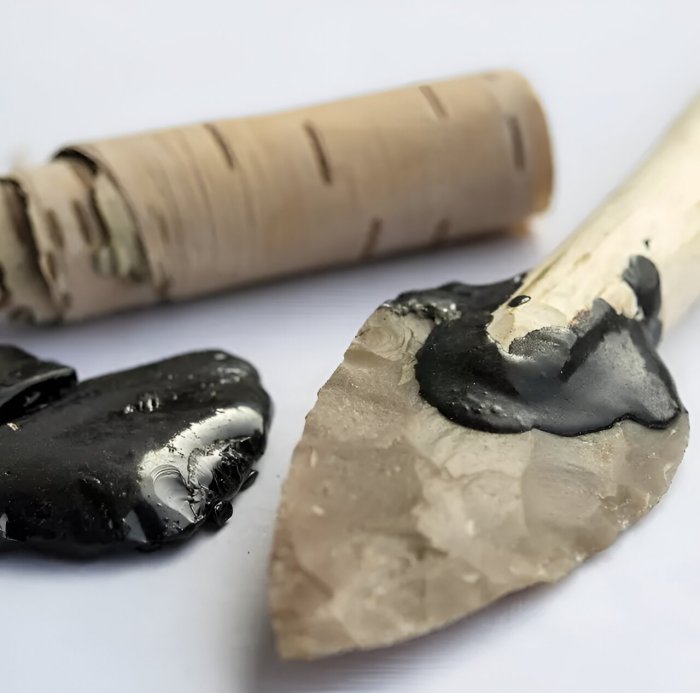
Reproduction of a stone tool hafted to a wooden handle with birch bark tar adhesive Credit: Delft University of Technology
"Neanderthals used, at least on some occasions, a complex production process to make tar. To do that they needed ways to deal with a lot of information, like understanding and a way to transmit information very well," he said. The findings from the study suggest that Neanderthals probably relied on several cognitive traits that archaeologists often associate with modern thinking and behavior.
Scaling up
Taking one of the metrics Fajardo used, Kozowyk applied it in more detail to one of the tar production techniques to explore how scaling up a technological process affects its complexity.
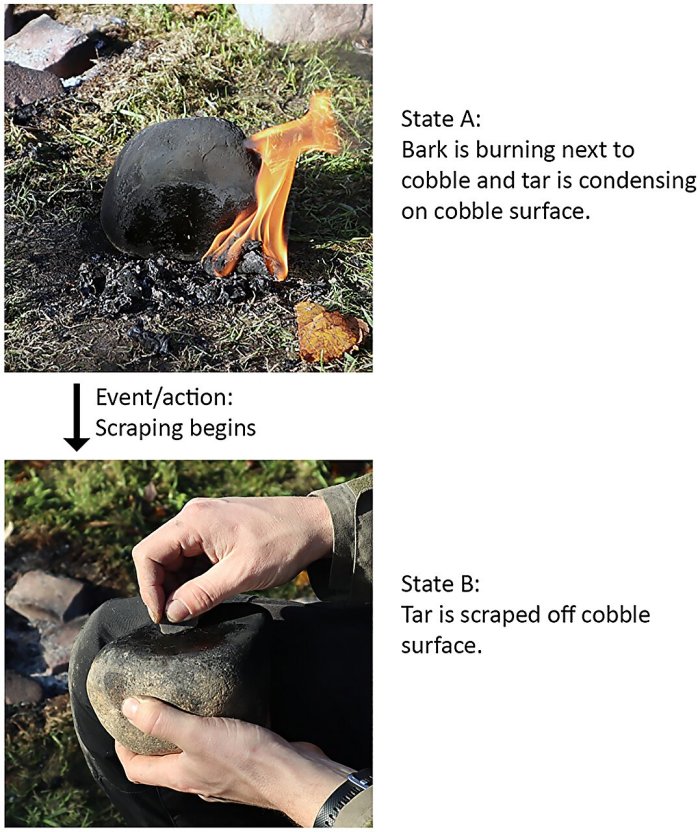
Event altering the state spaces of the system. A state is a unique instance in time, represented here by each photograph. Events or actions that can change the state from one form to another are represented by the arrow between each photo. The state space represents all possible states between the beginning and end of the entire process. Credit: Scientific Reports (2023). DOI: 10.1038/s41598-023-41963-z
"The outcome in this case was that it has a very significant impact on the complexity and that suggests people had a way to deal with this complex upscaling," he said. That might involve inventing a different method or working together as a group which requires more communication. "We don't prove that they were using a particular method, but our findings show that regardless of the methods employed, prehistoric tar making likely required a level of information processing that extended beyond simple behaviors."
Materials then and now
Archaeological research has found a niche at the TU Delft, and Fajardo said it all comes down to analyzing materials. "For example, at 3mE we try to find new materials," he noted. "We try to understand how these new materials were produced in the past because if we understand how the first human-made materials were created, we can also start to identify human conditions we need to make new materials now with the resources that we have."
See also: More Archaeology News
For Kozowyk, whose research is mostly experimental, it's about looking at the material properties of the adhesives to try to understand the decisions that people made in the past. "A lot of my experiments involve mechanical testing of the materials so this is the right place to be."
The study was published in the journal Scientific Reports
Written by Jan Bartek - AncientPages.com Staff Writer