
Charlemagne – Most Famous Emperor Of Education And Enemy Of Pagan Worshippers – What Did He Really Mean For Europe?
A. Sutherland - AncientPages.com - Charlemagne, also known as Charles the Great (742 - 814), is considered the most remarkable of all medieval rulers in the history of the European continent.
His kingdom stretched to the territories today, including France, Germany, Benelux, part of Italy, and Switzerland; his contemporaries called him the 'Father of Europe.'
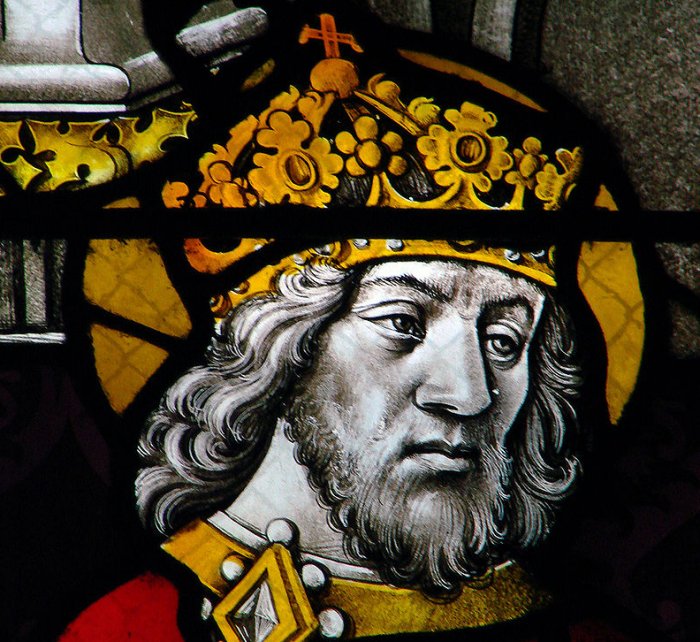
In the Cathedral of Moulins, France, the end of the 15th century. Photo: Vassil/Wikipedia
For some, he was a national hero. For others, he was the almost semi-legendary figure, and after his death - in a way - he was still alive. His life was remembered, and his achievements inspired the Crusades and later European leaders such as Louis XIV, Napoleon I, and Hitler. Even today, some people claim Charlemagne as the founder of European unity.
Charlemagne proved to be a talented diplomat and able administrator of the vast European kingdom he controlled. He was a true enemy of pagan worshippers.
Charlemagne was an enthusiastic promoter of literacy, respected education, and loved books. An excellent scholar in many other subjects, including language and mathematics, unfortunately, he never learned to write.
Charlemagne was born around 742, but his birthplace is unknown, although Aachen in modern-day Germany and Liege in present-day Belgium were proposed as possible locations.
Very little is known about his childhood. He was illiterate for much of his life. He studied grammar, rhetoric, and mathematics and learned to speak Latin and understand some Greek in addition to his native Frankish, but he had difficulties to learn to write.
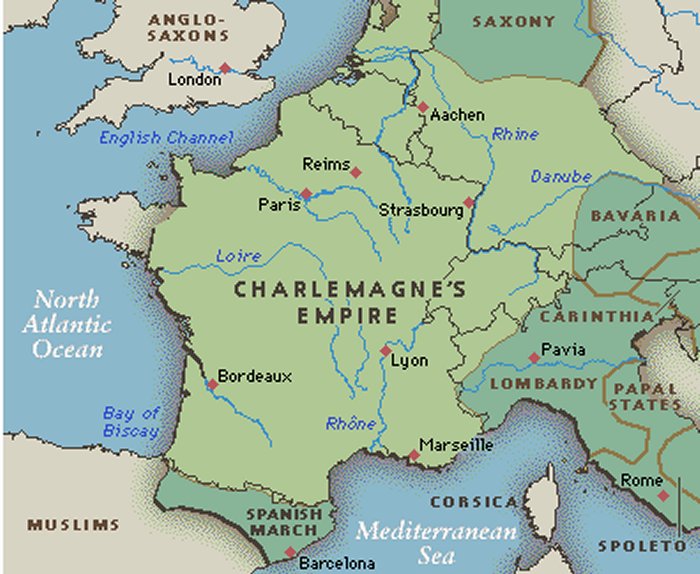
Charlemagne was a successful conqueror. He defeated the Lombards in northern Italy and made himself their king. He campaigned in Spain and Hungary.
He hired learned men to read out loud to him at dinner. We know from ancient historical records that he practiced writing on his wax tablets while in bed and then hid them under his pillows.
When his father, Pepin the Short (714 – 768), died, the kingdom was divided between Charlemagne and his brother Carloman. When his brother died in 771, Charlemagne became the leader of the reunified Frankish empire, which ruled from several cities and was engaged in many military battles during his reign.
He conquered Saxony in the 8th century, but winning the battle over the Saxons was not easy. He spread Christianity into Northern Europe by forcing Catholicism on the conquered people and slaughtering those who refused to convert. Charlemagne financially supported churches and protected the popes. He also made churches function as refugee shelters.
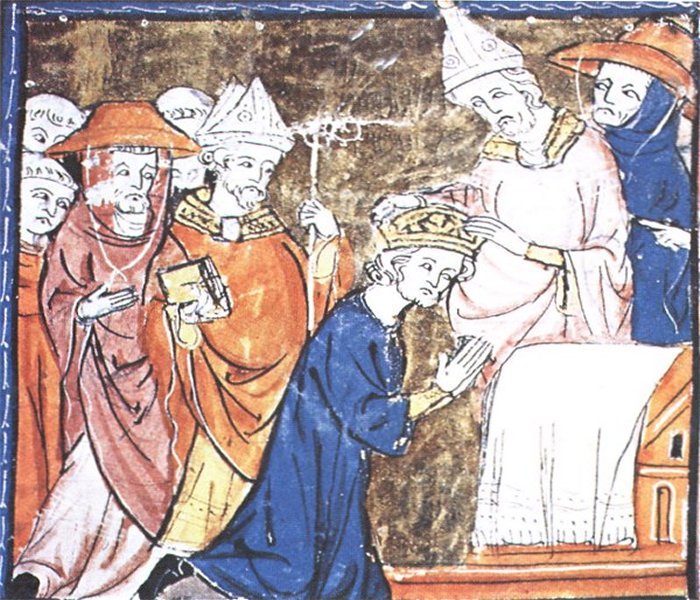
The coronation of Charlemagne by Pope Leo III. source
Pope Leo III acknowledged Charlemagne as a ruler, and in 800, at Mass on Christmas day at St. Peter's Basilica in Rome, he was named Roman Emperor.
Interestingly, Charlemagne began to use this title much later, probably because he feared it would create dependence on the Pope.
Charlemagne made many contributions to the future of European education. He sponsored the creation of a new uniform script for copying texts, developing textbooks for teaching Latin to non-Latin speakers, and collecting Latin manuscripts. Charlemagne also promoted learning that was given a time and a place to flourish. He set up monastic schools, supported authors and artists, and devised the pounds, shillings, and pence system used during the middle ages and in Britain until the 1970s.
Among his other achievements was the creation of the "Carolingian Miniscule," an alternative to the capital letters used in the Latin text.
Charlemagne died in 814 and was buried at the cathedral in Aachen. His empire encompassed much of Western Europe at the time of his death. He left control of his kingdom to his son, Louis the Pious.
His enormous cultural legacy has survived until today.
Written by A.Sutherland - AncientPages.com Senior Staff Writer
Updated on March 14, 2023
Copyright © AncientPages.com All rights reserved. This material may not be published, broadcast, rewritten or redistributed in whole or part without the express written permission of AncientPages.com
Expand for referencesReferences:
Fried J. Charlemagne
Becher M. Charlemagne
More From Ancient Pages
-
 On This Day In History: American General Benedict Arnold Commits Treason – On Sep 21, 1780
-
 Thousands Of Ignored ‘Nummi Minimi’ Coins Found In Ancient Marea, Egypt With Hidden Fascinating History
-
 On This Day In History: Edict Of Longjumeau Was Signed And Ended Second War of Religion – On Mar 23, 1568
-
 Ancient Script Reveals Mysterious Location Of Legendary Hanging Garden Of Babylon
-
 Olmec Civilization Remains An Intriguing Ancient Puzzle
-
 Olive Trees Were First Domesticated 7,000 Years Ago In The Jordan Valley
-
 Poles conduct mural restoration in the villa buried by the ashes of Vesuvius
-
 Arrow Pre-Dating The Vikings Discovered After Being Lost In The Ice For 1,500 Years
-
 On This Day In History: Great Fire Of Rome Recorded – On July 18, 64 AD
-
 3,000-Year-Old Bakery With Large Amounts Of Flour Discovered In Armenia
-
 History Of The Saltire – Scotland’s National Flag And World’s Oldest Sovereign Flag
-
 Political Debates In Ancient Rome: Great Harshness, Personal Attacks And Unpleasant Atmosphere
-
 Puzzling Ancient Artifacts And Skeleton Discovered In Iowa – Evidence Of A Lost Ancient Civilization?
-
 Uncovering Ancient Secrets Hidden In China’s Dunhuang Caves
-
 Historic Event – Exeter Museum Returns Ceremonial Dress Of Famous Chief Crowfoot To Canada’s Siksika People
-
 Maya Settlement In City Of Itzan Is Much Older Than Previously Thought – New Study
-
 Mystery Of Giant Ancient Statues And A Vanished Civilization With Unusual Physical Characteristics – Strange American Connection – Part 2
-
 Ancient Secrets Of Iberian Warrior Vase – 2,000-Year-Old Masterpiece Of Art
-
 Ancient Secrets Of Mistletoe – Sacred Celtic Plant With Magical Powers
-
 Symbol of Immortality: Honey Offering In A 2,500-Year-Old Shrine – Identified

