
Ancient Intriguing Sao People: “Men From Another Time” – One Of The Oldest Civilizations Of Central Africa
A. Sutherland - AncientPages.com - The Sao people - means "the men from another time" are an intriguing and one of the oldest civilizations of Central Africa.
Ancient civilization was developed by the Sao people in the region of Southeast of Lake Chad, located in the far west of Chad and the northeast of Nigeria.

Fragment of an anthropomorphic figurine in terracotta Sao. Image source.
The Sao civilization is identified by its use of stone and bone implements and the construction of walled cities.
This civilization flourished in Middle Africa from ca. the sixth century BC to as late as the sixteenth century AD. The Sao lived by the Chari River south of Lake Chad in territory that later became part of Cameroon and Chad. They are the earliest people to have left clear traces of their presence in the territory of modern Cameroon.
According to a Toubou tradition, the Sao originally come from a region about 500 kilometers north of Lake Chad. In the 7th century, they lived in the Bilma, Tadjeré, and Fatchi oases.
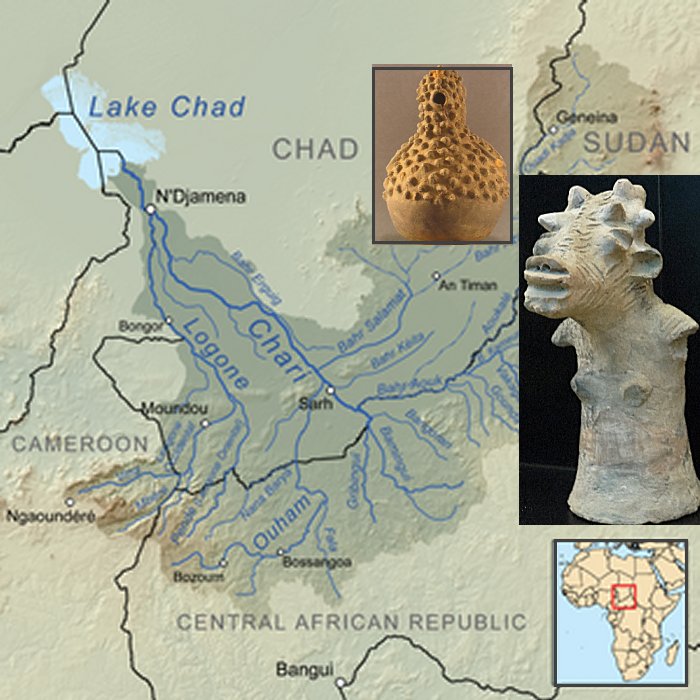
The Sao civilization may have begun as early as the sixth century BCE, and by the end of the first millennium BCE, their presence was well established south of Lake Chad and near the Chari River.
In the 11th century, the Sao, who were great architects, built large cities surrounded by dry earth walls complete with fortifications and ramparts. Sometime around the 16th century, conversion to Islam changed the cultural identity of the former Sao but they still claim descent from the civilization of the Sao.
It had long been suggested that the Sao were descendants of the Hyksos who conquered Ancient Egypt that they moved south from the Nile valley into middle Africa under pressure from invaders, or that they originated in the Bilma Oasis north of Lake Chad.
However, a more widely accepted theory is that the Sao people were simply the indigenous inhabitants of the Lake Chad basin and that their ultimate origins lie south of the lake. Recent archaeological studies suggest that the Sao civilization developed indigenously from earlier cultures in the region (such as the Gajiganna culture, which began at around 1,800 BC and began to build fortified towns by about 800 BC), which gradually increased in complexity.
Sao artifacts show that they were a sophisticated civilization working in bronze, copper, and iron. Finds include bronze sculptures, funerary urns, terra cotta statues of human and animal figures, coins, household utensils, jewelry, highly decorated pottery, and spears.
 Sao art. Museo di Quai Branly, Parigi. source
Most of the archaeological finds related to the Sao people have been uncovered south of Lake Chad.
Studying Sao’s legacy, researchers discovered that these people buried their dead.
Tombs have been found, grouped in vast necropolises some of which had three, even four levels. The oldest of these tombs were simple pits where the corpse would be laid down on its back, the head resting on a kind of dried clay pillow.
The Sao people developed remarkable pottery especially large terra cotta earthenware jars, entirely or partially decorated with a herringbone pattern over which sexual motifs were added. A smaller earthenware jar, in which the deceased would be placed in the fetal position, was closed either by another jar of the same size placed upside down over the opening or more frequently by a smaller ovoid pot.
The tradition of placing the corpse in a jar dates from the 12th and 13th centuries. Beginning in the 15th century, this type of burial would start to be abandoned in favor of a simple burial. The culture’s terracotta animalistic and anthropomorphic sculptures represent the legacy that best attests to their civilization of Sao.
These intriguing figures – often associated with funerals - were discovered in the Sao’s sanctuaries and other places of offering.
Little is known about the Sao's culture or political organization because they left no written records and are known from oral traditions of the Sao and through archaeological discoveries. Sao artifacts show that they were skilled workers in bronze, copper, and iron.
Finds include bronze sculptures and terra cotta statues of human and animal figures, coins, funerary urns, household utensils, jewelry, highly decorated pottery, and spears.
The largest Sao archaeological finds have been made south of Lake Chad.
Written by – A. Sutherland AncientPages.com Staff Writer
Copyright © AncientPages.com All rights reserved. This material may not be published, broadcast, rewritten or redistributed in whole or part without the express written permission of AncientPages.com
More From Ancient Pages
-
 Ancient Temple At Taposiris Magna In Alexandria, Egypt, Reveals Some Of Its Secrets
-
 Mythical Danaides: Daughters Of Danaus Condemned In Hades To Eternal Punishment
-
 Unorthodox Ancient ‘Out-Of-This World’ Carvings Were Found And Destroyed – Discovery – Part 1
-
 A 500-Year-Old Stolen Copy Of da Vinci’s “Salvator Mundi” Painting – Found By Italian Police
-
 Neolithic Mendik Tepe Site Discovered In Southeastern Türkiye Is Older Than Gobeklitepe
-
 Viking Era Sword Discovered By Young Girl
-
 Enigma Of San Bernardo Mummies That Refuse To Decompose
-
 On This Day In History: Aviator Amelia Earhart Was The First Woman To Cross The Atlantic By Air – On June 18, 1928
-
 Ancient Tradition And True Meaning Of Candy Canes
-
 Man Following Sinister Green Light Discovers Mysterious Ancient Artifacts And Strange Mummies In Secret Cave
-
 Medieval French Women Were More Powerful Than Most Think
-
 ‘Exceptionally’ Rare Iron Age Axle Found In Suffolk
-
 Story Of Uncle Sam – Symbol Of The United States Government
-
 On This Day In History: Battle Of Rudau Was Fought – On Feb 17, 1370
-
 Surprising Inscription Discovered On Birka Ring – Ancient Viking Artifact
-
 Mystery Of The Lost Cahuenga Pass Treasure: Baffling Unexpected Deaths Caused By A Curse Or Natural Causes?
-
 Legend Of Sleeping Hero Holger Danske: Viking Warrior Who Never Died
-
 Xochipilli: Aztec God Of Love, Music, Song And Ecstatic Mushroom Trance
-
 Face Of Man From The Lost Medieval Village Of Dzwonowo Reconstructed Using 3D Printing Technology
-
 Three Punic Wars Between Rome And Carthage Lasted Almost A Hundred Years

