
Mystery Of The Giants’ Grave of Coddu Vecchiu
A. Sutherland - AncientPages.com - Some say these are the graves of the giants that walked the Earth in the distant past.
Are the mysterious tombstones remnants of the legendary lost continent of Atlantis?
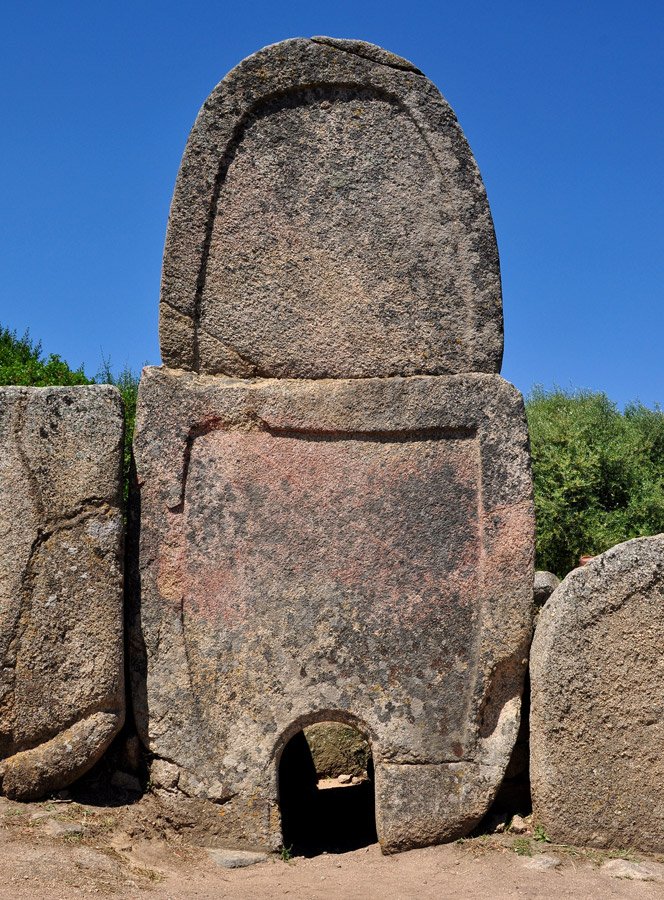
The Giants' Grave of Coddu Vecchiu. The stele consists of two large stones carved in bas-relief and contains the entrance to the tombI. mage credit: Michel Royon - CC BY-SA 3.0
There are several unanswered questions concerning the Giants' graves, or Tomba dei gigantic in Sardinia. Who constructed the massive tombstones, and for what purpose? Were they used as mass graves?
So far, researchers have located 321 such monuments in Sardinia, including the one at Coddu Vecchiu.
The tombs are made of a central stele, a stone or wooden slab, with a hole cut into it that functions as the entrance. Walls extend from the door and form an interior corridor grave. Scientists have not yet adequately investigated the tombs and are still shrouded in mystery.
People who visited the tombstones have spoken about the positive energy surrounding the giants' graves and providing spiritual rejuvenation.
According to ancient legends, these were the tombs of mighty giants that lived in the area.
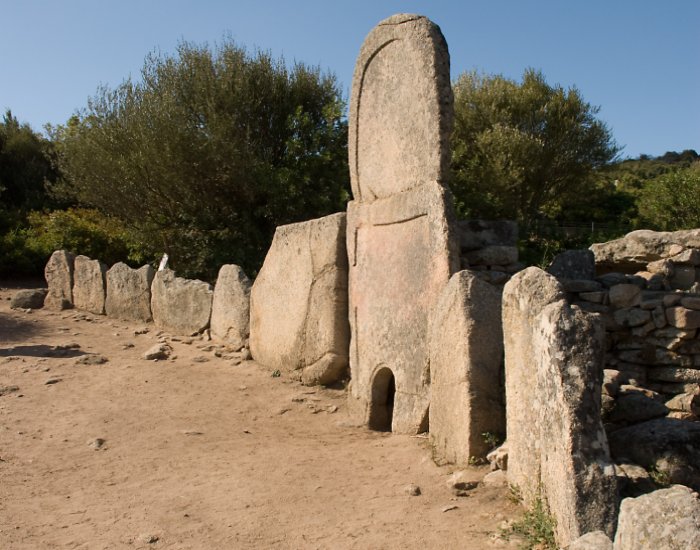
Coddu Vecchiu archeological site, near Arzachena, Sardegna, Italy. The megaliths of the forecourt form a semicircle. Image credit: pjt56 - CC BY-SA 3.0
One of the tombs is over 100 feet tall, suggesting a giant could have been buried there.
Sardinia is rich in ancient history and home to several mysterious stones, statues, and mysteries.
According to Miroslav Provod, "throughout the territory of the Italian island of Sardinia, historians have counted over seven thousand Nuraghes, which are wondrous ancient "beacons."
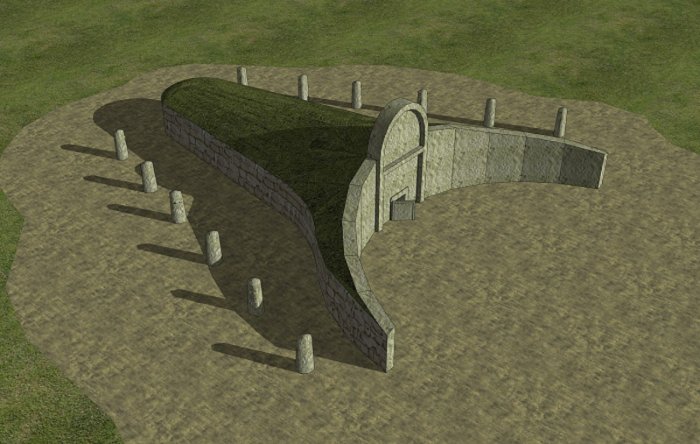
A 3D model of how the site may have once looked. Image credit: - CC BY 2.0
These buildings were built from large; often, several-ton weighing stones laid on each other without mortar and are hollow in their center.
The essence of all megalithic structures is the racking up material over the energy space to form a standard charge. The areas around the Nuraghes contained enough stones, so they were used as a building material. The vertically tapered construction ensures stability, especially when not using mortar - the interior space could be used as dolmens to supplement the body's energy. Nuraghes worked as menhirs and other megalithic structures, but their excessive concentration has not been explained. Similar conical structures - called Brooches - were built in Scotland."
Sardinia is also famous for the remarkable Giants of Monte Prama. Shortly after the astonishing discovery, these mysterious ancient statues were deliberately hidden in the basement of a museum.
In 1974, remarkable ancient stone sculptures were accidentally discovered in farmland near Monte Prama, Sardinia. There is very little knowledge about these statues, which are unique in size and material. The figures are finally in an exhibition open to the public.
Researchers believe they belong to the Nuragic civilization, which flourished in Sardinia for two millennia until the second century AD. Excavations revealed 30 gigantic stone statues, about two meters high.
The connection between the enormous graves, legends of giants, and Atlantis is an intriguing subject worth exploring further. Sardinia still holds many secrets of the past.
Written by – A. Sutherland - AncientPages.com Senior Staff Writer
Updated on August 1, 2022
Copyright © AncientPages.com All rights reserved. This material may not be published, broadcast, rewritten or redistributed in whole or part without the express written permission of AncientPages.com
Expand for referencesMore From Ancient Pages
-
 Ancient Maya People Used Volcanic Ash To Build Pyramids When Huge Eruption Occurred
-
 Ancient Oil Lamp Shop Discovered In Aizanoi, The Second Ephesus
-
 Lost City Of Irisagrig Comes To Life In Ancient Stolen Tablets
-
 On This Day In History: Roman Emperor Trajan Was Born In Spain – On Sep 18, 53 AD
-
 Famous Runestone Is Not What We Thought And Re-Writes History Of The Vikings – Scholar Argues
-
 Why Did Vikings Hide A Precious Silver Treasure Under The Thralls’ House?
-
 Surprising Discovery Of A Perfectly Ancient Road Shows Romans Moved Deeper Into Wales Than Previously Thought
-
 Secrets Of A Lake That Could Re-Write Ancient History Of America – Ancient Visitors From Distant Countries – Part 3
-
 Neanderthals Vanishing When Homo Sapiens Emerged In Europe Was Coincidental – Are Herbivores The Answer?
-
 Ruins Of Xunantunich – Mayan City That Once Flourished
-
 Ancient Liangzhu Culture Collapsed Due To Climate Change – New Study Says
-
 3,000-Year-Old Silver Goblet That May Have Belonged To Mannaea Kingdom – Unearthed
-
 AI Tool ‘Aeneas’ Helps Historians Restore Damaged Latin Texts By Accelerating Complex And Time-Consuming Work
-
 Invisible Ink On Antique Nile Papyrus From The Island Of Elephantine – Revealed
-
 History Of Eyeglasses: One Of The Most Important Inventions Is Lost To History
-
 Ancient DNA Unravels The Mystery Of Huge 6,500-Year-Old Cemetery And The Tomb Of A ‘Masculine Woman’ In Normandy, France
-
 Unique Find: Sacred Gate Found At The Minoan Palace Of Archanes In Crete
-
 Secrets Of An Unusual And Mysterious Medieval Danish Axe Revealed By Scientist
-
 Cacao Was Cultivated By Cultures Along The Pacific Coast Around 5,000 Years Ago – New Study
-
 Mysterious Ancient European Civilization – Puzzling Mysterious Ancient European Civilization – Part 2

