
Lamashtu Plaque: Assyrian Healing Device Against The Evil Goddess
A. Sutherland - AncientPages.com - 'Lamashtu Plaque' (or 'Hell Plaque') was an Assyrian healing device against the female demon Lamashtu and her evil doings.
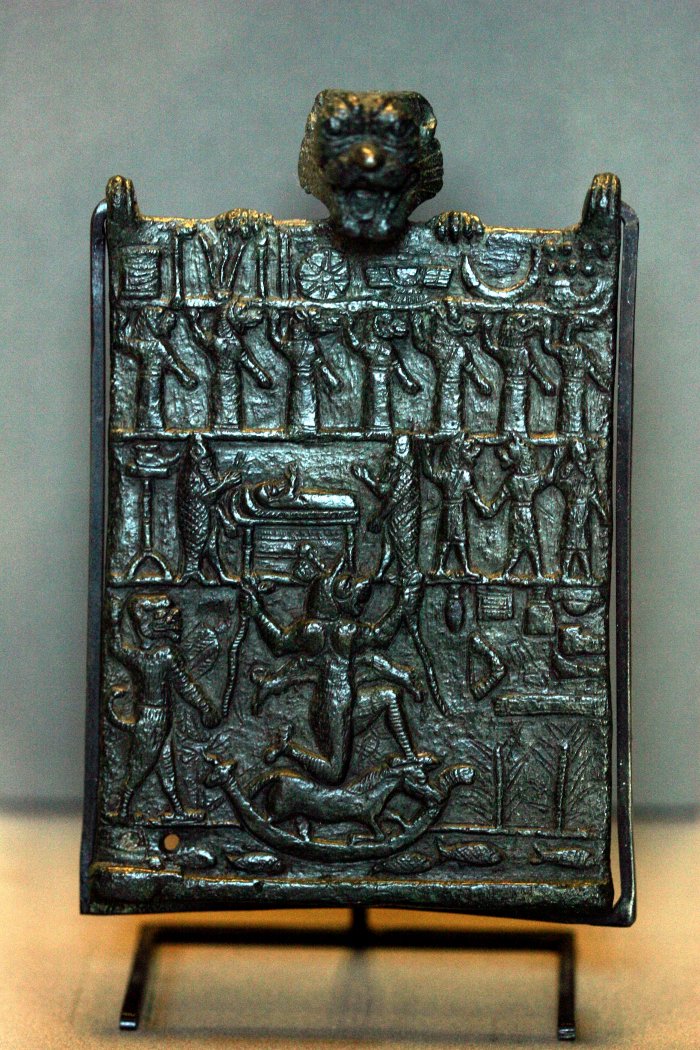
Lamashtu plaque held by Pazuzu. Image credit: Rama - CC BY-SA 2.0 fr
Now in the Louvre, the original of this plaque is made of bronze and dates from the Neo-Assyrian period between the tenth and seventh century BC. Lamashtu plaque held by the demon Pazuzu, the king of the demons of the wind and son of Hanbi, the god of all evil forces and the father of Pazuzu and Humbaba.
The artifact is one of many valuable ancient Assyrian treasures.
Lamashtu, often called "she who erases," is an evil creature blamed for the deaths of children and mothers, poisoning water, killing plants, consuming the flesh, drinking the blood of adult men, and causing nightmares. She had a hairy body with a lioness's head, a donkey's teeth and ears, and bird talons.
According to Mesopotamian beliefs, hanging the plaque over the bed was important to ward off sickness by driving evil Lamashtu out. She was believed to cause many illnesses. Her husband Pazuzu, shown on the back, is invoked to persuade her to go away and thus speed the patient's recovery.
Exorcism Ceremony Depicted On The Artifact
The exorcism scene is divided into registers. The upper register shows symbols that symbolize the great cosmic gods invoked to heal the sick person: the sun of Shamash, the crescent moon of Sin, the lightning bolt of the storm god Adad, and the winged disc of Ashur, the supreme god of the Assyrian Empire.
The seven spirits depicted in the second register (each with a different animal's head) probably had a beneficial function because they symbolically guard the door of the patient's bed-chamber.
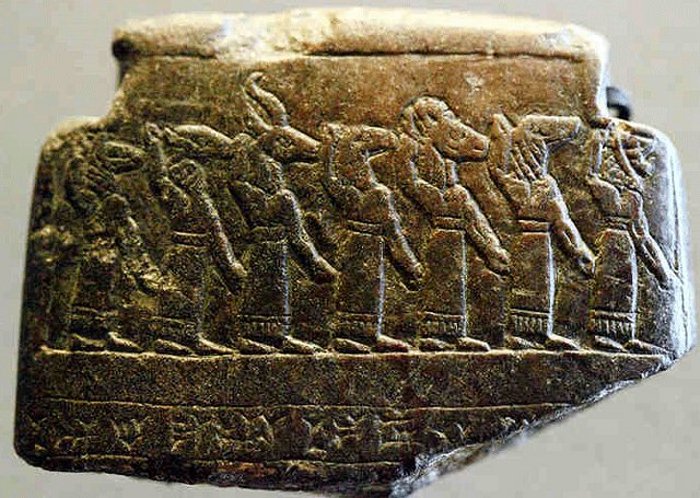
Protection plaque against Lamashtu (fragment). Dimensions: 6.40 cm high, 8.40 cm wide, 1.20 cm deep. Photo credits: Rama - CC BY-SA 2.0 fr - Louvre Museum
The patient is seen in the third register, lying on a bed surrounded by two figures dressed in fish skins. These figures could be the spirits associated with Ea, the god of the depths and wisdom. They are probably the priestly exorcists conducting the ritual with the help of three animal-headed spirits.
Driving Out Evil Spirits
Lamashtu, sitting on a donkey in a boat is depicted in the lower register. The evil Lamashtu is twice as big as all the other characters. She is presented as physically fearsome, with a hairy body, lion's head, and talons.
She is holding and suckling two lion cubs and snakes. From an inscription, we learn that she is "furious and cruel, a dazzling goddess. As a she-wolf; she snatches the young man on the path, the girl at play, the child from his nurse's arms." Clearly, she is responsible for evil deeds.
The boat is sailing along a river full of fish, symbolizing the world of Apsu (Abzu) - the underworld home to demons. Do all the gifts depicted on the artifact encourage Lamashtu to set off on her journey back to the underworld? Pazuzu is standing behind Lamashtu and is as fearsome as his wife.
He is present there to protect the patient by urging his wife to retreat. This ancient belief was very strong and widespread in the 1st millennium in Mesopotamia. Ancient Mesopotamians feared Lamashtu and searched for different means to protect themselves from this dangerous female demon and her evil doings.
The uppermost part of the plaque displays the different gods involved in the healing process: the sun of Shamash, the crescent moon of Sin, the lightning bolt of Adad, and the winged disc of Ashur.
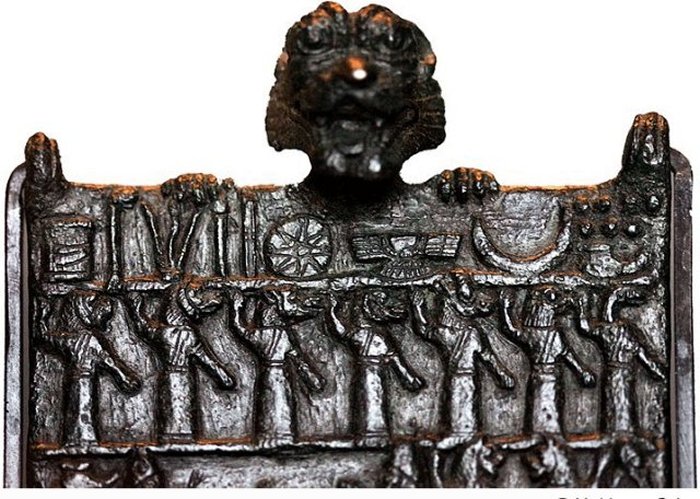
Close-up of plaque' s top register. Pazuzu holding the protection plaque against Lamashtu. Photo credits: Rama - CC BY-SA 2.0 fr - Louvre Museum
In the second register, seven animal-headed spirits guard the door to a bed-chamber, and in the third, the patient is depicted lying on a bed, flanked by two priests, who are aided by three animal spirits associated with Ea god (or Enki), the Sumerian god of water, knowledge, mischief, crafts, and creation.
Overlooking the plaque is Lamashtu's husband, the demon Pazuzu, the only one who could persuade her to go away. It's worth mentioning that 'Lamashtu Plaque' was originally thought to have represented the Babylonian goddess Eresh-kigal and her journey through the underworld.
The lion-headed figure at the top was believed to be the Babylonian god Nergal, ("Great Watcher") and Ereshkigal's husband.
In Mesopotamian mythology, the goddess Ereshkigal, "Queen of the Great Earth," ruled the underworld. She was also called Irkalla and the only one who could pass judgment and give laws in her kingdom.
Was the female demon Lamashtu the goddess Ereshkigal?
Based on Mesopotamian mythology, Lamashtu was the daughter of the sky god Anu. There is also a Semitic list of seven called Kamu or captive demons: Lamashtu, Labasu, Akbazu, Lilu, Lilitu, Ardat, Lili, and Mukil.
Was Lamashtu punished for misbehaving by the supreme gods and expelled from the Earth to underground realms where she was forced to stay indefinitely?
Written by – A. Sutherland AncientPages.com Staff Writer
Updated on March 14, 2023
Copyright © AncientPages.com All rights reserved. This material may not be published, broadcast, rewritten or redistributed in whole or part without the express written permission of AncientPages.com
Expand for referencesReferences:
Leick, Gwendolyn, Mesopotamia
More From Ancient Pages
-
 A 500-Year-Old Funerary Bundle And Pottery Probably Belonging To Ychsma Culture – Unearthed Near Lima, Peru
-
 Ancient European Languages Shed Light On A Great Migration And Weather Vocabulary
-
 Pyramid Of Unknown Ancient Egyptian Queen And Hundreds Of Mummies Discovered In Saqqara
-
 How Did 20th-Century Philosophers Explain Ghosts And Other Spooky Subjects?
-
 Mystery Of 2000-Year-Old Basel Papyrus Likely Written By Physician Galen – Is Solved
-
 Strange Case Of The ‘Impossible’ Glove Remains Unexplained – The Discovery – Part 1
-
 Ancient Human Traces Found In The Inhospitable Namib Desert
-
 Why Did Students Turn Medieval Oxford Into A Murder Capital?
-
 Peace Of Callias – A Treaty That Ended The Greco-Persian Wars
-
 Unique 17th Century Sunken Swedish ‘Bodekull’ Ship – Identified
-
 Eleanor Of Aquitaine – Mother Of King Richard The Lionheart And One Of Most Powerful Women Of Middle Ages
-
 On This Day In History: Treaty of York Was Signed – On Sep 25, 1237
-
 Two Scribes Penned 8th Century ‘Samaria Ostraca’ Inscriptions Unearthed In Samaria
-
 Has a 2,000 Year Old Podium Been Found in the City of David?
-
 Mythical Underground Labyrinth And Legendary Long-Lost Golden Tomb Found In Italy?
-
 First Chinese Murals Unearthed In Shimao Ruins Are Over 4,000 Years Old
-
 10 Norse Gods Who Vikings Gained Strength From
-
 Ancient Chinese Ball Game Cuju Is Earliest Form Of Football
-
 Unique Ancient Map Depicting The Earth As Seen From Space Restored Digitally
-
 Prehistoric Rock Art Discovered Near Kadiri, Andhra Pradesh, India

