
Great Ruins of Zimbabwe: Unsolved Secrets Of Bizarre Buildings Without Windows And Doors
A. Sutherland - AncientPages.com - The ruins extending over approximately 385,000 square miles are located in Zimbabwe, on the high plateau of southern Africa.
The ruins contain the remains of about five hundred perplexing structures. Most of them are of conical shape, but it is not their shape that makes them so bizarre.
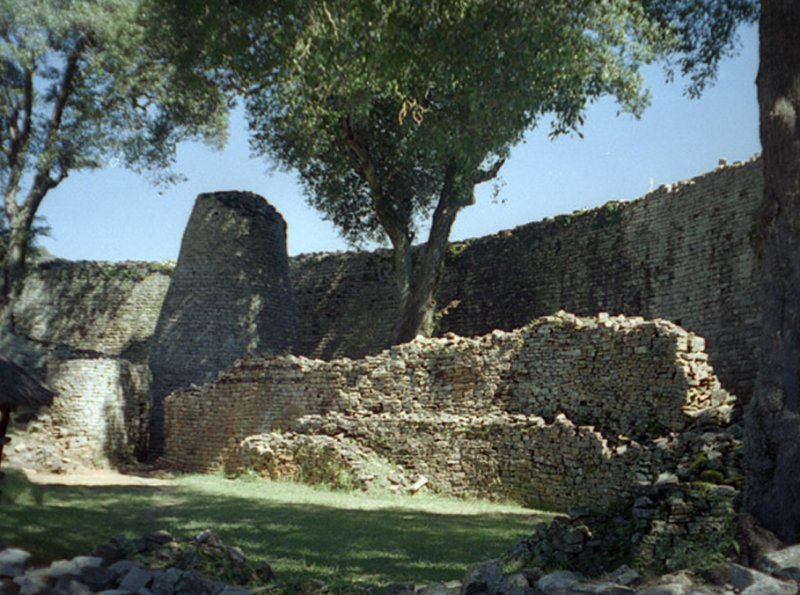
Inside of the Great Enclosure which is part of Great Zimbabwe ruins. Image credit: Jan Derk - Public domain
The lack of doors and windows and other openings made them useless for humans. The conical towers are thirty-three feet thick, and some elliptical walls are three stories tall.
"A square fortress, masonry within and without, built of stones of marvelous size, and there appears to be no mortar joining them," wrote Joao de Barros, of the first great Portuguese historians from the sixteenth century. He also mentioned the locals - illiterate people in the area - who referred to the ruins as Zimbabwe.
No one knew when and who built them, but these people were convinced that the structures were the devil's work. These strange buildings were constructed of rock, split into separate blocks, and put together without using mortar.
In 1868, the German traveler and explorer Adam Renders got lost in a deep South African jungle and accidentally came across the remarkable ruins near Lake Victoria.
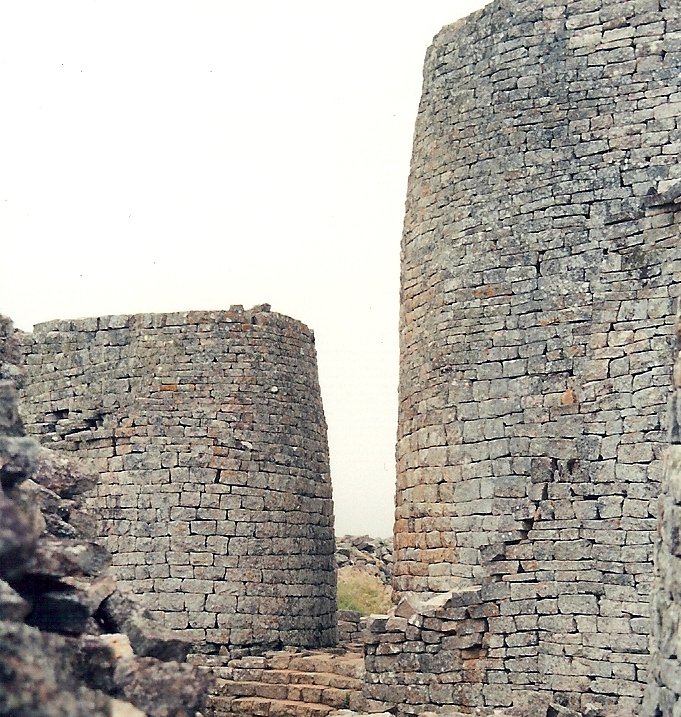
Towers of Great Zimbabwe showing unmortared, dressed masonry. Taken c.1996 on film. Image credit: JackyR - CC BY-SA 3.0
Trying to get out of there, he was moving along the walls for a while, having the impression of going in circles. At that time, he did not know that he had found the Great Ruins of Zimbabwe.
Three years later, Karl Mauch (1837 - 1875), a German explorer, adventurer, and one of the first white men to find gold in the region, decided to research ruins that could belong to a legendary land, Ophir, famous for its gold mines and governed by one of the vassals of the Queen of Sheba. Any convincing proof of his assumption has never been found.
Adam Renders, who came upon the site, had perhaps no theories on its origin. But he was thinking about these curious ruins often and anxiously. He stayed for the rest of his life there and died in Zimbabwe.
Who were the unknown builders of these structures? What was the original purpose of these enigmatic buildings?
Among many theories, one suggested that the builders came from North Africa. Jewels, pearls, bracelets from Arabia, artwork from India, and at least one thousand years old Chinese porcelain were found, but no inscriptions could shed some light on the great mystery of the ruins.
"No mortar was employed, but the stone was dressed and squared by the hammer. Amongst the ruins numbers of relics have been discovered, including statuettes of Astarte or Venus in hawk form; Phallic symbols of various dimensions; bowls, trinkets, etc..." German ethnologist and archaeologist, Leo Frobenius said about the greatness of ruins.

Curved passageways circling the Great Enclosure Great Zimbabwe. Image credit: - CC BY 2.0
Did a lost race construct Zimbabwe? Had the ruins an astronomical purpose? Did a prehistoric race like the builders of Stonehenge create the conical towers? These structures could not have been intended to serve humans without doors, windows, or other openings.
On the citadel, some soapstone birds (eagles) have been found, placed on heavy five-foot-high stone pedestals similar to the Egyptian statues of falcon-headed Horus piloting his flying vehicle. What did the soapstone eagles from Great Zimbabwe Ruins symbolize?
Skillfully put together, the walls and towers of the Great Zimbabwe are evidence of power, knowledge, and a well-organized settlement. They are impressive monuments to their creators.
The puzzling origin of Zimbabwe's bizarre buildings remains a mystery.
Written by – A. Sutherland AncientPages.com Staff Writer
Updated on January 24, 2023
Copyright © AncientPages.com All rights reserved. This material may not be published, broadcast, rewritten or redistributed in whole or part without the express written permission of AncientPages.com
More From Ancient Pages
-
 LIDAR Will ‘Map’ The Ground Surface To Reveal New Picture Of Ancient Native American Culture
-
 New West Papua Findings Provide Insights Into Early Human Migration To The Pacific
-
 Surprising Discovery – Replica In The Field Museum Is A 3,000-Year-Old Sword
-
 ‘Saimaluu-Tash’ Time Capsule: Largest Millennia-Old Collection Of Petroglyphs In Central Asia
-
 Phoenicians: Powerful Traders And Their Remarkable Seafaring Achievements
-
 Ignored Archaeological Discovery At Puma Punku That Could Re-Write Ancient History
-
 Mystery Of The Ancient Forgotten Mizoram Civilization And Lost City Of Vangchhia
-
 Ancient History Of The Christmas Tree And Its Pagan Roots – How The ‘Forbidden’ Tree Survived Against All Odds
-
 Never-Before-Seen Roman-Era Wall Paintings Discovered In Ashkelon Revealed To The Public For The First Time
-
 Precious Ancient Chinese Immortality Suits Made Of Jade
-
 How Climate Change Contruibuted To The Transition From Nomadic Hunter-Gatherers To Settlement And Farming Societies
-
 World’s Oldest Hand Stencils Were Made By Neanderthals In The Maltravieso Cave 66,000 Years Ago
-
 Did Ancient Romans And Greeks Love As We Do? Perhaps Even More Hopelessly
-
 7,000-Year-Old Kilns From Ceramics Workshop Unearthed In Northeast Bulgaria
-
 3D Scans Used To Study Mysterious Roman Burial Practice
-
 Prehistoric Hi-Tech Nanospirals Barely Visible To The Naked Eye: Still Remain An Unsolved Mystery
-
 1,200-Year-Old Wari Temple Discovered In Peru
-
 Before The Pharaohs: The Evidence For Advanced Civilization In Egypt’s Mysterious Prehistory
-
 Intriguing Fragment Of A Byzantine-Era Jar Handle, Dating Back Approximately 1500 Years – Unearthed
-
 Bolivia And The Mystery Of The Twins Of Atlantis


