
Chinese Invention: World’s First Known Movable Type Printing
A. Sutherland - AncientPages.com - German printer Johannes Gutenberg did not invent movable type printing; he contributed movable type mechanical printing technology in Europe in 1450.
More than four centuries earlier, the Chinese inventor Bi Sheng (990-1051 AD) created the world's first known movable type system for printing.

Left: Bi Sheng (about 970 - 1051) is a native of Yingshan, Hubei. He is the inventor of Movable-Type Printing. Image source
Without the importation of paper and printing from China, Europe would have continued to copy books by hand for much longer, in a painstaking and slow process that could take more than a year for each book
His printing system was invented between 1041 and 1048 during the Song dynasty.
Block printing was an expensive and time-consuming process, for each carved block could only be used for a specific page of a particular book; additionally, a single carving mistake could ruin the whole block.
The new innovative printing system created by Chinese porcelain made books faster to print.
Bi Sheng carved individual characters on identical pieces of fine clay. Each movable type had only one Chinese character carved in relief on a small block of moistened clay.
After the block had been hardened by fire, the type became durable and could be used anytime and anywhere. The movable type pieces could be glued to an iron plate and easily detached from the plate.
Contrary to many claims, Bi Sheng's clay types were not fragile but 'hard and tough as horn' as described by Bao Shicheng (1775-1885).
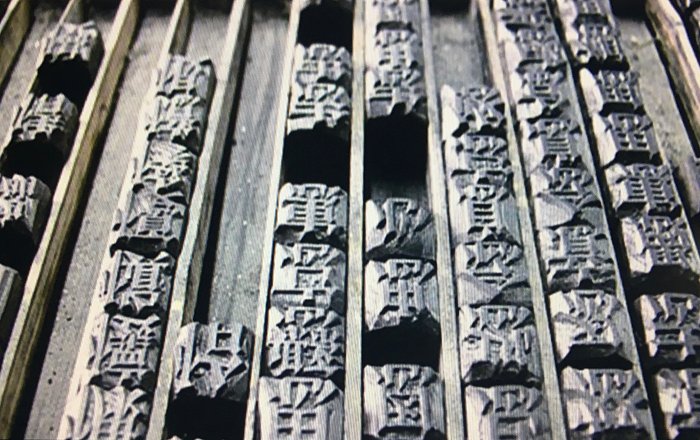
Bi Sheng's (about 970 - 1051) invention paved the road for cultural and economic development of China, and also contributed to the improvement of world civilization. Image credit: General Office of Hubei Provincial People's Government
Characters could be assembled to print a page and then broken up and redistributed as needed. When the printing was finished, the pieces could be put away for future use.
Bi Sheng's invention was recorded by Shen Kuo (1031-1095), the Chinese polymath, scientist, and statesman, in his book The Dream Pool Essays in 1088 AD.
'[Bi Sheng] took sticky clay and cut in it characters as thin as the edge of a coin. Each character formed, as it were, a single type. He baked them in the fire to make them hard. He had previously prepared an iron plate and he had covered his plate with a mixture of pine resin, wax, and paper ashes. When he wished to print, he took an iron frame and set it on the iron plate. In this, he placed the types put close together.
 Bi Sheng's invention was recorded by Shen Kuo (1031-1095), the Chinese polymath, scientist, and statesman, in his book The Dream Pool Essays' in 1088 AD. Image credit: General Office of Hubei Provincial People's Government
When the frame was complete, the whole made one solid block of type. He then placed it near the fire to warm it. When the paste [at the back] was slightly melted, he took a smooth board and pressed it over the surface so that the block of type became as even as a whetstone.
If one were to print only two or three copies, this method would be neither simple nor easy. But for printing hundreds or thousands of copies, it was marvelously quick.
As a rule, he kept two forms going. While the impression was being made from the one form, the type was being put in place on the other. When the printing of one form was finished, the other was then ready. In this way, the two forms alternated and the printing was done with great rapidity...'(Needham, Joseph (1986). Science and Civilization in China: Volume 5)
It did not take Bi Sheng long to make 30,000 characters in everyday use.
Movable type printing developed very fast and spread to Korea, Japan, Vietnam, and finally to Europe, while based on the clay type, the type made of wood, lead, tin, and copper gradually appeared.
Written by – A. Sutherland AncientPages.com Staff Writer
Updated on January 13, 2024
Copyright © AncientPages.com All rights reserved. This material may not be published, broadcast, rewritten or redistributed in whole or part without the express written permission of AncientPages.com
More From Ancient Pages
-
 Vikings’ Self-Image Was Influenced By Ancient Rome – Intriguing Grave And Artifacts Reveal
-
 Ancient Secrets Of The Theopetra Cave: World’s Oldest Man-Made Structure And Home To Humans 130,000 Years Ago
-
 Mysterious Ancient Site Of Çatalhöyük: Remains Of Early Structures May Shed More Light On Its Obscure Past
-
 Ancient DNA Reveals Hunter-Gatherers From Mexico Moved To California 5,200 Years Ago
-
 Historical Artifacts Found In The Mammoth Cave’s Mysterious Passageway
-
 Young Boy Finds Baffling Artifacts In New Mexico Predating The Anasazi, The ‘Ancient Ones’
-
 How Is DNA Preserved In Archaeological Sediments For Thousands Of Years
-
 Your Destiny Is Engraved And Stored – Guardians Of The Great Mystery – Part 2
-
 Excavations At Okazaki Castle Reveal A 400-Year-Old Massive Unbroken Wall
-
 Prehistoric Evidence Of Sophisticated Prosthetics In Ancient Egypt – Artificial Toes Helped Egyptians Walk
-
 2,000-Year-Old Roman Sandal With Nails Found In Germany
-
 Völuspá – Norse Prophecy Of The Völva, A Feared Shaman By The Vikings
-
 Mystery Of The 1,700-Year-Old ‘Salt’ Mummy With Long White Hair
-
 Urartian Noble Woman Buried With Jewelry Found In 2,750-Year-Old Necropolis Of Çavuştepe Castle
-
 Byzantine Sandals With A Nice Message Found In The Harbor Of Eleutherios (Theodosius) – Now On Display
-
 Mysterious Medes: Was It An Ancient City Of Ecbatana?
-
 Crypto-Hieroglyphs Deciphered – Previously Unknown Message Discovered On The Luxor Obelisk In Paris
-
 Amazing Time Capsule – La Roche-Cotard Cave Sealed For 50,000-Years Offers Evidence Neanderthals Were The World’s First Artists
-
 Climate Change May Have Impacted The Rise And Fall Of Middle Eastern Civilizations
-
 On This Day In History: Powerful And Controversial Roman Emperor Frederick II Excommunicated – On Sep 29, 1227

