
Zhang Heng Seismograph Could Record Earth’s Dangerous Movements
A. Sutherland - AncientPages.com - Zhang Heng (A.D. 78 - 139) was one of the world's first scientists to propose that the universe is infinite in space and time.
He was also convinced that the number of dimensions we cannot see with the naked eye is unlimited.
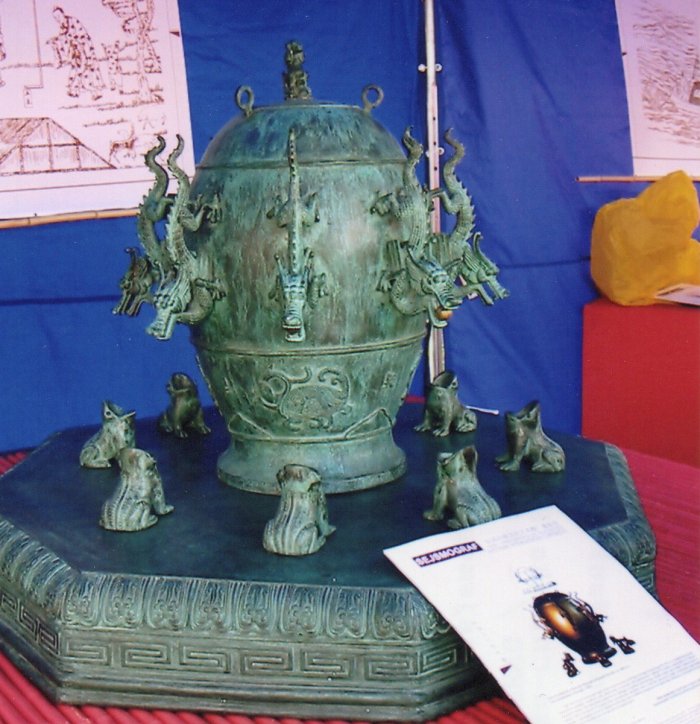
A full-size replica of the first seismograph invented by Zhang Heng during the reign of the Eastern Han Dynasty (ab. CE 130), displayed at the open-air exposition held in Warsaw, Poland (June 2008). Credit: Cyborian - Creative Commons Attribution-Share Alike 4.0
He's considered Leonardo da Vinci of the far East. He made significant contributions to the development of astronomy in ancient China along with 32 works on science, literature, and philosophy, of which Ling Xian, a summary of astronomical theories at the time, and the Map of Ling Xian, are astronomical works.
Among the many impressive inventions of the Chinese scholar Zhang Heng, there is an instrument for testing wind and earth movements.
In 1703, Jean de Hautefeuille, a French physicist, created the first seismograph of modern times. This device allowed scientists to measure earthquakes accurately. However, like in so many other cases, we must remember that what de Hautefeuille really invented was only a rediscovery of a device that the ancients were already familiar with many centuries earlier.
The instrument was invented in 132 A.D. and given the Chinese name Houfeng Didong Yi - or Didong Yi.
The instrument could determine the direction of an earthquake, contrary to popular belief at that time.
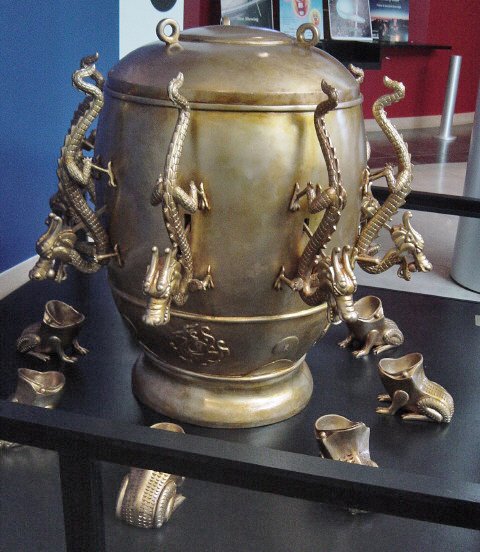
A replica of an ancient Chinese Seismograph from the Eastern Han Dynasty (25-220 CE). Credit: Kowloonese - Creative Commons Attribution-Share Alike 3.0
Zhang Heng maintained that earthquakes were not signs of Heaven's anger but natural disasters.
Over the years, there has been scholarly disagreement about the exact scientific principles applied to the seismograph and how precisely the instrument initially worked.
Some Western scholars even suggested that the instrument never existed.
In 2005, a team of Chinese archeologists, seismologists, and experts in mechanical engineering from the Chinese Academy of Sciences, the National Museum, and the China Earthquake Administration - announced that they created a new replica of the Didong Yi instrument - the world's first seismograph.
As the scientists said, the replica is a "historic step" toward complete reconstruction.
"What we are exhibiting is a scientific device, not a toy," said Tian Kai, deputy curator of Henan Museum. "If we put a seismograph that is unable to move or detect on exhibition," Tian said, "we will not only deceive our audience but also show our apathy and irresponsibility towards our nation's splendid cultural legacy."
"As a treasure of our Chinese nation, Didong Yi is an attractive goal for reconstruction to scientists around the globe," Teng said. "If we can't finish the job, it will be our fault."
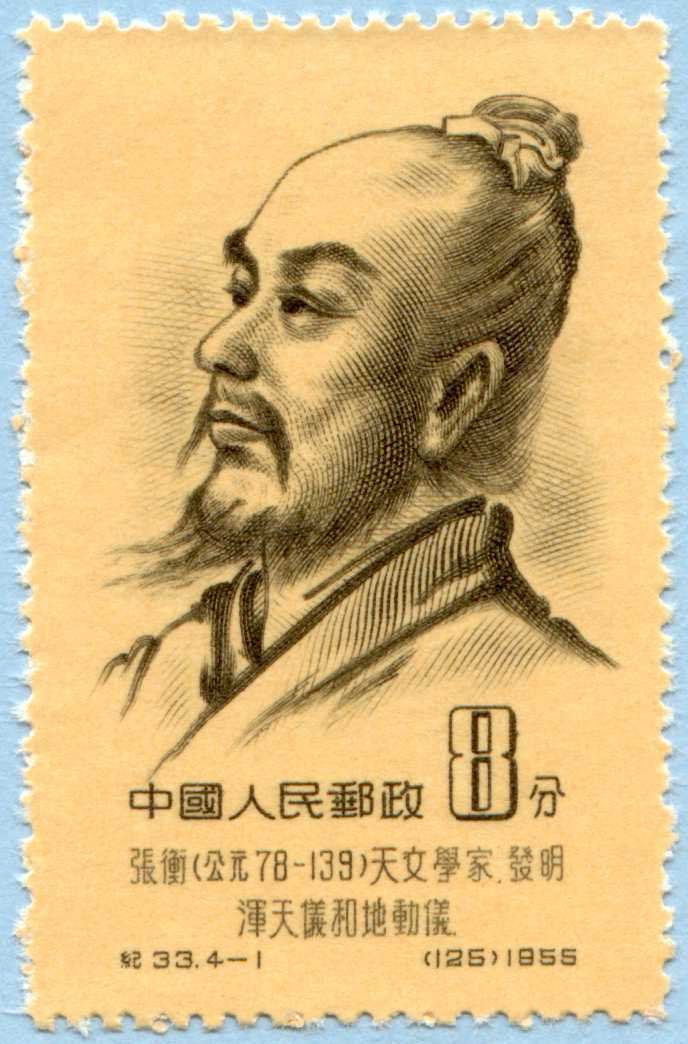
Postage stamp of The Han Dynasty Chinese scientist and statesman Zhang Heng (78-139 AD). Credit: Public Domain
According to the Book of the Later Han (also known as History of the Later Han), an official Chinese historical text covering the history of the Han Dynasty from 6 to 189, this ancient device was destroyed and no longer exists.
From historical sources, we learn that in 138 A.D., the seismograph accurately records the time and direction of the earthquake that occurred in the Longxi Shire, about 600 kilometers from Luoyang, China's capital at the time.
Was the seismograph also destroyed during this earthquake?
The device, an urn-like instrument with a central pendulum, was made of refined copper in the form of a vase decorated with eight dragons holding balls in their mouth.
The heads of the dragons pointed out the eight directions east, west, north, south, northeast, southeast, northwest, and southwest.
Below the dragons were eight porcelain frogs placed around the vessel. All of them were raising their heads and opening their mouths opposite the dragons' mouths.
The inner side of the seismograph was ingeniously constructed: when an earthquake occurred, an earth tremor would cause the pendulum to lose balance and activate a set of levers inside. Then, one of the eight dragons outside the urn would release the bronze ball held in its mouth. The ball would fall into the mouth of the toad and give off a sound, letting people know when and in which direction an earthquake had occurred.
Based on the description in Zhang Heng's biography, a few attempts have been made to reconstruct this prehistoric Chinese apparatus. Unfortunately, none of the replicas could detect an earthquake.
Will the instrument be able to measure earthquakes one day accurately?
Yet, as far as we know, the seismograph's construction was rather basic. More historical data and simulated analysis will probably be needed to reconstruct this prehistoric piece of technology.
Written by – A. Sutherland AncientPages.com Staff Writer
Updated on March 6, 2023
Copyright © AncientPages.com All rights reserved. This material may not be published, broadcast, rewritten or redistributed in whole or part without the express written permission of AncientPages.com
Expand for referencesReferences:
Robert Temple, The Genius of China
Wang Zhong Qiang, Armillary sphere and seismograph
More From Ancient Pages
-
 Scythian Gold-Plated Sword ‘Akinakes’ Unearthed In Southern Ukraine
-
 Nakanishi Ruins: One Of Japan’s Largest Ruins Discovered In Nara
-
 Mystery Of The Controversial Jordan Lead Codices Solved? Perhaps Not
-
 Mysterious Underwater Ruins In Canada And America – Evidence Of An Unknown Ancient Civilization?
-
 Ruins Of Ancient City Emerged From The Sand In Kerman Province, Iran
-
 Last Supper Of 15-Million-Year-Old Freshwater Fish
-
 World’s Oldest Paycheck Reveals Ancient Sumerian Workers Were Paid In Beer
-
 Great Viking Fortresses Built By King Harald Bluetooth
-
 4,000-Year-Old Lunar Calendar Developed At Kokino Megalithic Observatory – Evidence Of Remarkable Astronomical Knowledge
-
 Is ‘Someone’ Regularly Altering The Course Of History? – Is So How, Why And Who? Part 1
-
 Evidence Of 3,600-Year-Old Settlement Unexpectedly Uncovered On Arabian Peninsula
-
 Ancient Byblos: Powerful Phoenician City With Own Kings
-
 Magnificent Alsengem Among 30,000 Archaeological Objects Discovered In Kalmar, Sweden
-
 Yali – Divine Protector And Guardian Of Temples Warding Off Evil Forces In Hindu Mythology
-
 DNA Of Nine 13th Century Crusaders Provides A Glimpse Into Soldiers’ Life And Death
-
 Cave 53 In Qumran Region In Judean Desert Reveals More Secrets
-
 Has The Mystery Of The Lost Trading Ship Zuytdorp Been Solved?
-
 Controversial Davenport And Pontotoc Stele Reveal Ancient Egyptians And Black Africans Visited North America
-
 Secret Kumari Kandam Continent And Links To Lemurians
-
 Strange Mist, Unexplained Vanishings And Other Bizarre Incidents – What Is The Connection?

