
AncientPages.com - The ancient Romans venerated wine.
It was accessible to the masses, a fundamental staple of mainstream life and an indispensable part of the Roman economy and trade. It was utilised in a range of practices: a remedy in medical treatments, a common ingredient in cooking, and customarily used in religious ceremonies as libation to the gods.
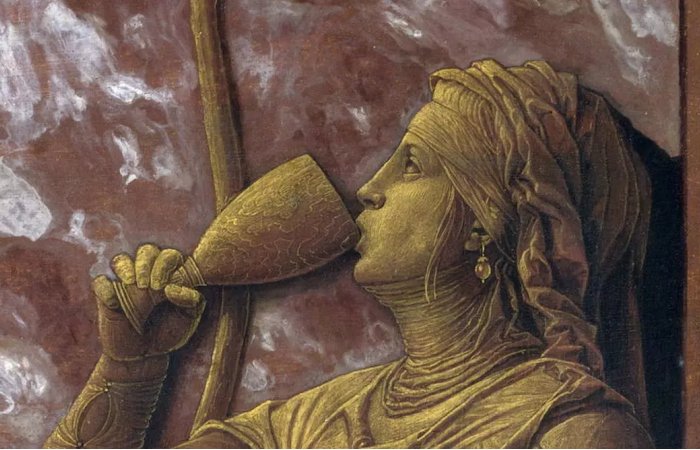
A Woman Drinking, Andrea Mantegna. about 1495-1506. The National Gallery, London.
Despite its centrality to the everyday life of the Romans, the ancient sources continuously attest it was a problematic drink when consumed by women.
Ancient Rome was a patriarchal society in which women were perceived as the objects of men.
Roman law and tradition sustained an immense fixation with regulating the bodily autonomy of women. Ancient male writers appraised and contextualised the boundaries of feminine morality in direct relation to notions of male auctoritas (social standing and authority) and dignitas (reputation and worth).
One of the ways in which this control over women was codified was through their drinking practices.
Punishment for drinking
In the customary laws of early Rome, the discipline of female sobriety was instilled through punishment.
During the earliest periods of Rome’s history and up until the Middle Republican period, it was a socially sanctioned custom for husbands to punish their wives for drinking. Many Ancient Roman sources speak of female drinking and adultery concurrently.
In 2 BCE, Julia, daughter of Emperor Augustus, was exiled from Rome by her father on the grounds of her adulterous behaviour. One of the noted prohibitions placed by Augustus upon Julia was the denial of wine.
In this act of banning wine in direct response to her adultery, Augustus was underlining an ideological and historical precedent that was fundamentally Roman.
It was a common belief women’s drunken desire led to debauchery. In some cases, to death.
In one of the most well known Roman exemplum, or moral anecdotes, various sources attest Egnatius Mecenius (a contemporary of Romulus) bludgeoned his wife to death for drinking wine.
The list of such stories goes on: a wife starved to death for pilfering the keys to her family’s wine cellar, another fined the amount of her dowry for having been found to have drunk wine in excess.
An enforced sobriety was equated with virtuous feminine propriety.
Some sources maintain it was a common practice for women to be kissed by their male kinsfolk for the purpose of detecting traces of wine upon their breath, a discernible odour validating the subsequent punishment.
Acceptable drinking
According to some Ancient Roman historians, wine was banned from women altogether. But recent scholarship demonstrates ancient Roman women did in fact consume wine.
Archaeological evidence attests to their drinking practices as far back as the ancient written sources state otherwise.
In recent years, excavations throughout Italy have uncovered numerous female burial sites containing amphorae (jars) of imported wines and drinking paraphernalia, dating back to the Archaic period.
It is now believed women did drink wine, but only specific varietals and alcoholic strengths.
Certain types of wine, such as passum, a type of sweet raisin wine, were perhaps acceptable in the strict confines of gendered drinking parameters.
Women were actively known to drink at the festival of Bona Dea (the “Good Goddess”), a religious female-only cult in which wine was ceremoniously offered to the goddess and consumed by women in this ritual celebration.
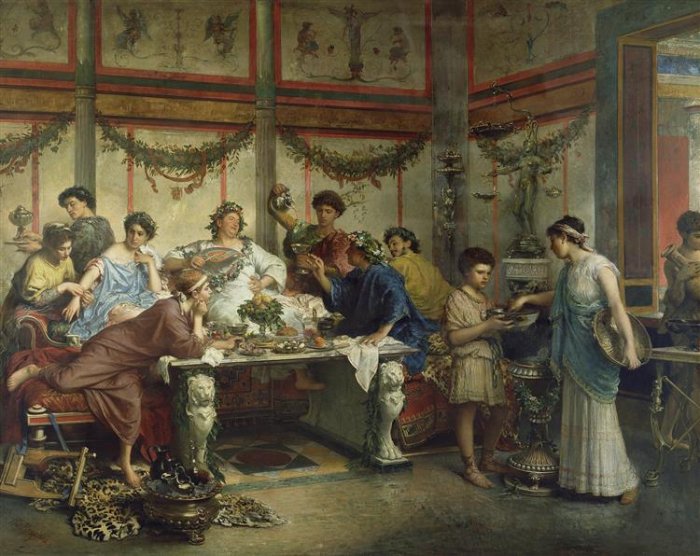
A Roman feast by Roberto Bompiani 1875. Credit: Public Domain
Yet even here drinking wine was shrouded in innuendo, invariably described as “milk” and carried in a “honey-pot”.
The titular goddess could not escape the brutal consequences of her own mythologised inebriation: according to the myth, Bona Dea was beaten to death by the god Faunus for her conspicuous consumption of wine.
A socially acceptable drink
Our knowledge about women’s drinking practices during the early periods of Roman history comes from both Greek and Latin sources composed centuries later. The male authors of these texts heavily mythologised the past, often to convey the inferred wickedness of their present day.
In constructing a past practice of female sobriety where drinking resulted in dire consequences, the ancient writers underlined a direct correlation between the act of drinking and the social conduct expected of women.
By the time of the transition from Republic to Empire (around the first century B.C.E), it was customary for women to drink wine. With the popularisation of Roman convivium (a type of banquet or dinner party) and increasing cultural appreciation of viticulture, female participation in these practices signalled a social acceptance of their drinking.
Livia, wife of Emperor Augustus, is said to have credited her longevity to a wine varietal from Istria. For the women of ancient Rome, drinking wine was not something of considered indifference.
Written by Lily Moore, PhD Candidate in Classics and Archaeology, The University of Melbourne
Provided by The Conversation
This article is republished from The Conversation under a Creative Commons license. Read the original article.