
Artifacts Discovered At Yirra Confirm Aboriginal People Lived In Pilbara During The Last Ice Age
Conny Waters - AncientPages.com - Archaeological excavation on a sacred site in the Pilbara has found proof Aboriginal people lived in the region during the last Ice Age.
Scientists have analyzed stone tools, charcoal, and bone collected from the Yirra rock shelter at Rio Tinto's Eastern Channar mine. The study results confirm the Yinhawangka people's ties to the land.
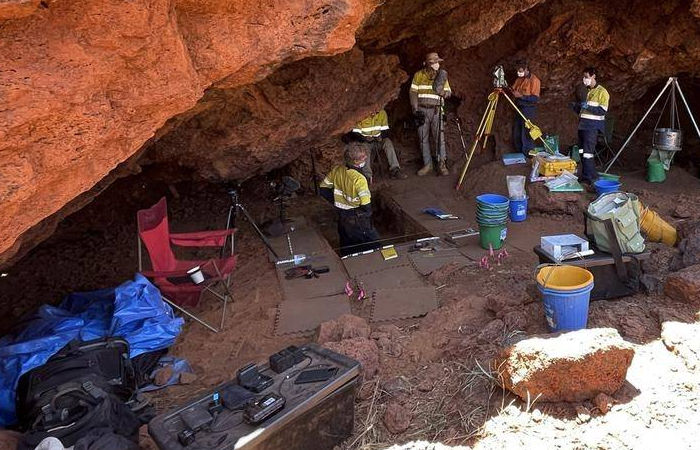
Artifacts collected at a Pilbara rock shelter show Aboriginal presence for over 50,000 years. Credit: Archae-aus
It is evident Aboriginal people lived in the eastern Pilbara region for more than 50,000 years, including throughout the height of the last Ice Age.
"The Yinhawangka Aboriginal Corporation commissioned the excavation project of the Yirra rock shelter at Rio Tinto's Eastern Channar mine about 17km southeast of Paraburdoo.
The project was led by YAC in collaboration with Archae-aus heritage consultants, and researchers from the University of Western Australia and had funding from Rio Tinto.
YAC chairperson Halloway Smirke said Yirra has great significance not only to the Yinhawangka people, but also to the Wangarada and Ngarngarada.
"We hope that Yirra will help us tell our ancestral story to Australia and our future generations," he said.
"We would still be visiting this site if it wasn't for the mining leases.
"All Pilbara groups should have this kind of science work done on cultural sites. Important sites like Yirra need to be protected, especially when they turn out to be amongst the oldest known places of human habitation in Australia."
Initial dating results indicate it is one of the oldest sites found in Australia, with Yirra providing proof of Aboriginal occupation in the region for more than 50,000 years and throughout the height of the last Ice Age," the Pilbara News reports.
According to Professor Peter Veth from the University of Western Australia, the early age range of this site is extremely important to the traditional owners of Yirra.
"Radiocarbon dating had shown the age of the site reached 23,000 years with hearths laid down during the Last Glacial Maximum," he said.
"By expanding the excavation and using new dating methods, such as optically stimulated luminescence dating, the age of the Yirra site has been extended to the radiocarbon 'barrier' — and beyond 50,000 years."
TO learn more about this historical site and those who lived there during the last Ice Age, scientists are now organizing an ongoing analysis of the Yirra site. This project requires collaboration between researchers and landowners.
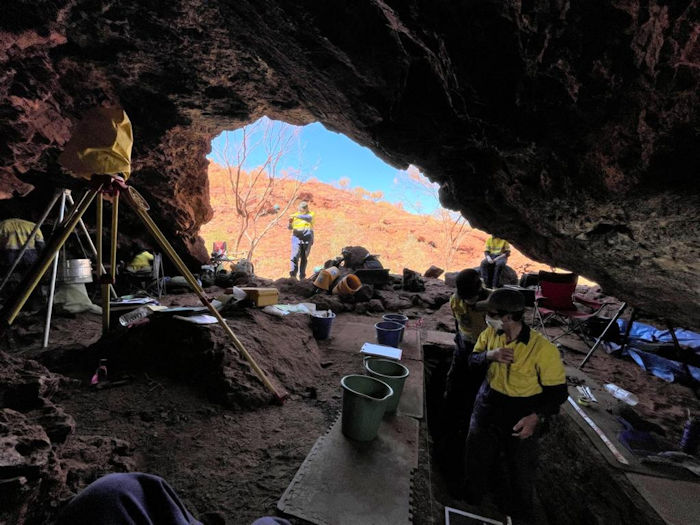
Excavation activity at Yirra. Credit: Archae-aus
According to the Pilbara news, the site was originally excavated by Archae-aus excavation project manager and director Fiona Hook with her husband Dr. Bruce Veitch and traditional owners more than 20 years ago."
They had long known the Yirra site was special and contained intact hearths from the last Ice Age. "There was no charcoal left to date after 23,000 years ago," Hook told the Pilbara News.
"We knew the old people were there before that as we found artifacts below the oldest date. We've now proven that beyond doubt."
See also: More Archaeology News
Rio Tinto iron ore chief executive Simon Trott said the findings were a major archaeological breakthrough of international significance, expanding knowledge of Aboriginal occupation in the Pilbara.
"We acknowledge the significance of Yirra and are committed to working in partnership with the Yinhawangka people to ensure it's preserved for future generations," he said.
Written by Conny Waters - AncientPages.com Staff Writer
More From Ancient Pages
-
 Unique Medieval Spindle Whorl With Cyrillic Inscription Discovered In Poland
-
 Ten Ancient Jugs May Reveal The Location Of The Biblical Tabernacle
-
 On This Day In History: The Battle Of Fulford Was Fought – On Sep 20, 1066 AD
-
 Did Neanderthals And Modern Humans Meet In The Czech Republic 50,000 Years Ago?
-
 Unknown Ancient Structures Discovered At Machu Picchu By LIDAR
-
 Abu Erteila’s Lost Temple And The Meroitic Empire: New Discoveries Shed Light On Nubian Civilization
-
 Long-Lost Ancient Tomb Of ‘China’s Shakespeare’ Finally Found
-
 Justinianic Plague: Modeling Study Challenges Death Rate And Severity Of Infectious Disease
-
 3,000-Year-Old Shoe Found On A Beach In Kent, UK
-
 Dinosaur With Spikes Exhibiting Unprecedented Properties Discovered In China
-
 Scientists Attempt To Solve An Ancient Greek Volcano Mystery
-
 Ancient Egyptians Were Familiar With Advanced Ink Technology 2,000 Years Ago – Copper Papyri Reveals
-
 9,600-Year-Old Permament Settlement And Daily Tools Discovered In Turkey
-
 Mystery Of Ancient Gaza Wine – New Insight
-
 Spectacular Finds Discovered At The Bottom Of The North Sea Are 13,000-Year-Old
-
 On This Day In History: Powerful Warlord And Emissary Of Spear-Thrower-Owl Arrived At Tikal – On Jan 8, 378 AD
-
 Fossils Of Mysterious Homo Naledi Change Our Understanding Of Evolution
-
 Message In A Bottle Thrown Overboard In Germany 132 Years Ago Was Found In Australia
-
 Humans Got To America 7,000 Years Earlier Than Thought – New Research Confirms
-
 7,000-Year-Old Tepe Ozbaki Mounds Yielded Valuable Relics – But Now The Site Is In Trouble

