
Mahabalipuram: Ancient Ruined City And Its Marvellous Rock-Cut Architecture In South India
Angela Sutherland - AncientPages.com - Mahabalipuram is a ruined city located on the coast just 60 km south of Chennai. Even looking at the city’s ruins, it is obvious the place represents one of the most famous examples of ancient Indian art and architecture.
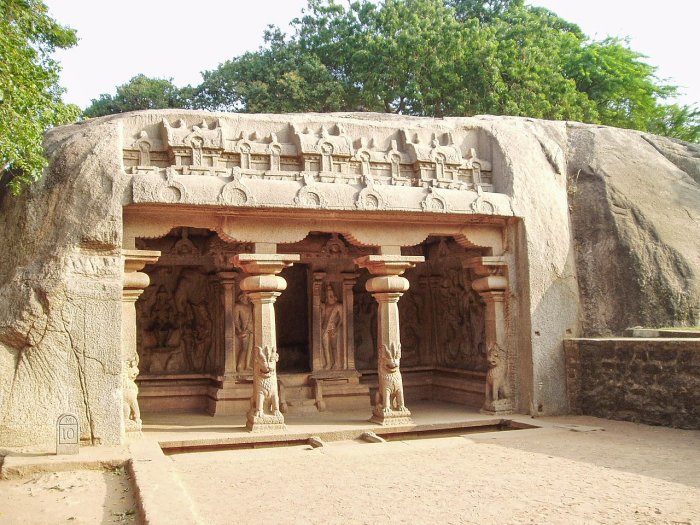 Varaha cave temple entrance. Image credit: Vsundar - CC BY-SA 3.0
This Pallava old site has some of the earliest examples of architecture in South India, rock-cut cave temples, stone carvings, and the shore temple on the beach.
During the 7th to 10th centuries, it was a flourishing seaport (one of two) of the Pallava Dynasty of rulers, situated in the southeastern Indian state of Tamil Nadu.
In Mahabalipuram (also known as Mamallapuram), especially the Hindu Group of Monuments are famous landmarks because they represent the impressive architectural legacy of the Pallava rulers, and they are artistic and technical wonders. The city was prosperous economically and had a complex of royal monuments, of which several were carved out of living rock.
Mahabalipuram represents not only Dravidian architectural style. The Chola architecture highly influences this style and techniques used by other dynasties that followed.
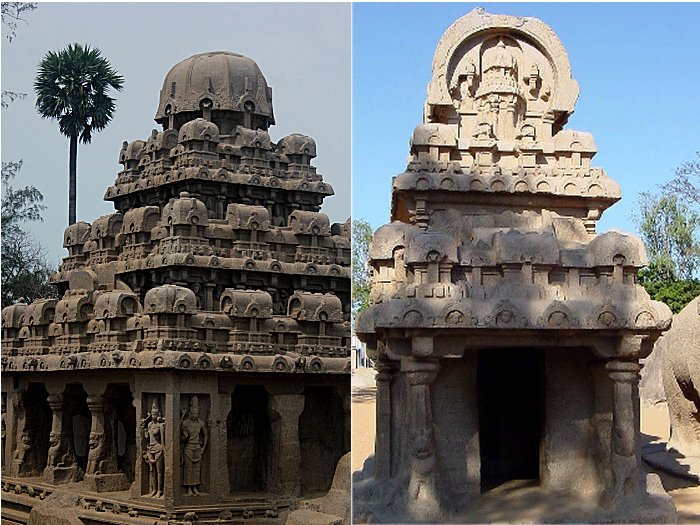 Left: Arjuna Ratha, Image credit: Xcibaangel- CC BY-SA 3.0; Right: Nakula Sahadeva Ratha. Image credit: G41rn8 - CC BY-SA 4.0
The city’s stone structures include mandapas (cave sanctuaries), which were typically built as a square vestibule, hall with pillars, or pavilion. Cells or sanctums would often be included, creating facilities for dwellings (vihara). The mandapas were used for people to gather socially, usually for ceremonies and rite-of-passage rituals.
There are many mandapas at Mahabalipuram, all dated to the 7th and 8th centuries. Other monuments are: the Rathas (‘chariots to the gods’) - striking rock-cut temples carved out of a single boulder, in the form of chariots, and dated to 600AD and 800 AD.
These rock-cut temples, named after the five Pandava brothers (Arjuna, Yudhistira, Bhima, Nakula, and Sahadeva) demigod warrior princes, and the heroes of the ancient Sanscrit epic poem Mahabharata are the outstanding examples of Pallava art.

Left: Dharmaraja‘s Ratha. Credit: Samrajclicks - CC BY-SA 4.0 - Right: Draupathi Ratha. Credit: Samrajclicks - CC BY-SA 4.0
Rathas – the full-sized models - recall the earlier architecture of the Buddhist chapels and monasteries. The architecture resembles Dravidian temples with their grand towers, sculptured walls, and halls decorated with Dravidian-style pillars.
Mahendravarman I (600-630 AD) was a great supporter of the arts. He had a passion for religion, so he introduced rock-cut architecture to the Pallava Dynasty.
He wanted both temples and artwork that decorated them to survive both weather and the passing of time. Therefore, he used a rock as a building material to better preserve the temples.
When he died, the temples were still not completed in the city of Mahabalipuram. His son was not so interested in art as his father, and he preferred to develop his military skills instead. The five temples have never been built, like his father, Mahendravarman, intended to do.
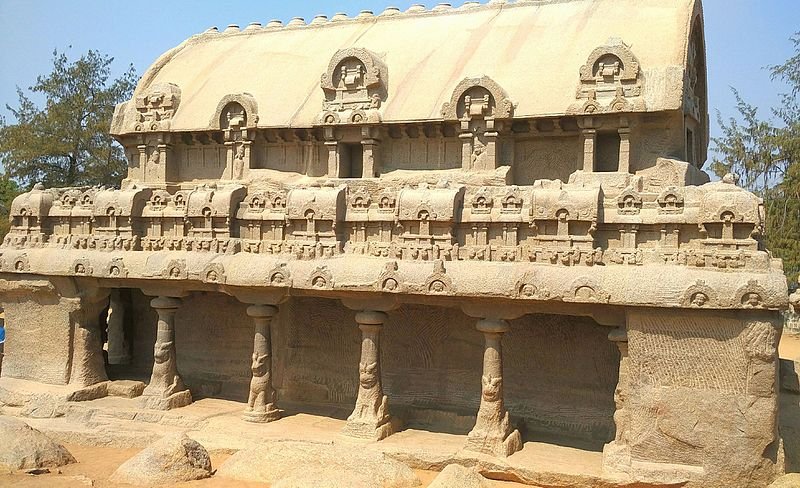
Bhima Ratha. Credit: Zuhebkhan94 - CC BY-SA 4.0
They stand unfinished until today and are called the Five Rathas of Mahabalipuram.
Another stone structure, the Shore Temple dedicated to the god Shiva is also one of Mahabalipuram’s most noted landmarks. Today, the facility is eroded and somewhat ruined, but it still holds many artistic details intact.
However, interestingly, this temple clearly shows a change in temple construction. The nearby five rathas are rock-hewn monoliths; the Shore Temple, on the other hand, is stone-built. It is considered one of the earliest stone-built temples in India.
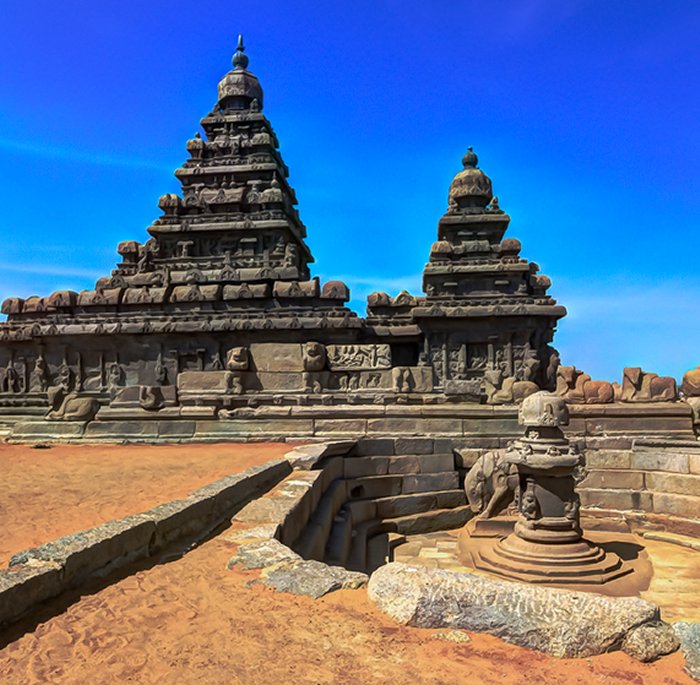 Shore temple, Mahabalipuram, India. Image credit: Balasubramanian S - CC BY-SA 3.0
It has a 16 sided lingam and a relief of Somaskanda, a form of Shiva dated to the early Pallava period (275 AD to 897 AD) that became widely popular.
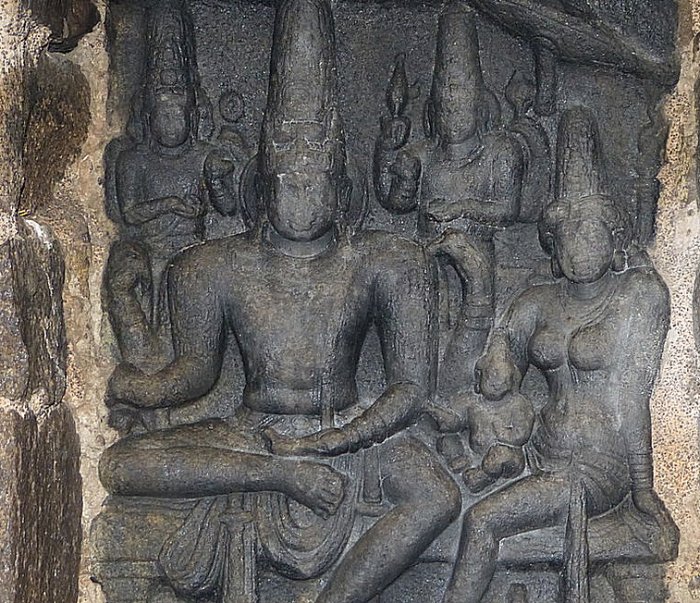 Somaskanda Panel with Shiva, Uma, and their son Skanda. Image credit: SatishKumar- CC BY-SA 3.0
Yet another architectural attraction of Mahabalipuram is a spectacular and massive open-air bas-relief sculpted out of pink granite. The boulder is carved with 153 different deities, humans, and various animals carved on it.
This relief is like the Mahabharata epic poem with beautiful mythical scenes, battles, and figures of animals, beings, gods, and goddesses. It also depicts the story of Arjuna doing penance to attain a weapon from Lord Shiva to fight his enemies. It also shows the story of the Ganges descent from the Himalayas.
 Arjuna's Penance relief. Image credit: Sainath adapa _ CC BY-SA 3.0
The open-air bas-relief was carved on the face of two gigantic, connecting boulders, approximately 96 feet long (29 meters) and 43 feet (13 meters) high. The brilliant artwork dates back to the mid-seventh century.
The concept of the story includes an essential piece of Hindu philosophy. It says that a person could, by penance, the infliction of pain, or other discomforts on oneself, reach miraculous blessings from the Gods.
The ‘Descent of Ganges’ story, on the other hand, describes the penance of the Sage Bhagirathi, who performed austerities to bring Goddess Ganges down to earth.
Written by – A. Sutherland - AncientPages.com Senior Staff Writer
Copyright © AncientPages.com All rights reserved. This material may not be published, broadcast, rewritten or redistributed in whole or part without the express written permission of AncientPages.com
More From Ancient Pages
-
 On This Day In History: The King James Bible Is Published For The First Time In London – On May 2, 1611
-
 Ramanathaswamy Temple Has Spectacular Corridors With Over 4000 Pillars
-
 Did Neanderthals And Modern Humans Meet In The Czech Republic 50,000 Years Ago?
-
 What Can Monument 9 Reveal About The Mysterious Olmec Civilization?
-
 Great Living Chola Temples: Outstanding Workmanship Of Chola Dynasty Builders Of South India
-
 Human Migration Out Of Africa To Middle East Through Corridors Provided By Monsoons
-
 On This Day In History: Discovery Of X-Rays By Wilhelm Roentgen Reported – On Jan 5, 1896
-
 Mystery Of Mexico’s Bizarre Mummy May Never Be Solved
-
 Early Harappan Burial Site With 26 Graves Unearthed In Kutch, Western India
-
 The Battle Of Anghiari – Lost Painting Of Leonardo Da Vinci – One Of Art History’s Greatest Mysteries
-
 12th Century Idol Of Vishnumurthy Unearthed In Abandoned Well Near Udupi, India
-
 Sunduki – ‘Home Of The Gods’ – One Of The World’s Oldest Astronomical Observatories
-
 Sailor’s Strange Discovery Of An Unknown Ancient Underground World At The North Pole
-
 Why Did Pirates And Sailors Wear Earrings?
-
 Treasure Of 1,753 Roman Silver Coins Accidentally Discovered In Poland
-
 Ancient Roman Street And Buildings Discovered Beneath Exeter Cathedral
-
 15 Precious Ancient Objects Returned To Greece From Switzerland – Antique Dealer Charged With Trafficking
-
 Seti I – Remarkable Pharaoh Who Saved The Kingdom Of Egypt And Gave It New Glory
-
 Ruins Of Sodom, Lost Ancient Biblical City Destroyed By God – Uncovered
-
 Chromium Steel Was First Produced In Ancient Persia

