Conny Waters - AncientPages.com - Researchers have completed the excavation of a huge 2,500-year-old water cistern, located in Lumbarda on the southern Croatian island of Korčula.
Throughout its history, Lumbarda was a region combining various nations and cultures, and current research revealed that the first inhabitants were the Illyrians, ruling the island during the Bronze and Iron Age.
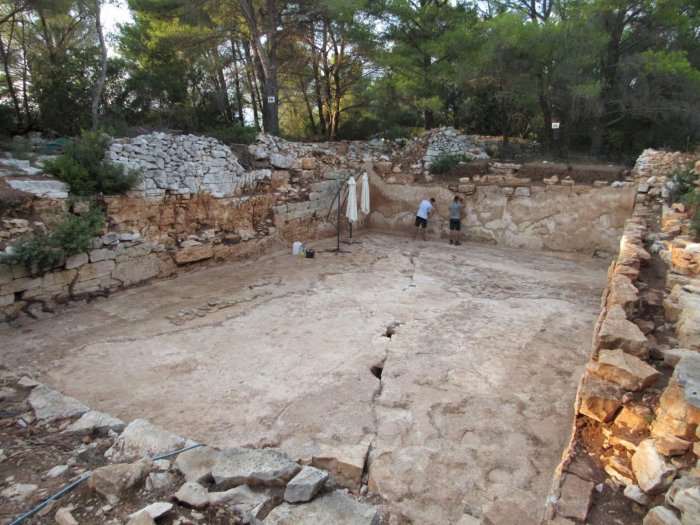 Ancient water cistern in Lumbarda on Korčula island. Image Photo credit: Dora Lozica
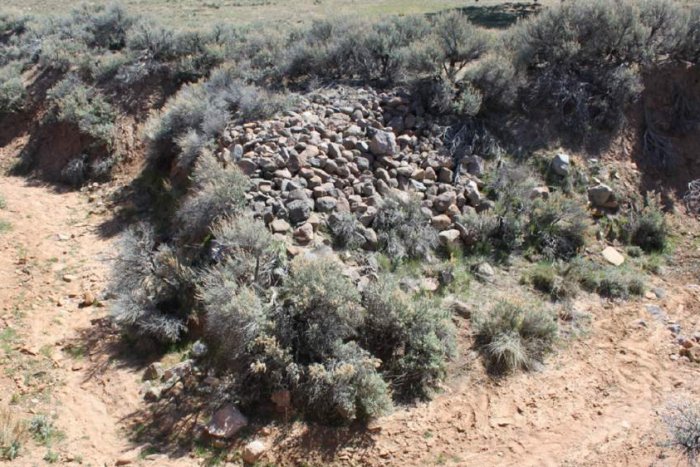
They left a number of artifacts unearthed by archaeologists in the graves and strategic stone stacks, located on the western areas of Lumbarda.
The ancient water cistern also happens to be the place where the legendary Psephisma - the Oldest Document about the division of land parcels in Croatia from the beginning of the 4th or 3rd Century BC - was found, one of the most important monuments of Hellenism in Europe.
Lumbarda Psephisma is a stone inscription telling about the founding of an ancient Greek settlement on the island of Korčula. The Psephisma was discovered in the ruins of the cistern on Koludrt hill in 1877 by Božo Kršinić. The inscription is considered as one of the oldest written monuments in Croatia. At the same time, it is a monument about the distribution of land to the Greek colonists in Croatia.
The artifact is a red-brownish lime-stone surmounted by a triangular decorative panel, about 1 meter high and 13 cm thick, with inscriptions 69 cm wide.
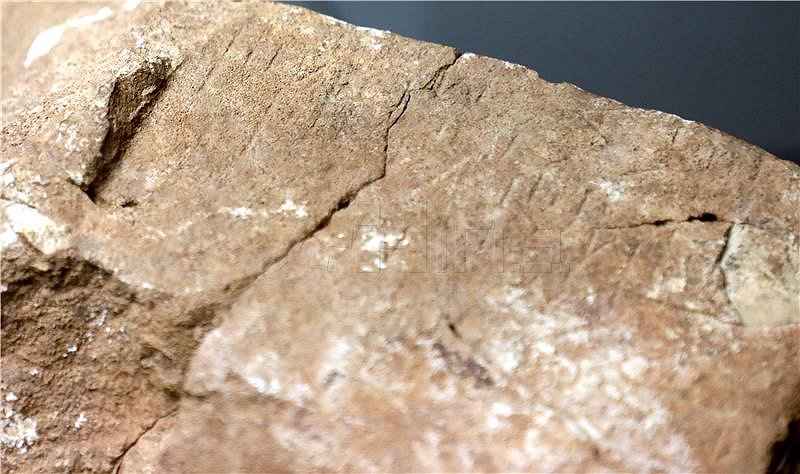 Lumbarda Psephisma. Image: HINA/ Lana Slivar Dominic
The stone inscription has a written decree that details the agreement surrounding the establishment of a Greek colony in the 4th or 3rd century BC. It is proof of the first urban center established in Lumbarda on the island of Korčula. Moreover, this ancient stone document is widely used by Croatian and foreign authors for studying Greek colonization.
With the intrusion of Greek interests on the Adriatic, the island became known as Korkyra Melaina (black), and as such, the region was of great importance to the Greeks, establishing two settlements on the Black Korkiri. The latter settlement was founded in the 3rd century in Lumbarda.
The most renowned and significant Antic stone inscription found in the Republic of Croatia gives witness to this historical event.
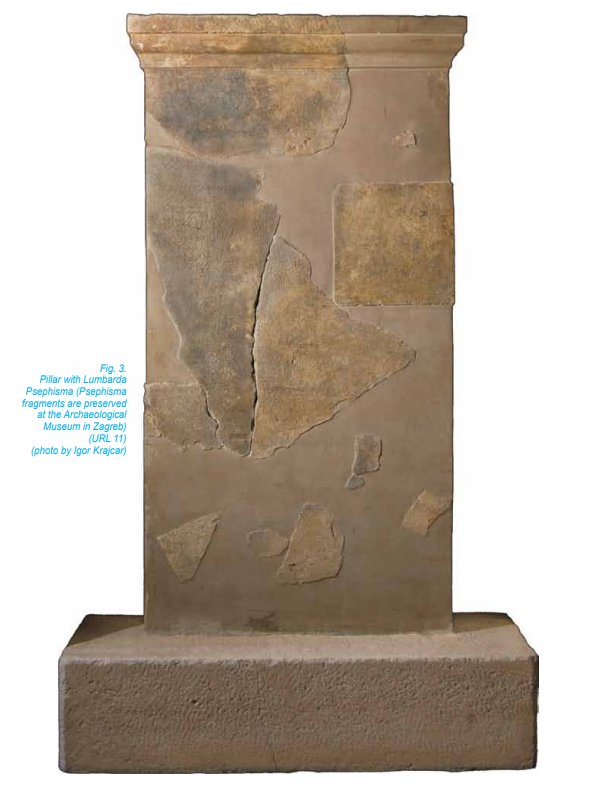
Lumbarda Psephisma. Image credit: Archaeological Museum in Zagreb
The recent archaeological discovery of 2,500-year-old water cistern dates from the same period as the Lumbarda Psephisma, the end of the 4th and the beginning of the 3rd century BC.
According to conservator Krešimir Bosnić, “especially the plaster, which is exceptional and unusual in every respect, is technically very well executed. However, since it, as in any other archeological site, is located outside – it is exposed to various conditions of decay.”
Cisterns were often built to catch and store rainwater and are distinguished from wells by their waterproof linings.
“The tank is huge, 10×17 meters in floor plan size and preserved height in the deepest part of 3 and a half meters. That’s a huge amount of water. Technologically, it is a fascinating object that is unique in the Mediterranean,” said archaeologist Hrvoje Potrebica.
One of the puzzles is that it is open, has no traces of a roof structure, but monumental in its size – there is no Hellenistic building on the east coast of the Adriatic that could match it. That is why the cistern is big news in the world of archeology, and it was recorded with the most modern 3D scanner in the world.
“We currently have the most modern scanner in the world that recorded a tank with 430 million points. So our resolution is one millimeter, so we hope that we will get documentation and an exceptional means of monitoring,” explains Potrebica.
Written by Conny Waters - AncientPages.com Staff Writer