
Wilhelm Tell: Famous Legendary Crossbowman And Swiss Patriot – Symbol Of Freedom And Dignity
A. Sutherland - AncientPages.com - Wilhelm Tell was a Swiss national hero symbolizing the political and individual freedom struggle.
The scene depicting the hero shooting an apple off his son's head is probably known to everyone.

Monument of the Swiss Hero and Patriot with his son.
The father pulls the string, checks the wind, aims, and releases the bolt.
The arrow flew whistled only millimeters over his son's head and pierced a red autumn apple.
Tell breathes a sigh of relief but also knows he will never forgive the Austrians.
The event took place on November 18, 1307, according to a widespread urban legend mentioned in books dating back to the late fifteenth century. Tell, a famous mountaineer and crossbowman, was a resident of Bürglen in the canton of Uri, whose capital was in Altdorf, Switzerland.
The brave Swiss patriot Tell lived during the 13th and early 14th centuries when his country was not unified yet but was a conglomeration of small states under Habsburg feudal rule.
The Austrian governor and colonial overlord Hermann Gessler was an unpopular figure. He sought to humiliate the residents of Altdorf, so he ordered the erection of a tall pole in the town square, at the top of which would be displayed his hat - a symbol of the power of the Habsburg.
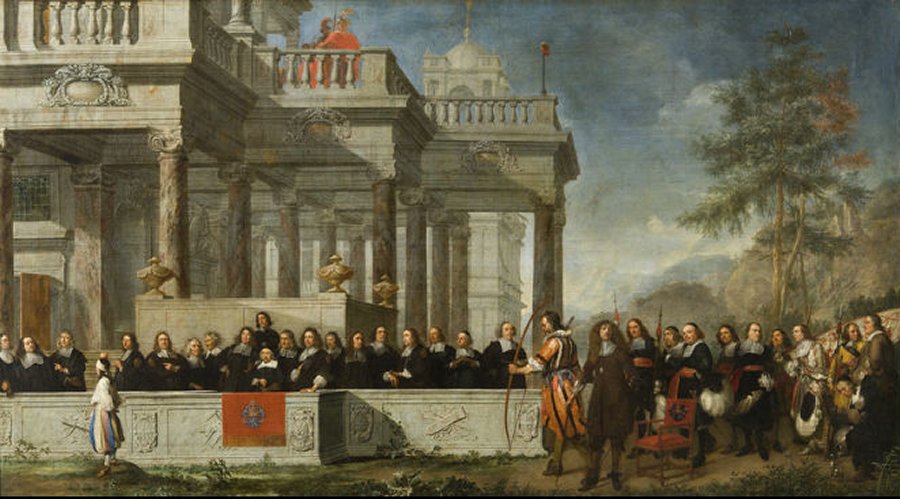
The Legend of Wilhelm Tell shown to the Antwerp Guild of St Sebastian. 1672; Credits: Philips A. Immenraet, W. Schubert van Ehrenberg, Charles E. Biset via Wikimedia Commons
Every Swiss man who entered the square would be obliged to pay allegiance to a cruel tyrant Gessler and the foreign imperial power he represented by bowing before his cap.
The famous crossbowman disobeyed Austrian authority; he refused to pay homage to a Habsburg liege and was forced to submit to the marksmanship test.
He had to shoot an apple from his son's head; the test was dangerous and humiliating, but Tell won it.
When the governor asked why Tell had a second bolt in the quiver, the Swiss replied, "… the second arrow was for you if the first had wounded my boy…"
The tyrannic Austrian official had Tell arrested for this insult and ordered to transport him across Lake Lucerne.

Tell with Son. Credits: E. Stückelberg (1831 - 1903) Kunstsammlung Basel
A sudden storm allowed Wilhelm Tell to escape, or perhaps he was secretly released during the transport to the fortress. Later, the patriot Tell killed Gessler, the tyrant of Altdorf, and this event began the uprising against the Habsburg power in the cantons. It was also the Swiss first to take a crucial step in its struggle toward the independent Swiss Confederation.
Several accounts of the Tell legend exist, and many of them have been compared with the stories of Palnatoke, a legendary Danish hero, and other legends of migration from Sweden to Switzerland during the Middle Ages.
However, tracing any historical source concerning the Swiss Wilhelm Tell is difficult.
In 1470, a chronicle named the "White Book of Sarnen" reports the legend for the first time, and the classic story appeared in the standard history book 'Chronicon Helveticum' (1734–36) by Aegidius Tschudi.
Wilhelm Tell remains an immortalized national hero of the Swiss people.
Written by A. Sutherland AncientPages.com Staff Writer
Updated on December 4, 2023
Copyright © AncientPages.com All rights reserved. This material may not be published, broadcast, rewritten or redistributed in whole or part without the express written permission of AncientPages.com
Expand for referencesReferences:
More From Ancient Pages
-
 Andvaranaut: Magical Ring That Made Gold And Was Stolen By Norse God Loki
-
 Buccaneers And Privateers Were Pirates – But What’s The Difference Between Them?
-
 Unique Chachabamba Complex Hidden In Peruvian Forest Reveals Its Secrets
-
 5,000-Year-Old Russian Skull Offers Evidence Of Brain Surgery Made With Stone Scalpel
-
 Is There An Over-Looked Ancient Secret In Sahara?- Intriguing Theory Examined
-
 Lothal – ‘City of Dead’ – One Of The Most Prominent Ancient Places In Danger To Be Forgotten
-
 On This Day In History: Grote Reber, Great Amateur Astronomer And Ham Radio Operator Born – On Dec 22, 1911
-
 Rare Well-Preserved 2,500-Year-Old Dagger Linked To The Keeladi Civilization Discovered In Tamil Nadu, India
-
 Charlemagne – Most Famous Emperor Of Education And Enemy Of Pagan Worshippers – What Did He Really Mean For Europe?
-
 Crusader-Era Sword Discovered At Previously Unknown Burial Site In Finland
-
 Egyptian Artisans In The Valley Of The Kings Had Permanent Jobs In The Time Of The Pharaohs
-
 Is The Tomb Of Genghis Khan Hidden And Protected In The Khentii Mountains Because Some Fear It’s Cursed?
-
 Mysterious Headless Skeleton May Be Sir George Yeardley – The Man Who Shaped Early America
-
 Unique Ancient Roman Cavalry Swords Found In Cotswolds, UK
-
 Vikings Brewed Beer With Heated Stones – Old Tradition Popular In Germany, Finland And Baltic States
-
 First Dream Of The New Year – Japanese Hatsuyume Tradition
-
 On This Day In History: Treaty Of Worms Signed Between Great Britain, Austria And The Kingdom Of Sardinia – On Sep 13, 1743
-
 Fossil Of Extinct Human Species Reveals Climate Change Led To Unexpected Anatomical Changes 2 Million Years Ago
-
 Dunino Den: Mysterious And Sacred Ancient Site In Scotland With Enigmatic Rock Faces And Symbols
-
 Vast Trade Of Ancient Obsidian Artifacts, Not Just Conquest, Made The Aztecs Powerful

