
Full Moon In Ancient Myths And Legends Of Our Ancestors
A. Sutherland - AncientPages.com - Full Moon is related to numerous ancient myths and legends and even paranormal tales.
Many different superstitions and beliefs influenced our ancestors who looked at the celestial ‘phenomenon’ – supermoon.
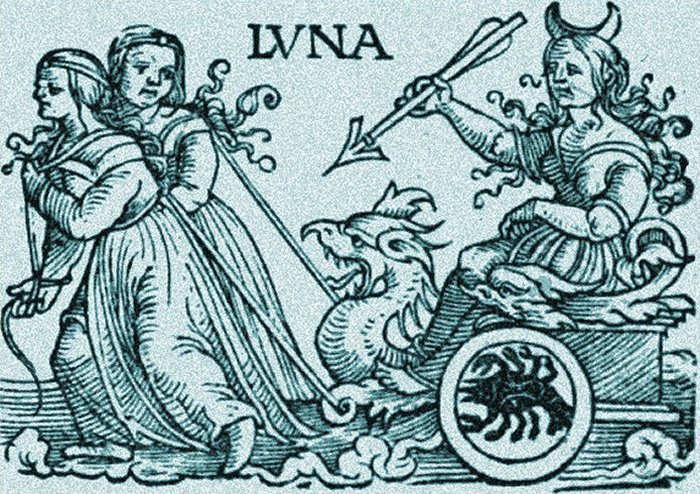
An ancient moon Goddess, the namesake for the Latin word luna meaning 'moon'. Her name also forms the root of the English words 'lunar' and 'lunatic'.
One of them says that when our Silver Globe is full and shines brightly, then we can expect the next day will beautiful weather. The occurrence of rainfall, on the other hand, was associated with a hazy moon surrounded by a white circle (‘halo’).
In earlier times, it was also believed that the red or transparent shield of the full moon was a harbinger of natural disasters, wars, and worst plague outbreaks. Also, the moon's effects date back to the legends and mythology of ancient civilizations. The full moon has been associated with strange or insane behavior, including sleepwalking, violence, and suicide.

In East Asia, it is seen as a rabbit pounding the ingredients for rice cake; in Chinese folklore, it is often portrayed as the rabbit companion of the Moon goddess Chang'e, constantly pounding the elixir of life for her.
In Aztec mythology, Tecciztecatl was a lunar deity, representing the old "man-in-the-moon". The 'Man in the Moon' refers to several images of a human face, head, or body that certain people in ancient times recognized in the disc of the full moon.
In some of the Aztec depictions, Tecciztecatl carried a large, white seashell on his back, representing the moon itself.
Talmudic tradition describes that the image of Jacob is engraved on the moon, and ancient Chinese tradition says a beautiful Chinese girl called Chango'e has been living there for 4,000 years. It is said she was banished to the moon because she stole the pill of immortality from her husband and consumed a double dose of it. She is accompanied by a small group of 'moon rabbits' that live on the Moon, an image that the human mind has perceived through the centuries, in the face of the Moon.
The story exists in many cultures, especially in East Asian folklore and Aztec mythology.
In East Asia, it is seen a rabbit pounding the ingredients for rice cake; in Chinese folklore, it is often portrayed as one of the rabbit companions of the Moon goddess Chang'e, constantly pounding the elixir of life for her. The Japanese also believed that the moon was a god with powers to foretell the future.

Left: A scribe writes at the feet of Thoth as a baboon with a lunar disk and crescent moon. Image via touregypt.net; Right: God Khonsu the Egyptian lunar god of fertility. His headdress consists of a crescent moon, topped by a full moon.
Algonquin (Algonquian) people had a myth of the medicine woman in the moon.; in fact, these Native American people have many different names for the ‘full moon’ through the year, which reflects on their strong connection with nature, hunting, fishing, and farming and the seasons they depended on.
An agricultural treatise dated to 15th century Spain states that in March, “melons, cucumbers, gourds, oats, sorghum, onions, and green beans can be sown in the waning moon.

Left: Prediction of fertility with the help of the Moon's phases; Right: Lunar god Chandra, Tibet
Cabbage seed and radishes in the old moon. Green beans and sorghum and spelled can be sown in the new moon. Graft fig trees and other trees in the waxing moon.”
S. S. Tomkins, in his book "In Affect Imagery Consciousness" writes that "the rays of Luna, goddess of the moon, have long been regarded as the cause of lunacy and cites Roger Bacon, who believed that "many have died from not protecting themselves from the rays of the moon..."
In the religion of ancient Egypt, the moon has played an important role, though it was only considered the nightly replacement of the sun because the Sun was the most important to them.
In depictions, the moon was commonly represented as a combination of the full-moon disk with the crescent moon.
Lunar gods were almost always shown with this symbol on their heads.
Khonsu was the Egyptian lunar god of fertility on his head he wore a crown or headdress consisting of a crescent moon, topped by a full moon. The moon god Khonsu, was described as the pendulum of heaven and precise divider of months.
Written by A. Sutherland - AncientPages.com Staff Writer
Copyright © AncientPages.com All rights reserved. This material may not be published, broadcast, rewritten or redistributed in whole or part without the express written permission of AncientPages.com
More From Ancient Pages
-
 Mysterious 1,800-Year-Old Roman Marble Inscription Found In The Ancient City Of Aigai Deciphered
-
 Prehistoric Brits Used Rare Rock Crystals To Mark Burial Sites – New Study
-
 Germany’s Stonehenge Pömmelte Reveals More Secrets – 140 Wooden Houses And 78 Silos Found
-
 Mystery Of The Forgotten Explorers And Ancient Artifacts That Re-Write History Of North And South America
-
 Deciphered Ancient Cuneiform Tablets Reveal Locations Of Long-Lost Cities And Shed Light On The Secrets Of Mesopotamia
-
 Pytheas’s Voyage To The Arctic In 325 B.C. And Account Of Thule, The Strange Land Beyond
-
 What Was The Law Of The Innocents?
-
 Thoth: Ancient Egypt’s Most Mysterious, Highly Venerated God Of Knowledge And Writing
-
 What Was The Danelaw?
-
 Medieval Friars Were ‘Riddled With Parasites,’ Study Finds
-
 The Kitchen God In Ancient Vietnamese Tradition Is Still Alive
-
 Swords And Spears Of The Yotvingians – A Long-Forgotten Ancient Warrior Culture Discovered In Poland
-
 Mazu: Chinese Goddess Of The Sea – Protector Of Fishermen
-
 On This Day In History: Treaty Of Worms Signed Between Great Britain, Austria And The Kingdom Of Sardinia – On Sep 13, 1743
-
 The Maya Produced Rubber 3,000 Years Before Goodyear
-
 Neanderthal Intelligence Revealed By Their Use Of Fire For Cooking
-
 Mysterious Gympie Pyramid: Evidence Of An Ancient Lost Civilization In Australia?
-
 Runic Inscription On The Forsa Ring Is Not What We First Thought – Scientists Say
-
 13 Ancient Terracotta Figurines Associated With Cybele And Attis Unearthed In Pompeii
-
 Mysterious Ancient Rulers With Elongated Skulls – Who Were They Really?

