AncientPages.com - When we read about the lives of people from the ancient past, we naturally want to know what they looked like.
But how do we find this out?
In recent years, computer-assisted reconstructions of the faces of famous figures from the Greco-Roman world have become popular.
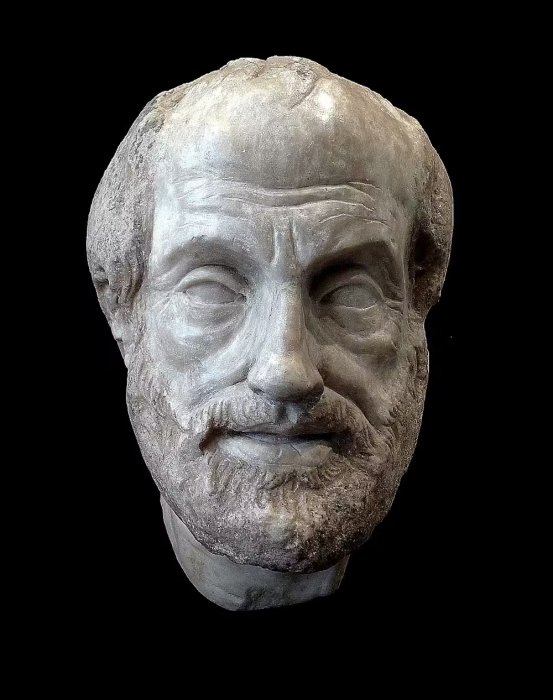
A Roman bust in the Louvre Museum, Paris, widely regarded as a depiction of Aristotle based on an earlier Greek original from the late 4th century BCE. Wikimedia Commons, CC BY
In 2020, for example, a digital artist went viral for using artificial intelligence (AI) technology on the busts of Roman emperors to recreate their faces in a photo-realistic way.
How are facial reconstructions done?
The simplest form of facial reconstruction involves adding realistic-looking skin, eyes and hair to Greek or Roman busts. Other methods can be more complicated.
One of the most famous facial reconstructions of any individual from the Greco-Roman world was the case of Hermione Grammatike. Hermione was a teacher in her 20s who died in Egypt in the early 1st century CE.
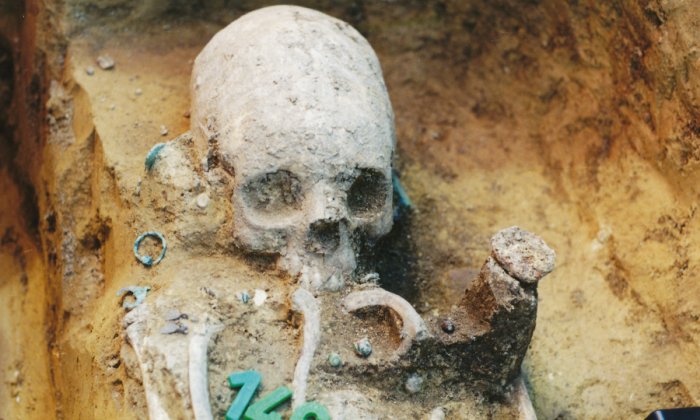
Hermione’s ancient portrait and skeleton both survived with her mummy. So, any attempt to reconstruct her face on the basis of the skeletal remains could be compared with the portrait of her.
In 1997, British Museum researchers used CT (computed tomography) scans to create a 3D image of Hermione’s face.
After reconstructing the surface of the face using the skull, the researchers then consulted the coffin portrait to nuance the details.
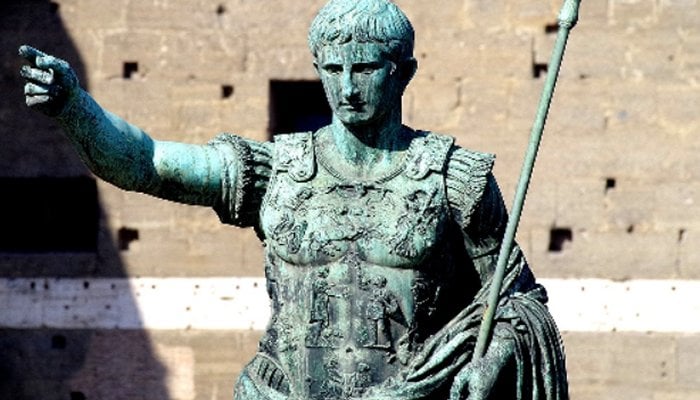
Image credit: Pixabay
In spite of this rigorous combination of methods, they acknowledged difficulties: Since the skull does not carry enough information to completely determine the facial surface, facial reconstruction from skulls will always contain an element of art. The reconstructed face is likely to resemble that of the living person but is very unlikely to be an exact replica.
So, even with careful techniques, there still remain some doubts about facial reconstruction.
But such reconstructions are becoming more accurate. This is largely thanks to new methods of DNA extraction and analysis, which make it possible to work out the correct colours of people’s hair, skin and eyes.
How reliable were ancient portraits of people?
Basing reconstructions of people’s faces on their surviving busts or portraits is not an entirely safe procedure.
In some cases, there are discrepancies between ancient portraits of people and ancient literary descriptions of what they looked like.
For example, according to ancient texts, the philosopher Aristotle was bald or (alternatively) had short hair and a short beard, as well as small eyes. He wore rings on his fingers and luxurious clothes.
However, ancient busts that have been identified as depicting Aristotle show him with a full beard and plenty of hair.
This raises a new problem: which pieces of information are more reliable – the ancient artwork or the ancient literary description? In cases such as these, it seems almost impossible to decide.
But some ancient portraits must have been fairly accurate depictions of their subjects.
Other authors indicate portraits were not always made solely for accuracy. The Roman writer Claudius Aelianus informs us that "in Thebes a law was in force which instructed artists – both painters and sculptors – to make their portraits flattering. As punishment for those who produced a sculpture or painting less attractive than the original the law threatened a fine of a thousand drachmae."
The wish to see historic faces is universal
In around 39 BCE, the Roman scholar Marcus Terentius Varro published a collection of famous people’s portraits, “not allowing their likenesses to disappear or the lapse of ages to prevail against immortality in men”.
Varro’s collection apparently included 700 portraits of famous historical Greek and Roman people, and each portrait was accompanied by an epigram and brief biography. This collection must have satisfied the wish of the public to know what the faces of famous people looked like.
Clearly, ancient and modern people share this fascination.
We can surely enjoy reconstructions of the faces of people from ancient times. We just need to keep in mind two important issues.
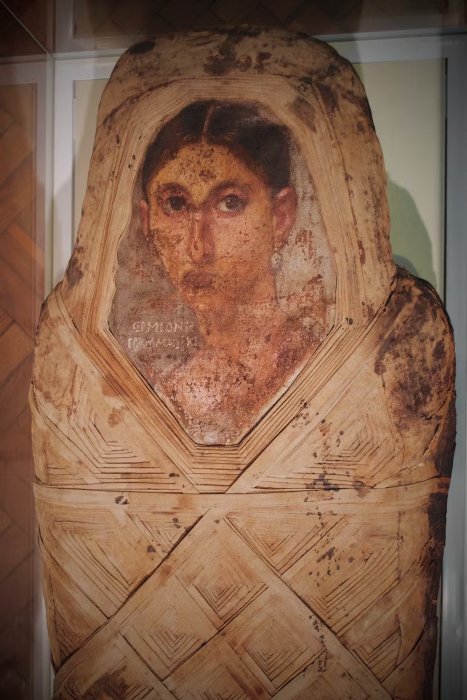
The elaborately wrapped mummy of Hermione Grammatike is held at Girton College, Cambridge. Mark Vuaran/Flickr
Firstly, ancient portraits and busts were themselves not always reliable depictions of people, so reconstructions based on them are of uncertain accuracy.
Secondly, modern researchers acknowledge that reconstructions based on skulls have limitations, though the accuracy of this method is rapidly improving.
So, the next time you see a reconstruction of some ancient person’s face, be cautious before thinking that you are really looking at the exact, almost photographic likeness of someone from the past. You might be – or you might not.
Provided by The Conversation
This article is republished from The Conversation under a Creative Commons license. Read the original article.