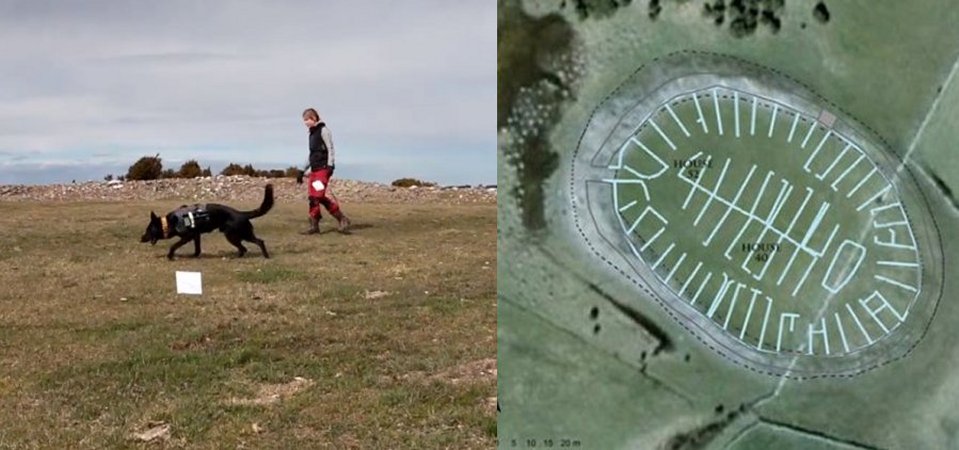
AncientPages.com - A valley of lost cities has been discovered in the Ecuadorian Amazon. When you hear of such a discovery you might think of archaeologists with chisels and brushes or explorers in pith helmets stumbling across sites deep in the forest. Instead, without needing to brave the hazards of the forest, Light Detection and Ranging (Lidar) has revealed networks of buried roads and earthen mounds.
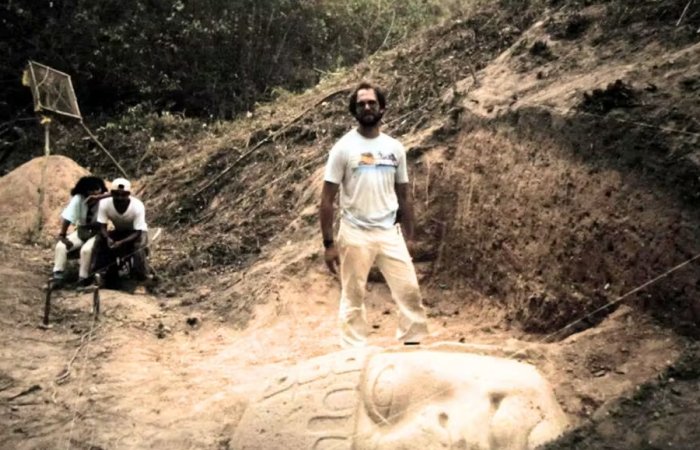
Jay Silverstein with an Olmec head he helped discover in Mexico in 1994. Jay Silverstein, Author provided
The point of exploratory science is to reveal what has so far been hidden. Whether at the edge of the universe with the James Webb Space Telescope (JWST), the bottom of the sea with Underwater Autonomous Vehicles (UAVs), or through the canopy of the densest forests with Lidar, we are discovering things that reshape our understanding of the world.
The increasing ability to discover things with technology without having to actually dig them up might lead to questions about whether we are nearing the end of the age of archaeological discovery. Since the 18th century, the scientific search for ancient cities and lost temples has fed our imaginations and filled our museums, but the past is a finite resource.
Now, remote sensors and drones probe the most far-removed places on the globe. So has 300 years of research and recent technological advances left us with little left to be discovered? As an archaeologist with 30 years of experience working on sites, I can tell you it has not.
During my first dig at San Lorenzo, Mexico, in 1994, we uncovered the last of the great Olmec heads. As the face peered out from the earth where it had been buried for 3,000 years, I wondered if I would ever see such an incredible discovery again. Luckily, I have.
Following this dig, I led projects in the Tierra Caliente of West Mexico, Tikal in Guatemala, and for the last 15 years in Egypt. The changes in technology are wonderful tools that help me find and model history, but they do not deplete it.
Why excavation is key to understanding
The biggest advances in archaeological search come from the application of drones, canopy-penetrating Lidar and UAVs. They have opened up areas of exploration that were previously too remote, too deep, or too dangerous. But seeing an image of something in the ground or at the bottom of the sea is only the most preliminary step in discovery.
You cannot truly understand an image until you have seen the artefacts associated with ancient constructions and you have studied the occupational history. The more we find with modern technology means we are that much farther behind than we thought in actually discovering the secrets of the buried past.
My current project at Tell Timai in the Egyptian Delta consists of a study of the ancient Graeco-Roman-Egyptian city of Thmouis. The city was occupied from at least the 6th century BC to the 9th century AD.
Buried within the ruins are the fossilised records of lives, economies and religions of hundreds of thousands of people. These ancient people witnessed the rise of empires, revolutions, religious transformations and wars. Every aspect of those lives offers an opportunity for investigation.
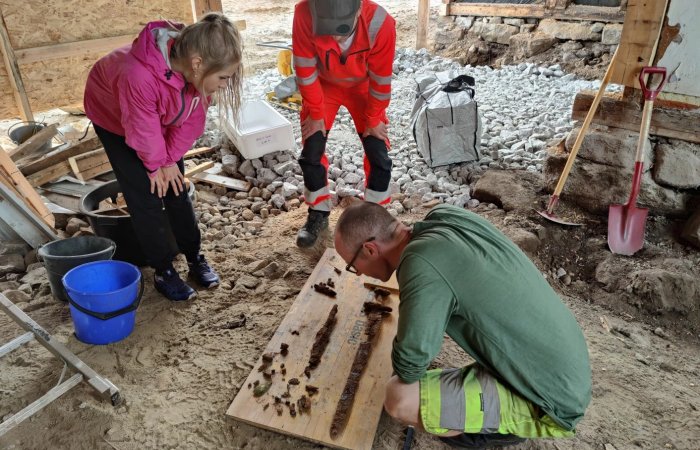
Now, consider what we can see from a remotely sensed image and what we learn from archaeological investigation. At Thoumis, a Hellentisic Building we found was first seen with a magnetometer while still buried underground. However, to understand more the house had to be excavated.
In the excavation, coins, the evidence of burning, catapult stones and ceramics were discovered. These finds tell us that the house had undergone at least three episodes of rebuilding and a destruction event in the early 2nd century BC that corresponds with a rebellion discussed on the Rosetta Stone that wrecked the city.
More and more sites to study
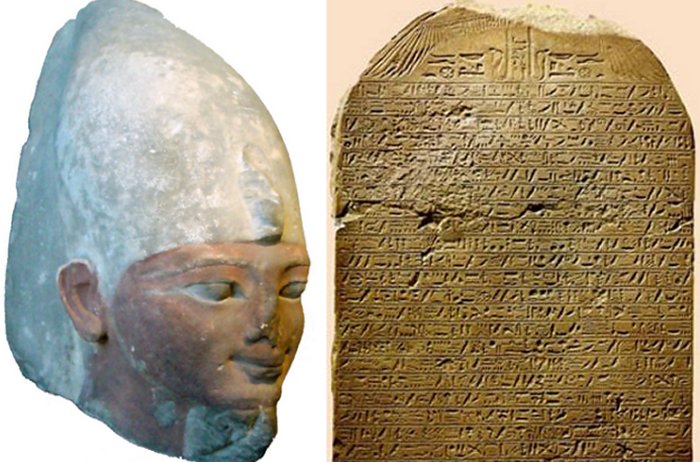
Last year, we discovered a lost temple, which included a monumental dedication to the 29th dynasty pharaoh, Psammuthes. In searching satellite imagery around the temple, I found a circular feature suggesting that it might be a sacred nilometer (a device used for measuring flood levels and for sacred ceremonies involving the waters of the Nile).
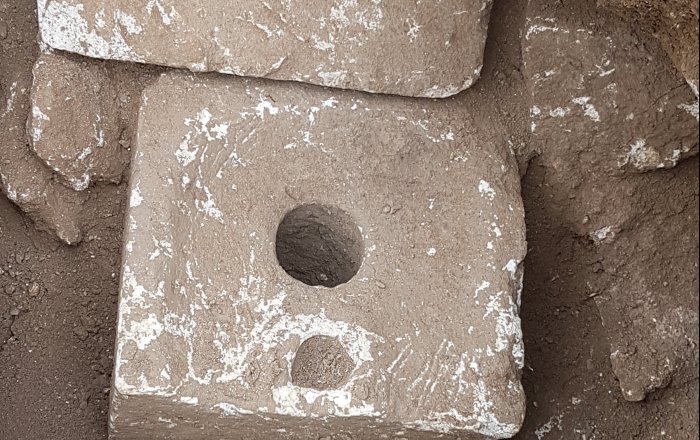
When we excavated the feature, we found that it was actually a large Roman well that had been constructed through the temple layer more than 500 years after the temple had been destroyed. So, even if you find a location, it takes decades to explore and understand the significance of what remote sensing can detect.
The challenges in the field are not that we are running out of things to study, but that we lack the resources to study and protect the abundance of poorly understood ancient sites. Each new place revealed is only the tip of an iceberg. The increased capacity to find sites highlights the need to conserve these places and protect them from development and looting.
Seeing architectural geometries in a remotely sensed image is only a superficial starting point. Profound knowledge comes with the study of the culture and the vertical excavation that peels back the history of a lost civilisation.
Archaeology is more than knowing that a site exists, it is about knowing why it exists and what it tells us about the evolution of our contemporary civilisation.
Sadly, the more I have worked in archaeology, the more I recognise that one lifetime is not enough. It barely gives me time to scratch the surface of mysteries waiting to be solved.
Provided by The Conversation
This article is republished from The Conversation under a Creative Commons license. Read the original article.