
The Parthenon Marbles Evoke Particularly Fierce Repatriation Debates – An Archaeologist Explains Why
AncientPages.com - The Parthenon marbles are rarely out of the news. Most recently, Turkish officials have rejected claims by the British Museum that British diplomat Lord Elgin was given permission from Ottoman authorities to remove the marbles from the Acropolis in Athens in the early years of the 19th century.

Parthenon in Athens (Attica, Greece). Image credit: A.Savin - CC BY-SA 3.0
The Parthenon marbles are probably the most renowned example of a country calling for heritage objects to be returned. They are part of a larger move to investigate the colonial contexts through which most western museum collections have been formed. As a result, we are beginning to see greater transparency about acquisition histories.
There’s also a new willingness in specific cases to repatriate – or “bring home” – contested objects, such as the Benin Bronzes, some of which are in the process of being repatriated to Nigeria.
All repatriation cases matter greatly to those involved, but that of the Parthenon marbles has become famous far beyond the dispute between the key parties of Greece and the UK. Why, then, do they resonate so deeply? In what ways were they important in classical Greece, and to the modern Greeks now?
The Parthenon marbles were removed from the Acropolis in Athens by Lord Elgin between 1801 and 1805. He then shipped them to Britain to join the collections of the British Museum in 1816.
The removal happened under Ottoman imperial rule, a mere five years before the creation of the modern Greek state. Today, the British Museum has 17 figures from the pediments (the triangular shape that forms the gable of the temple’s pitched roof), 15 high-relief metopes (the decorated panels placed just above the colonnade), and 75 metres of the low-relief frieze which encircled the Parthenon. These are in addition to materials from other structures on the Acropolis.

A photograph of the Acropolis Museum as seen from the top of the Acropolis hill. Une photographie du musée de l'Acropole vu du haut de la colline de l'Acropole. Image credit: Louis Dalibard - CC BY-SA 4.0
Since 1983, Greece has formally sought the return of the marbles. Debate has swirled around the legality of ownership, where they are best cared for and displayed, and the idea – at the forefront of current discussion – that they belong together as part of a carefully designed building. Since 2009, a purpose-built Acropolis Museum has been ready to display the marbles together, so they can be viewed within sight of the Acropolis.
The importance of the marbles
The Parthenon is a temple dedicated to Athena, patron goddess of Athens, that sits atop the Acropolis hill. It is regarded today as one of the most important monuments of the ancient world, an artistic and architectural wonder.
One measure of its modern importance is that the logo of Unesco – keepers of the World Heritage List – refers to the temple. Indeed, the whole Acropolis has been inscribed as a world heritage site since 1987. The sculptures are stunning works of art but beyond that, they embody the identity of classical Athens, its myths of origin and its ideologies. They are a physical manifestation of what it meant to be Athenian during the 5th century BC.
The Parthenon was a monument of Athenian imperial power, but also a hymn to democracy (if not in the form we recognise today – this was a society with slavery, after all).
It is the marbles’ symbolic message of equality and freedom that resonates so powerfully today, and which gives them both local historical significance and modern global importance. It was because of the legacy of antiquity, the literature, philosophy and arts of Greece, that western Europeans, by the 18th and 19th centuries, viewed Greece as the cradle of western civilisation.
British historian Paul Cartledge, in making the case for their return, has stated that “the Parthenon sculptures simply mean much, much more to the Greeks than they do to us in Britain”.
The reasons for their importance to Greece (far beyond any of the thousands of Greek artefacts in museums across the world) are clear, yet complex. The ancient past was drawn upon as a unifying symbol of the modern Greek state.
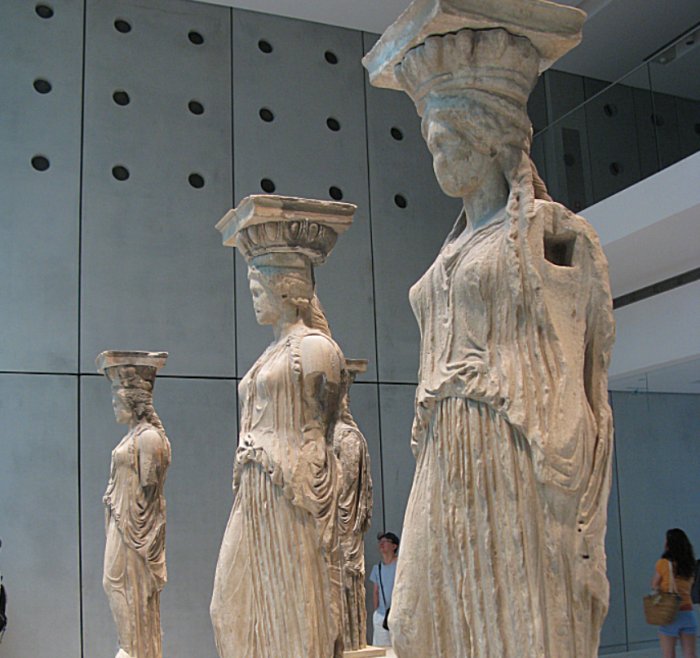
Porch of the Maidens (Caryatids) of Erechtheum. Acropolis New Museum. Image credit: Tilemahos Efthimiadis - CC BY-SA 2.0
Two short examples help illustrate the role the Parthenon and its marbles play in the modern Greek imagination. The first is a fractious incident in December 2014, when the British Museum loaned the figure of the reclining Greek river god Ilissos (which was originally part of the Parthenon) to the Hermitage Museum in St Petersburg, Russia.
At the time, the museum’s director, Neil McGregor, suggested it would be the first time that the people of Russia had been able to see this great moment of “European” art and thought.
The framing of the sculpture as belonging to Europe is suggestive and links into the global story embedded in the marbles. It also illustrates the soft political power of the world of international museum exchanges. Unsurprisingly, this sparked sharp anger in the Greek press.
The second is a much older story. According to 19th-century folklore, when one of the six Caryatids (the female figures that form the architectural support for the temple) was removed from the Erechtheion (a temple on the north side of the Acropolis), locals claimed to have heard the others “wailing in sadness, calling for their sister”.
That image – of Parthenon sculptures as lonely, abducted and imprisoned away from the Athenian sun – has been used in campaigns for their return, and speaks strongly to the emotive connections with the marbles that Greeks feel today.
Provided by The Conversation
This article is republished from The Conversation under a Creative Commons license. Read the original article.
More From Ancient Pages
-
 Ancient “Mona Lisa Mosaic Of Kadirli” – Discovered
-
 Many Roman Citizens Joined The Huns And Preferred Their Nomadic Lifestyle – New Study
-
 Why Were Medieval People Buried Twice In Nowy Chorów, Poland?
-
 Child’s Play: Are Tibetan Hand And Foot Traces The Earliest Example Of Parietal Art?
-
 2,ooo-Year-Old Ancient Roman Treasure Found Underwater Of The Coast Of Portofino, Italy
-
 New Underwater Discoveries Made Around The Antikythera Shipwreck
-
 25 Stone Age Caves And Rock Carvings Found In Odisha, India
-
 Sandstone Statue Of A Sphinx Discovered In Kom Ombo Temple
-
 A 19th-Century Sailing Ship Loaded With Champagne, Wine, Porcelain And Mineral Water Found At The Bottom Of The Baltic Sea
-
 Bes: Egypt’s Intriguing Dwarf God Of Music, Warfare And Protector Against Snakes, Misfortune And Evil Spirits
-
 Long-Lost Home Of Harold, The Last Anglo-Saxon King Of England Found On Depicted On The Bayeux Tapestry
-
 Horned Serpent – Unusual Ancient Creature Encountered Worldwide – Can Archaeological Finds Confirm Thousand-Year-Old Myths Again?
-
 Biblical Event Verified By Study Of Earth’s Magnetic Field?
-
 8,000 Year-Old Human Skeleton Discovered By Cave Divers Near Tulum, Mexico
-
 Two Millennia Old Bamboo Slips With Records Of Ancient Rituals Deciphered
-
 Controversial ‘Anomaly’ Discovered On Mount Ebal Could Be Biblical Joshua’s Altar
-
 200-Year-Old Message In A Bottle Written By Archaeologist Unearthed In France
-
 What Important Role Did Almost 3,000 Year-Old Royal Bowls Play In Prestigious Urartu?
-
 How Did St. Nicholas Become Santa Claus? – History, Legend And Tradition
-
 The Real Paleo Diet: New Archaeological Evidence Changes What We Thought About How Ancient Humans Prepared Food

