
Oldest Long Count Inscription Discovered On Monument At El Palmar, In Campeche, Mexico
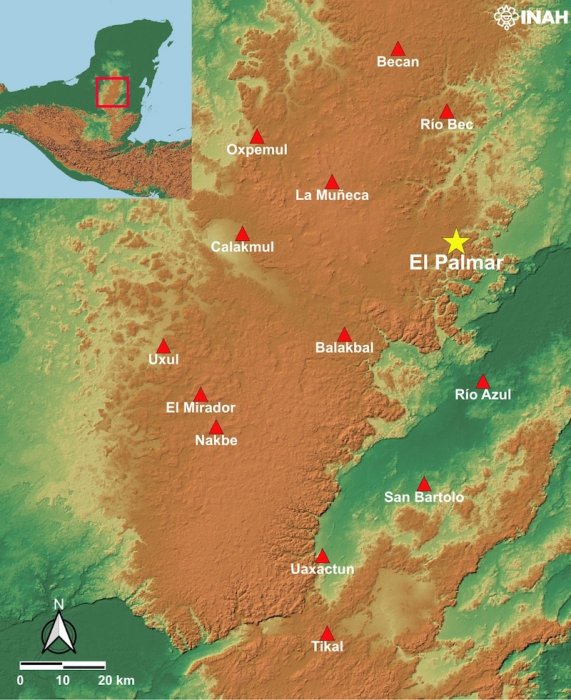
Conny Waters - AncientPages.com - Archaeologists at the ancient Maya site of El Palmar in Campeche, Mexico, have uncovered what may be the earliest known Long Count calendar date in the Maya lowlands. Carved into a stone monument, the date corresponds to August 31, AD 180. This discovery may provide new insights into how early Maya rulers used time to legitimize their authority.
Credit: INAH
The Mesoamerican Long Count calendar is a non-repeating base-20 and base-18 system used by pre-Columbian cultures, especially the Maya. It is therefore often referred to as the Maya Long Count calendar. The Long Count played a key role in the prosperity of lowland Maya kingship during the Classic period (ca. A.D. 250–900), but how it was first used in the rise of kingship remains poorly understood.
Maya rulers recorded personal milestones such as births, marriages, and victories in stone to assert and legitimize their authority. The previously earliest known Long Count date in the region was AD 292, making this discovery over a century older.
Scientists now report that the ancient Maya monument at El Palmar contains the earliest documented Long Count date in the Maya lowlands.
This discovery is the result of two decades of research by the El Palmar Archaeological Project (PAEP), led by archaeologists Kenichiro Tsukamoto of the University of California, Riverside, and Javier López Camacho of the National Institute of Anthropology and History (INAH).
Using modern photogrammetry and high-resolution 3D scanning, the team identified the Long Count date 8.7.1.0.0 (AD 180), which is 112 years older than the date recorded on Stela 29 of Tikal, Guatemala (AD 292), previously considered the oldest in the Maya region.
These findings suggest that the site's ruling lineage was among the longest-lived in the region, spanning from the Terminal Preclassic period (300 BC–250 AD) to the Terminal Classic period (800–950 AD).
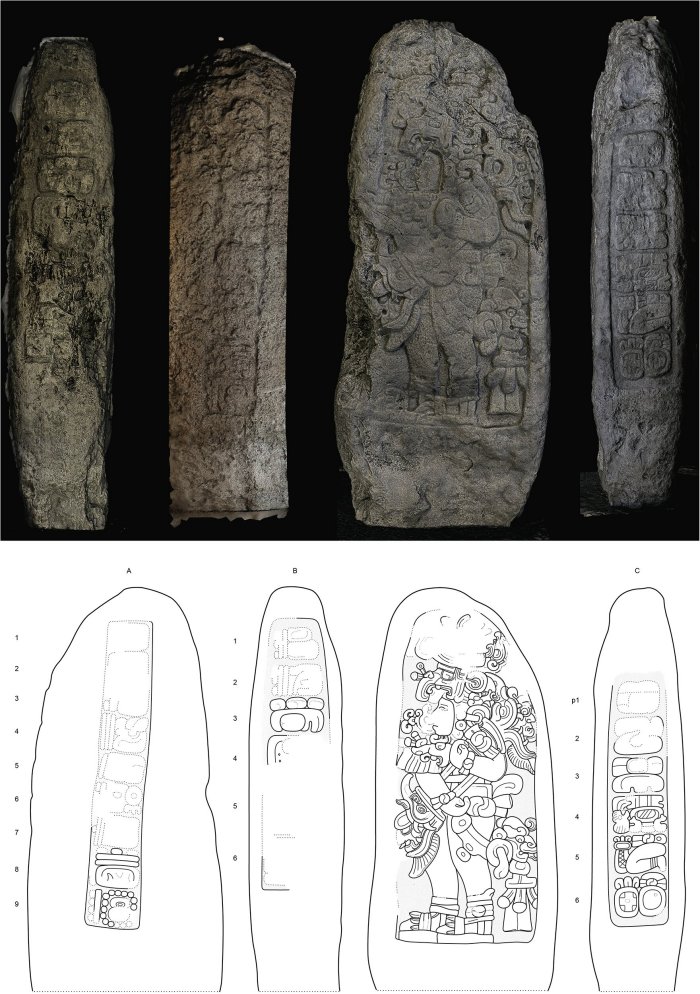
Stela 45. Back face, left side, front face, and right side. Credit: Three-dimensional modeling by Kenichiro Tsukamoto, epigraphic drawing by Octavio Q. Esparza Olguín and Kenichiro Tsukamoto, and iconographic drawing by Daniel Salazar Lama, PAEP. From Ancient Mesoamerica (2026). DOI: 10.1017/s0956536126100984
In addition to the Long Count and enthronement-related inscriptions, the monolith depicts a ruler wearing a feathered headdress and holding what may be a jaguar head, an animal associated with the underworld and various symbolic meanings.
The sculpture, measuring 2.96 meters long by 0.78 meters wide at the front and 2.96 meters high by 0.62 meters deep at the sides, had been previously examined by specialists. However, deterioration and limited technology at the time prevented a thorough analysis.
The research, published in Ancient Mesoamerica, notes that erosion has left the ruler's name incomplete. He has been provisionally identified as Ajaw K'al Ubaah, who assumed the throne in 131 AD.
Researchers report that another glyph documents the monarch's request, 49 years after his enthronement, to erect the stele. This event may have included a ritual.
Archaeological context and early stelae confirm the age of Stela 46. Materials from test pits in the Arcos Group also indicate occupation during the Terminal Preclassic period (300 BC–250 AD), aligning with the stela's inauguration.
The El Palmar Archaeological Project (PAEP) also analyzed Stela 20, erected in the 6th century AD, which offers key information about the origin of the ruling lineage and aligns with the date on Stela 46.
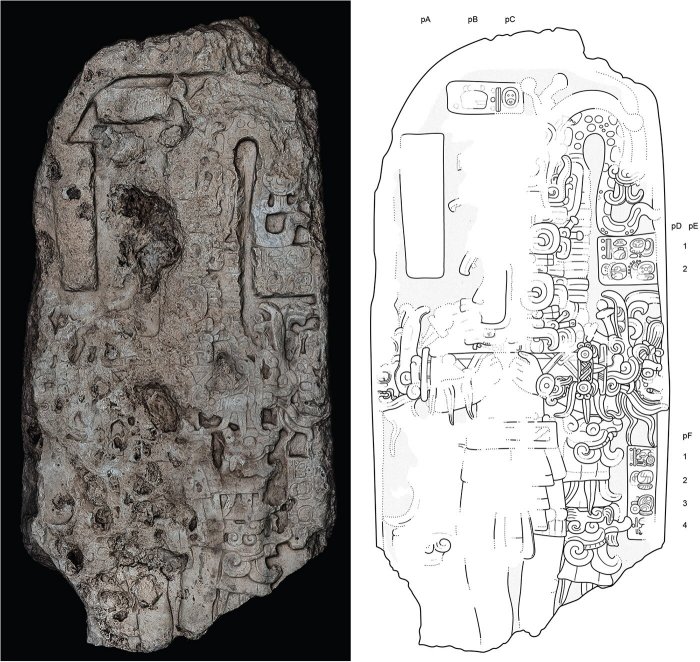
Stela 20. Front face. Credit: Epigraphic drawing by Octavio Q. Esparza Olguín and Kenichiro Tsukamoto, and iconographic drawing by Daniel Salazar Lama, PAEP. From Ancient Mesoamerica (2026). DOI: 10.1017/s0956536126100984
Stela 45, housed in the Museum of Maya Archaeology at the Fort of San Miguel, displays the long count 8.15.5.8.11, 13 Chuwen 9 Mol (342 AD), and provides information on the 4th-century ruling succession.
This evidence suggests that El Palmar's early rulers had the resources to establish a dynasty, as shown by the carving of stelae and altars and the construction of related architectural works.
Like Stela 46, this monolith is eroded, making some texts difficult to read or incomplete. Glyphs Cp2 to Cp6 may record the name of the sovereign Tz'u Chak Ahk.
See also: More Archaeology News
"The presence of carved monuments in the central karstic upland demonstrates that the emergence of kingship in the central Maya Lowlands during the Late Terminal Preclassic period was a regional phenomenon.
Unlike its absence on other early inscriptions such as El Mirador and San Bartolo, El Palmar Stela 46 and subsequent monuments suggest that the Long Count played a vital role in the continuity of kingship during the Classic period. Further study of this region will provide new insights into the emergence of Maya kingship," the scientists write in their study.
The study was published in the journal Ancient Mesoamerica
Written by Conny Waters - AncientPages.com Staff Writer
More From Ancient Pages
-
 Hidden Silver Casket With Bones Of 13th Century Saint Found
-
 5th-Century Tomb With Finds Of Historical And Artistic Value Discovered In Eastern Bohemia
-
 Mystery Of The Lost Anglo-Saxon Queen Cynethryth May Soon Be Solved By Archaeologists
-
 Advanced Heating System Discovered In Ruins Of Metropolis ‘City Of Mother Goddess’
-
 Archaeologists Investigate The Mysterious Disappearance Of Human Skeletons In England And Wales During The 5th Century
-
 350-Year-Old Remains Unearthed In A Stone Age Site In Portugal
-
 Surprising Discovery Of Oldest Decoratively Carved Wood In Britain
-
 Ancient Disc-Shaped Copper Ingots Found In Shipwreck At Bulgaria’s Sea Coast
-
 2500-Year-Old Objects Made From Goat Bones Discovered In Turkey’s City Of Aigai
-
 New Study Questions ‘Incestuous Royalty’ In Neolithic Ireland
-
 A 1,600-Year-Old Mosaic Accidentally Unearthed In Ancient City Of Yavne, Israel
-
 3,800-Year-Old Cuneiform Clay Tablet With Agreement To Purchase A City Discovered In An Ancient Tumulus In Turkey
-
 New Historical Finds Near Khoja Ahmed Yassawi Mausoleum In Turkestan – Uncovered
-
 First Evidence Common People Drank Wine In Troy (Not Just The Elites)
-
 Mysterious Ancient Andean Waskiri Structure Built For Unknown Purpose Investigated By Scientists
-
 2,400-Year-Old Metalworking Workshop Discovered In Africa
-
 Warming Of North Pacific Helped First Human Migration From Asia To North America
-
 Danish Royal Sunken Ship Sheds Light On Psychological Warfare In The Middle Ages
-
 Remains Of Ancient Predators Shed Light On How Humans Did Or Didn’t Find Food
-
 Fascinating Artifacts Excavated At Harappan Site In Rajasthan, India

