
Hundreds Of Bronze And Iron Age Artifacts Discovered On Hungary’s Volcanic Somló Hill
Conny Waters - AncientPages.com - Somló Hill, located in Veszprém County, Hungary, is considered as one of the most significant hilltop settlements dated to the Late Bronze Age and Early Iron Age.

Alpine-style spearhead from Hoard I. Image source
Especially the discovery of six new hoards provides an exceptional opportunity to examine hoarding traditions and depositional practices. Furthermore, it allows researchers to conduct a thorough evaluation of the significance of the hilltop site.
It all started in early 2023, when the research team from the National Archaeological Institute of the Hungarian National Museum began their studies of the settlement.
According to research, the Somló Hill site offers distinctive insights into the organization of bronze artifacts, including their layering and combination, as well as dual hoarding practices. It also sheds light on the fragmentation patterns of metal objects, which were discovered genuine without being touched by modern influences. Furthermore, this site reveals the presence of non-metal components within hoards, such as amber beads, boar and domestic pig tusks, along with fabric and leather elements.
During the initial year of metal detector surveys, the team identified over 300 artefacts from the Late Bronze Age and Early Iron Age.
The distribution pattern of these discoveries indicates a high concentration on the south-eastern plateau, and it is contrasted by a notable scarcity, particularly in abandoned areas of vineyards.
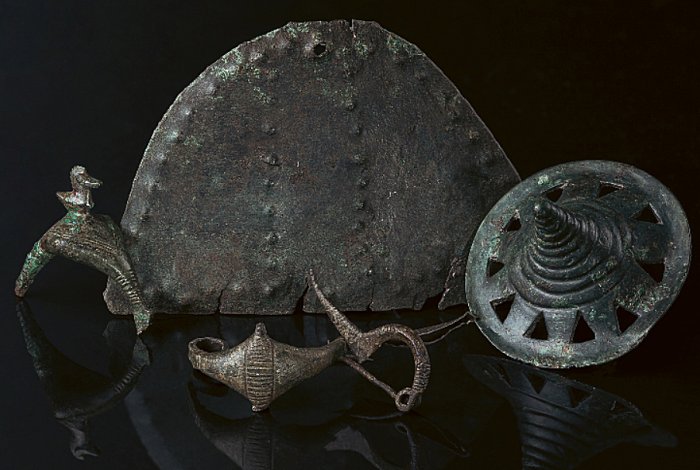
Early Iron Age metal finds from Somló Hill; the diameter of the phalerae with openwork decoration is 45.51mm; the length of the fibulae varies between 34.15 and 55.27mm; the large pendant is 90.1mm long (photograph by László György).
Most metal artefacts from Somló Hill are dated to the Late Bronze Age, when compared with findings from other hilltop settlements in western Hungary
Somló Hill is notably distinguished by possessing one of the most extensive collections of Early Iron Age metal artifacts from any hilltop site within the region. While the earliest artifacts originate from the Reinecke Bronze Age C period (1400–1300 BC), it is those from the Hallstatt B1–B2 periods (1080–900 BC) that are most abundantly represented.
Five Late Bronze Age and one Early Iron Age metal hoard have been discovered since 2023. Detailed documentation, including photogrammetry and video recording, has provided enormous opportunities for researchers to further understand Late Bronze Age depositional practices in Hungary.
Preliminary evaluation suggests deposition occurred around the Hallstatt B1 and B2 periods. Transdanubian hoards from this time are scarce and lack secure archaeological contexts.
The Hallstatt culture was one of the most important periods in the transition from the European Bronze and Iron Ages.
It was the predominant Western and Central European archaeological culture of the Late Bronze Age (Hallstatt A, Hallstatt B) from the 12th to 8th centuries BC and Early Iron Age Europe (Hallstatt C, Hallstatt D) from the 8th to 6th centuries BC
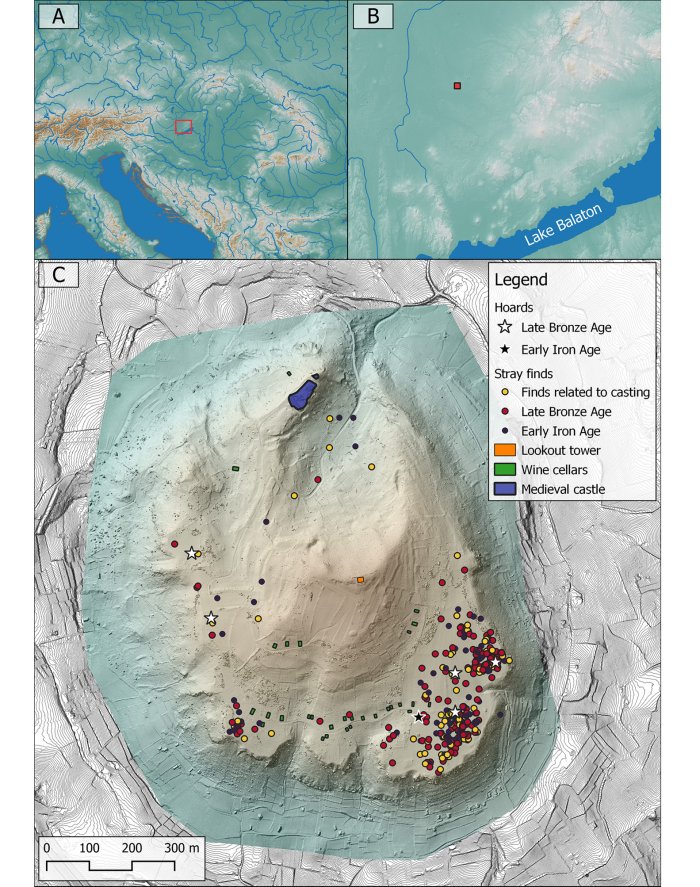
Location of the research area (A) and Somló Hill (B). A digital terrain model of Somló Hill (C) shows the locations of archaeological evidence recovered (figure by authors).
“The unearthed hoards testify to an intentional and complex hoarding tradition on Somló Hill. They offer a unique opportunity to redefine hoards during the Hallstatt B period in Transdanubia through the patterning and study of previously unknown hoard components and phenomena, using advanced analytical techniques and methods,” the researchers write in their paper.
One of the main goals of the study is to clarify the chronology of hoarding and habitation on Somló Hill in absolute terms. Hoard I contained zooarchaeological material suitable for radiocarbon dating, something that is lacking from contemporaneous hoards in the region.
Typo-chronological analysis indicates that Hoard V is probably the most recent of the Late Bronze Age depositions so far identified on the hill; radiocarbon dating of zooarchaeological material associated with this hoard, therefore, could provide a clearer chronological understanding of the transitional period between the Late Bronze Age and the Early Iron Age at the site.
Written by Conny Waters - AncientPages.com Staff Writer
More From Ancient Pages
-
 Secrets Of Ark of The Covenant Revealed In Ancient Manuscript
-
 War Between Romans And Persians Lasted 721 Years: One Of The World’s Longest Human Conflicts In History
-
 Researchers Find Oldest Evidence Of Human-Caused Lead Contamination In Aegean Region
-
 Archaeologists Discover Long-Lost Scottish Monastery Of Deer And Solve An Old Manuscript Mystery
-
 Cryptic Ice Age Markings In European Caves Deciphered – Proto-Writing Discovered By Amateur Archaeologist
-
 Deeper Look Into Chinese Swords Throughout The History Of The Dynasties
-
 Lost Treasure Of King Atterdag Remains An Unsolved Ancient Mystery
-
 Ancus Marcius: Semi-Legendary Fourth King Of Rome Obliged To Make War To Defend And Expend Territories
-
 Riddle Of The Old ‘Cursed’ Car – Supernatural Forces Or Unusual Coincidences?
-
 Lost Astronomical Treatise By Claudius Ptolemy Discovered
-
 Sonar Images Reveal The Existence Of A 700-Year-Old Shipwreck At The Bottom Of Lake Mjøsa, Norway
-
 Ancient Burial Of Woman Equipped With A Unique Gold Pectoral Ornament Discovered In Siberian ‘Valley Of The Kings’
-
 Mysterious Underground City In Brazil Could Re-Write Ancient History – Riddle Of The 12 Men – Part 2
-
 Ancient Fossil Found In Sahara Suggests Loch Ness Monster Could Be Real
-
 Operation Nightingale – Veterans Uncover Impressive 2,000-Year-Old Celtic Treasure
-
 Sensational Find: Huge Cuneiform Archive Of Mysterious Ancient Clay Tablets Discovered In Iraq
-
 Mystery Of The ‘Mummified Mermaid’ In Japan Solved!
-
 5,000-Year-Old Tavern With Food Remains Discovered In The Ancient Mesopotamian City Lagash
-
 The Aztec Sun Stone And Medusa Reveal An Intriguing Connection – Surprising Discovery – Part 1
-
 4,000-Year-Old ‘Woodhenge’ Discovered In Denmark Is An Extraordinary Find!

