
What America’s First Board Game Can Teach Us About The Aspirations Of A Young Nation
AncientPages.com - In 2023 alone, the board game industry topped US$16.8 billion and is projected to reach $40.1 billion by 2032.
Classics like “Scrabble” are being refreshed and transformed, while newer inventions such as “Pandemic” and “Wingspan” have garnered millions of devotees.
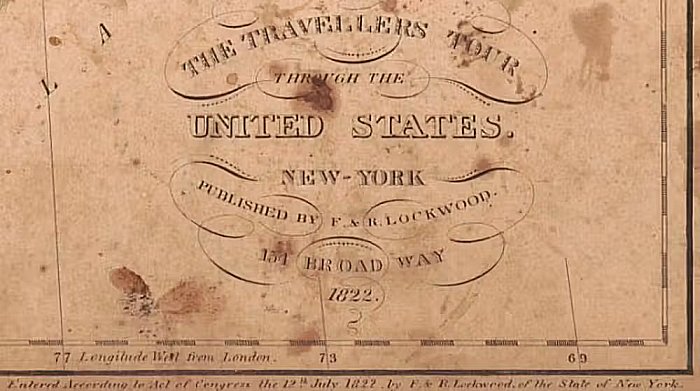
The title and printer’s address for the game. The copyright notice of July 12, 1822, appears in small type at the bottom. Library of Congress
This growing cardboard empire was on my mind when I visited the American Antiquarian Society in August 2023 to research its collection of early games.
As I sat in that archive, which houses such treasures as the 1640 Bay Psalm Book, the first book printed in British America, I beheld another first in American printing: a board game called “The Travellers’ Tour Through the United States.”
This forgotten game, printed the year after Missouri became a state, has a lot to say about America’s nascent board game industry, as well as how a young country saw itself.
An archival find
Produced by the New York cartography firm of F. & R. Lockwood, “The Travellers’ Tour Through the United States” was an imitation of earlier European geography games, a genre of educational game. Geography games generally used a map for a board, and the rules involved players reciting geographic facts as they race toward the finish.
“The Travellers’ Tour” first appeared in 1822, making it the earliest known board game printed in the U.S.
But for almost a century another game held that honor.
In 1894, the game manufacturer Parker Brothers acquired the rights to “The Mansion of Happiness,” an English game first produced in the U.S. in 1843. In its promotional materials, the company declared it “The first board game ever published in America.”
That distinction ended in 1991 when a game collector found the copy of “The Travellers’ Tour” in the archives of the American Antiquarian Society.
A new game for the new year
By 1822 the American market for board games was already becoming established, and middle- and upper-class parents would buy games for their families to enjoy around the parlor table.
At that time, New Year’s – not Christmas – was the holiday for gift giving. Many booksellers, who earned money from the sale of books, playing cards and other paper goods throughout the year, would sell special wares to give as presents.
These items included holiday-themed books, puzzles – then called “dissected maps” – and paper dolls, as well as games imported from England such as “The New Game of Human Life” and “The Royal And Entertaining Game of Goose.”
Since “The Travellers’ Tour” was the first board game to employ a map of the U.S., it might have been an especially interesting gift to American consumers.
It’s difficult, however, to gauge just how popular “The Travellers’ Tour” was in its time. No sales records are known to exist, and since so few copies remain, it likely wasn’t a big seller.
A global database of library holdings shows only five copies of “The Travellers’ Tour” in institutions around the U.S. And while a handful of additional copies are housed in museums and private archives, the game is certainly a rarity.
Teetotums and travelers
Announcing itself as a “pleasing and instructive pastime,” “The Travellers’ Tour” consists of a hand-colored map of the then-24 states and a numbered list of 139 towns and cities, ranging from New York City to New Madrid, Missouri. Beside each number is the name and description of the corresponding town.
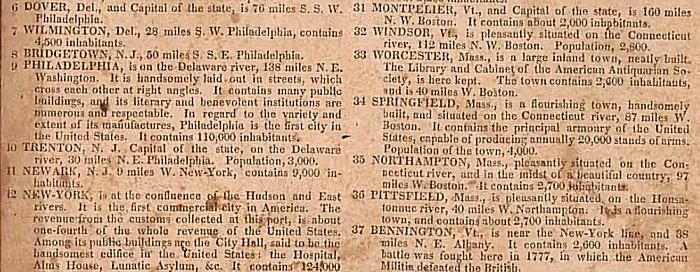
The ‘stop’ at Bennington, Vt., highlights the town’s Revolutionary War history, while Philadelphia’s entry points to the city’s educational institutions. Library of Congress
Using a variant spelling for the device, the instructions stipulate the game should be “performed with a Tetotum.” Small top-like devices with numbers around their sides called teetotums functioned as alternatives to dice, which were associated with immoral games of chance.
Once spun, the teetotum lands with a random side up, revealing a number. The player looks ahead that number of spaces on the map.
If they can recite from memory the name of the town or city, they move their token, or traveler, to that space. Whoever gets to New Orleans first, wins.

‘New-Orleans’ is the game’s ‘finish line.’ Library of Congress
An idealized portrait of a young country
Though not necessary to play “The Travellers’ Tour,” the descriptions provided for each location tell historians a lot about America’s national aspirations.
These accounts coalesce into a flattering portrait of the nation’s agricultural, commercial, historical and cultural character.
Promoting the value of education, the game highlights institutions of learning. For example, Philadelphia’s “literary and benevolent institutions are numerous and respectable.” Providence boasts “Brown University, a respectable literary institution.” And Boston’s “citizens … are enterprising and liberal in the support of religious and literary institutions.”
As the game pieces meander toward New Orleans, players learn about Richmond’s “fertile backcountry” and about the “polished manners and unaffected hospitality” of the citizens of Charleston. Savannah “contains many splendid edifices” and Columbia’s “South Carolina College bids fair to be a valuable institution.”

Teetotums were used in an era when dice were associated with vice. Museum Rotterdam/Wikimedia Commons, CC BY-SA
Absent from any corresponding descriptions, however, is any mention of what John C. Calhoun called America’s “peculiar institution” of slavery and its role in the fabric of the nation.
And while four entries briefly reference American Indians, no mention is made of the ongoing dispossession and genocide of millions of Indigenous people.
Though it promotes an American identity based on a sanitized version of the nation’s economic might and intellectual rigor, “The Travellers’ Tour” nonetheless represents an important step toward what has become a burgeoning American board game industry.
Two centuries later, board game culture has matured to the point that new titles such as “Freedom: The Underground Railroad” and “Votes for Women” push the genre to new heights, using the joy of play to teach the history of the era that spawned America’s first board game.
Provided by The Conversation
This article is republished from The Conversation under a Creative Commons license. Read the original article.
More From Ancient Pages
-
 Mystery Of Saint Brendan’s Island – Glimpses From An Alternate Reality, Fata Morgana Or A Submerged Land?
-
 Biblical Cherubim – Sweet Angels Or Dangerous Creatures With A Hidden Agenda?
-
 Heyoka – Sacred Clown Who By Doing The Opposite Helps And Guides In Daily Life
-
 Chilling Tale Of The Tailor And Odin’s Wild Hunt – Why The Norse God Warns Against Going Out On Christmas Eve
-
 Ancient Artifacts With Foreign Inscriptions And Unknown Signs Discovered In The American Southwest Reveal An Epic Story
-
 Trentren And Caicai: The Battling Serpents Of Chilote Mythology
-
 Something Unexplained Is Happening In Ancient English Caves – Reports From Numerous People
-
 Wonderful Long-Lived Nymphs In Greek And Roman Mythologies
-
 Enigma Of Ancient Upside Down Stairs At Sacsayhuamán
-
 Mnemosyne: Powerful Greek Goddess Of Memory, Bridge Between The Past And The Future
-
 Numa Pompilius – Remarkable Second King Of Ancient Rome Who Succeeded Romulus – Did He Ever Exist?
-
 Radar Discovers Huge Oval-Shaped Anomaly Beneath Ancient Egyptian City – An Archaeological Mystery In Lower Egypt
-
 Legend Of Sleeping Hero Holger Danske: Viking Warrior Who Never Died
-
 Cadmus – Legendary Phoenician Hero And Founder Of Prosperous City Of Thebes
-
 Witch Of Endor – A Biblical Ghost Story Or A Woman With Supernatural Powers?
-
 5 Lessons From Ancient Civilizations For Keeping Homes Cool In Hot, Dry Climates
-
 Arizona’s And Washington’s Baffling Beehive-Shaped Coke Ovens
-
 Enigmatic And Forgotten Polovtsian Stone Idols Of Eastern Europe
-
 Simon Magus ‘The Magician’ Who Faked Death And Resurrection
-
 Cupbearer Was Privy To Conversations And Political Secrets Hidden Behind Closed Doors

