Jan Bartek - AncientPages.com - People have used meteoritic iron to make tools, jewelry, ritual items, and even magical objects throughout history. The Inuit in northern Greenland made knives and scrapers from the Cape York meteorites. In pre-Columbian America, some meteorites were buried in rituals or turned into jewelry. In Egypt, a meteoritic iron talisman was thought to protect camels from bad luck. Today, Swiss watchmakers use iron meteorites to decorate luxury items.
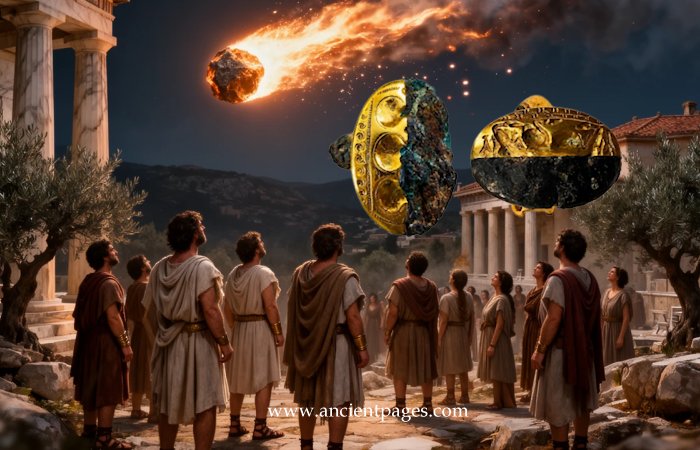
The Bronze Age stands out because smelted iron was very rare or nonexistent, so meteoritic iron was especially valuable. Recent research using modern analytical methods has found meteoritic iron at Bronze Age sites in northern Europe, the Iberian Peninsula, the Near East, and Asia.
Before now, no one had confirmed the presence of meteoritic iron artifacts in Greece using modern techniques.
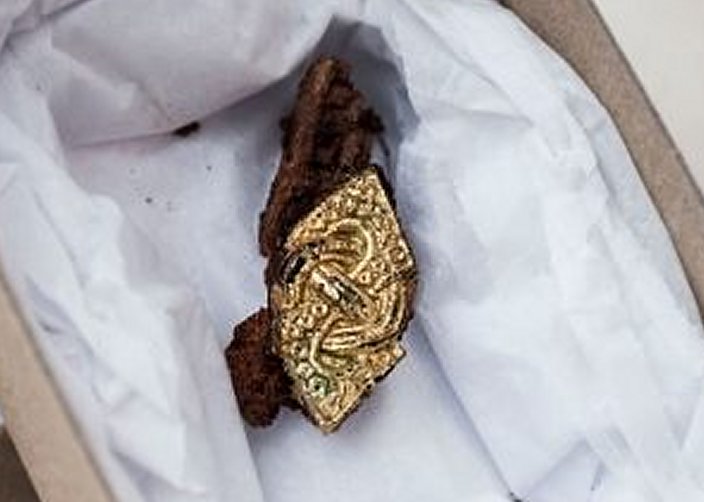
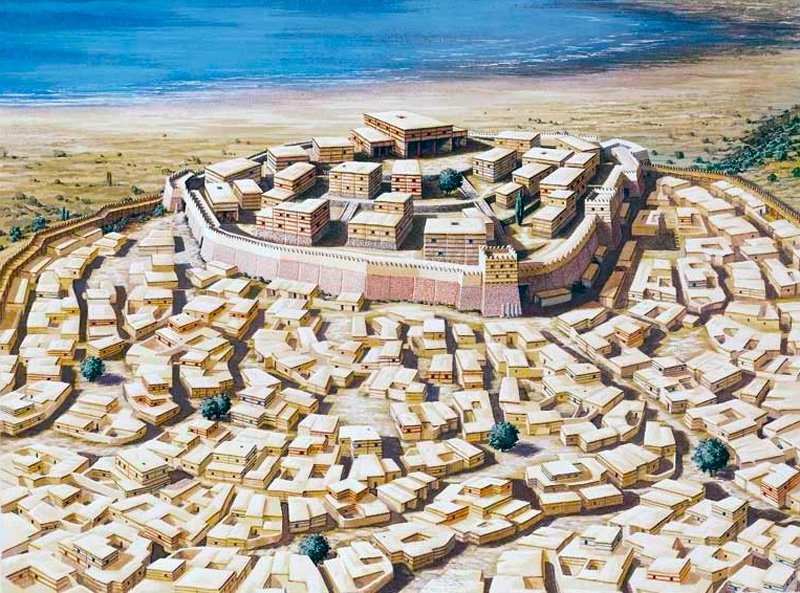
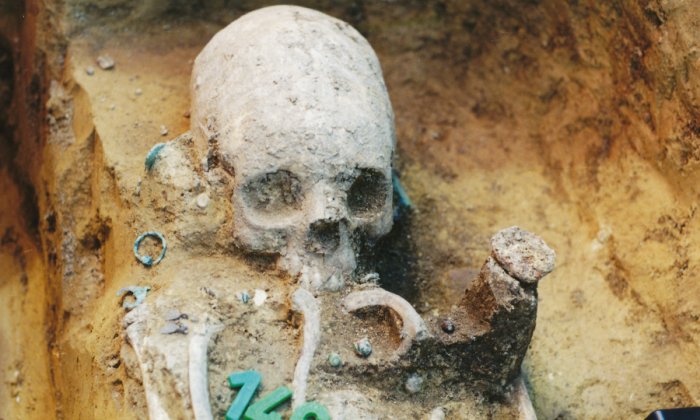
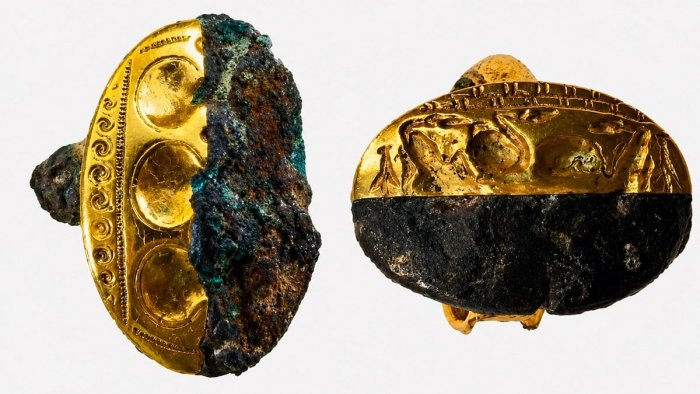
A Greek-French research team found that long before the Iron Age, leaders of the Minoan and Mycenaean civilizations in Greece probably wore rings made from meteoritic iron.
During the Bronze Age in Greece, which lasted until about 1100 BC, metalworkers could work with small amounts of iron.
Credit: Athen News
A study in the Journal of Archaeological Science reports that while most iron was mined, some came from meteorites.
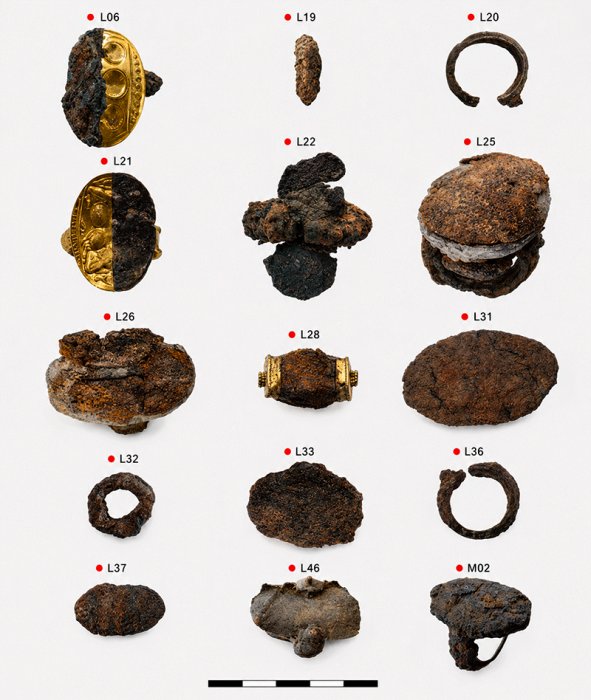
Mathieu Gounel, an astrophysicist, and Eleni Mantzourani, an archaeologist, used X-ray fluorescence to study 91 iron objects from 33 archaeological sites. These objects are between 3,000 and 4,000 years old.
Most of the artifacts, such as rings, bracelets, and tools, had only small amounts of nickel. This is normal for iron that comes from the Earth.
However, 13 rings had high levels of nickel, a common element in meteorites. The researchers say that ten of these rings were probably made of meteoritic iron, while the other three require further study.
"These observations led us to hypothesize that rings, likely made from meteorites, may have been popular symbols of power among prominent figures, members of the Minoan and Mycenaean palatial elite," the researchers write.
Credit: Athen News
But because meteorites are hard to find in mainland Greece and Crete, the metal probably came from Egypt. In Egypt, meteorites are easier to spot in the desert and stay in good condition because of the dry climate.
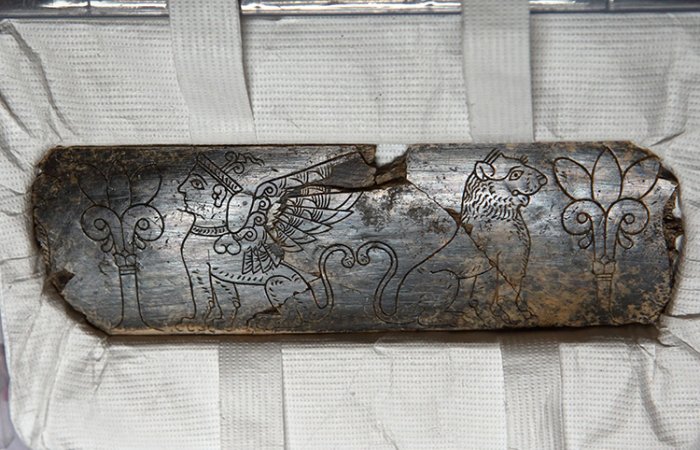
These rings are not the only objects made from meteoric iron. For example, a decorated dagger found in Tutankhamun’s tomb, dating to the 14th century BC, is also thought to be made of this material.
Two Bronze Age objects from the Treasure of Vilena in Spain, a bracelet and a scepter head, were also made from meteoric iron.
See also: More Archaeology News
The new study did not find any rings made from meteorites that date after the 12th century BC. This was about the time when the Mycenaean Civilization and other Bronze Age societies in the Mediterranean came to an end.
The researchers analyzed the chemical makeup of 91 iron artifacts from sites in mainland Greece, the Peloponnese, the Aegean Islands, and Crete. These included personal items such as rings, pendants, and pins, as well as weapons such as swords and daggers. Only four pieces were too damaged to identify. Interestingly, they did not find any tools among the artifacts they studied.
As the researchers write, "it is likely that the fashion for meteorite rings, almost exclusive to the Minoan and Mycenaean Bronze Ages, faded naturally as any fashion does."
Written by Jan Bartek - AncientPages.com Staff Writer
Expand for referencesMatthieu Gounelle, Eleni Mantzourani, Iron in Greece in the second millennium B.C.E., Journal of Archaeological Science, Volume 192, 2026, 106622, ISSN 0305-4403, https://doi.org/10.1016/j.jas.2026.106622.
in.gr