
A Rare Find In Ancient Timorese Mud May Rewrite The History Of Human Settlement In Australasia
AncientPages.com - Humans arrived in Australia at least 65,000 years ago, according to archaeological evidence. These pioneers were part of an early wave of people travelling eastwards from Africa, through Eurasia, and ultimately into Australia and New Guinea.
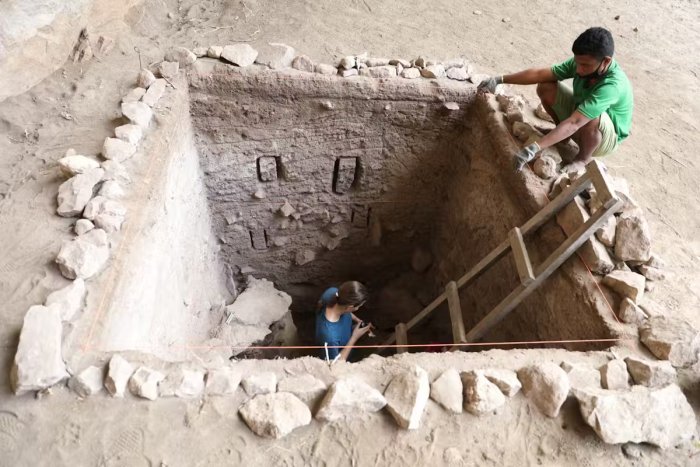
Archaeological trench in Laili rockshelter. Mike Morley
But this was only one of many waves of migration in the story of the human colonisation of the globe. These waves were probably driven by climate change and the ability of groups to adapt to a wide range of environments.
In new research published in Nature Communications, we have found evidence that a large wave of migration reached the island of Timor not long after 50,000 years ago. Our work at Laili rock shelter suggests the people who
first reached Australia some 65,000 years ago came via New Guinea, while Timor and other southern islands were only colonised by a later wave of settlers.
Potential routes to Australia
Timor has long been regarded as a potential stepping-stone island for the first human migration between mainland Southeast Asia and Australia and New Guinea. At the time of these ancient migrations, sea levels were lower, so many of what are now islands in Southeast Asia were joined to the mainland in a region known as Sunda, and Australia and New Guinea were joined together in a single continent known as Sahul.
The islands between Sunda to the west and Sahul to the east are known as Wallacaea. These islands have never been connected to each other or the mainland, owing to the deep channels that separate them. This has meant that even when sea levels were much lower than today they remained as islands.
The search for evidence of early migrations on Timor has been hampered by a lack of suitable sediments in caves and rock shelters.
However, we found a unique source of evidence at Laili rock shelter, overlooking the Laleia river in central-north Timor-Leste. Unlike other sites in the region, Laili preserved deep sediments dating between 59,000 and 54,000 years ago which contained no sign of human presence.

Map showing ancient land masses of Sunda (in the west) and Sahul, with the Wallacean Islands in between that always remained islands even during lower sea levels. Modern landmasses are shaded green, ancient ones dark grey. Huxley’s and Lydekker’s lines represent boundaries between realms inhabited by different groups of animals. Shipton et al. (2021)
On top of these layers we found clear signs of human arrival, in the dirt occurring about 44,000 years ago. This provides clear evidence that while humans were initially absent from the site and the local landscape, they subsequently arrived in what must have been significant numbers.
From other research, we also know there is evidence of humans arriving at other sites in Timor-Leste and nearby Flores Island between 47,000 and 45,000 years ago. Taken together, all this evidence strongly supports the view that humans only arrived in this region around this time.
Evidence in the dirt
Our analysis of the sediment layers at Laili suggests humans arrived in a deliberate and large-scale colonisation effort, rather than ad-hoc settlement by a small population. This is clearly seen in the earliest traces of occupation, which include hearths, dense accumulations of stone artefacts, and the remains of a diet rich in fish and shellfish.
We used a technique called micromorphology to study the layers of sediment under the microscope.

The dig at Laili rockshelter. Mike Morley
We could see the sediment from before the time of occupation did not carry signs of human presence. But when humans moved in to the site, many traces of human occupation appeared abruptly, including compressed trampled layers caused by the passage of people on the shelter floor.
Island hopping to Sahul
Our findings may prompt a re-evaluation of the route and timing of the earliest human migration into Sahul. They also show movement to the islands was an ongoing process rather than a single event, with occupation of the southern islands occurring thousands of years after the initial settlement of Australia.
The intensity of the initial occupation we found at Laili suggests this migration may have been large enough to overwhelm previous migrations in the islands of Southeast Asia and Australasia.
The earlier dispersal waves, including the people using the ancient Madjebebe rock shelter in Australia, may have been small numbers of people coming from a different route further north via New Guinea. The later wave of dispersal through the Wallacean Islands may have formed a much more significant arrival of humans on Sahul.
The absence of human occupation on Timor before 50,000 years ago indicates that humans arrived on the island later than previously supposed. This supports the theory that humans first arrived in Australia via New Guinea rather than Timor.
This path is less direct, but it may be explained by the fact the southern islands including Timor have far fewer land-dwelling animals to eat. Early colonists would have needed the flexibility to live on fish and shellfish. So moving into these southern islands could have been more challenging than the northern islands which had more medium to large land animals.
Provided by The Conversation
This article is republished from The Conversation under a Creative Commons license. Read the original article.
More From Ancient Pages
-
 Cooper’s Ferry Site In Western Idaho Was Inhabited 16,000 Years Ago
-
 Ancient Mystery Of The American Southwest – Secrets Of The Cliff Dwellers – Part 1
-
 How Did Indus Civilization Manage To Resist Climate Change?
-
 First Known Depiction Of The Biblical Heroines Deborah And Jael Unearthed On 1,600-Year-Old Mosaics
-
 Most Important Road In Scottish History Found In The Garden Of The Old Inn Cottage Near Stirling
-
 Bees Originated From An Ancient Supercontinent Millions Of Years Earlier Than Previously Thought
-
 Archaeologists Discover Builders In Mesopotamia Did Something Unusual: But Why?
-
 Which Came First: The Reptile Or The Egg?
-
 Radiocarbon Dating Of Santorini Eruption And Egyptian Artifacts Shed New Light On Pharaoh Ahmose And The New Kingdom
-
 Evidence Humans Used Fire 1 Million Years Ago In Israel Discovered By Artificial Intelligence
-
 Ancient 5,500-Year-Old Gate Was Discovered Recently At Tell Erani, Near The Kiryat Gat Industrial Zone, Israel
-
 ‘Sea Monsters’ Were Real Millions Of Years Ago: New Fossils Tell About Their Rise And Fall
-
 Oldest Giant Dinosaur Species Discovered In Argentina
-
 World’s Oldest Successful Dental Treatment Found In 60,000-Year-Old Neanderthal Tooth From Chagyrskaya Cave
-
 On This Day In History: Battle Of The Egadi Islands Took Place – On Mar 10, 241 BC
-
 Young Boy Finds A Huge Tooth From A Prehistoric Shark In South Carolina
-
 Bone Fragments Found Inside Mysterious Medieval Pendant
-
 Isabel Neville And Unsolved Mystery Of Her Death
-
 Magical Manuscripts With Thousands Of Ancient Spells Discovered In Germany
-
 Undeciphered Ancient Code Could Be Evidence Of The World’s Oldest Data Storage System

