
Hiding Tunnel Complex Dated To The Bar Kokhba Revolt Revealed Near The Sea of Galilee
Conny Waters - AncientPages.com - The archaeological excavation revealed that in anticipation of the First Revolt in 66 CE and the Bar Kokhba Revolt in 132 CE, the inhabitants of Huqoq converted a water cistern, originally constructed during the Second Temple period, into an intricate network of tunnels.

Image credit: Emil Aladjem and Dafna Gazit, Israel Antiquities Authority
The archaeological excavation site at Huqoq, located near the Sea of Galilee, has witnessed a collaborative effort involving students, local residents, and soldiers over the past few months.
The excavations have shed light on a crucial moment in Jewish history related to the preparations for the Jewish revolt against Roman rule, led by Bar Kokhba between 132-136 CE. The discoveries give insights into the construction of shelters and fortifications by the Jewish rebels, providing a tangible connection to this significant uprising and its impact on the region's historical narrative that gives accounts of real-life experiences.
This strategic adaptation was particularly important because it served as a preparatory measure for the forthcoming uprisings. In times of danger, a remarkable feat was accomplished – one of the walls of the mikveh (ritual bath) was breached, and a tunnel was excavated, leading into other subterranean spaces.
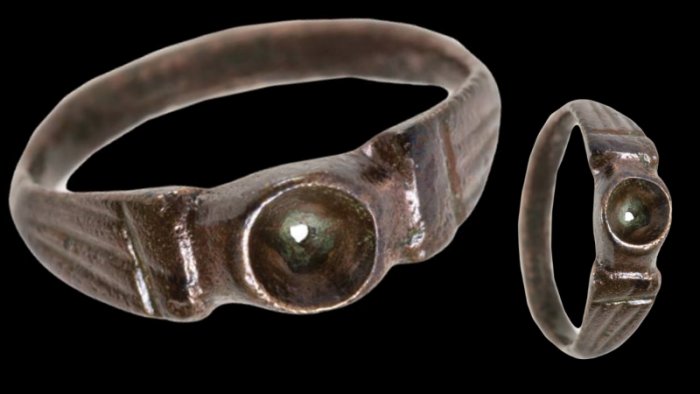
Image credit: Emil Aladjem and Dafna Gazit, Israel Antiquities Authority
This network of tunnels facilitated movement through confined areas beneath the houses, and enabeled strategic maneuvering and potential escape routes during precarious situations.
Unveiling the largest and most impressive underground system in the Galilee, this discovery is a significant milestone in the field of archaeology. The system comprises about eight chambers with connecting tunnels, strategically dug at 90 degrees to hamper the heavily armed Roman soldiers chasing the rebels.
The excavation has not only revealed the impressive underground system but has also unearthed a treasure trove of artifacts.
These include hundreds of broken clay and glass dishes, an exquisite ring with a mount for a precious stone (although the stone itself was not found), and other intriguing finds.

Image credit: Emil Aladjem and Dafna Gazit, Israel Antiquities Authority
Huqoq, a locality dating back to the Early Roman period approximately two millennia ago, is renowned as a Jewish settlement. The Jerusalem and Babylonian Talmuds refer to Rabbi Pinhas and Rabbi Hezekiah, esteemed sages from the third and fourth centuries CE, who were based in this region.
This historical account underscores Huqoq’s significance as a center of Jewish scholarship and religious life during that era.
On a hilltop near a tunnel complex, an archaeological expedition from the University of North Carolina, led by Professor Jodi Magness, has been excavating a synagogue site since 2011. The synagogue, dating back to the Byzantine period, has revealed impressive and unique mosaic floors. These mosaics are significant finds that provide insights into the artistic and cultural practices of the time.
Researchers believe that the ongoing excavation helps uncover more details about this ancient place of worship and its historical context.

Image credit: Emil Aladjem and Dafna Gazit, Israel Antiquities Authority
“The tunnel complex provides a glance at a tough period for the Jewish population in Huqoq and the Galilee in general,” said excavation directors Uri Berger of the Israel Antiquities Authority and Prof. Yinon Shivtiel of the Zefat Academic College.
“However, the story that the site tells is also an optimistic story of an ancient Jewish town that managed to survive historical tribulations.”
The researchers also add this is "a story of residents who, even after losing their freedom, and after many hard years of revolts, came out of the hiding complex, and established a thriving village, with one of the most impressive synagogues in the area.”
The discovery of the hiding complex sheds light on a long-standing debate among researchers regarding the extent of the Bar Kokhba Revolt.
This archaeological find could provide valuable insights into whether the revolt spread beyond Judea and central Israel, reaching as far as the Galilee region.
The evidence uncovered at this site may offer crucial information to help scholars better understand this significant historical event's geographical scope and impact.
Based on various findings, Berger and Shivtiel have dated the inner sections of the tunnel complex to the period when the Second Revolt began.
Their study suggests that several of these ancient structures were initially utilized as defensive fortifications during the First Revolt against Roman occupation in Judea, which took place between 66-73 CE.
“It is not certain that the complex was used for hiding and escaping during the Second Revolt, but it does appear to have been prepared for this purpose,” they say. “We hope future excavations will bring us closer to the answer.”
Written by Conny Waters - AncientPages.com Staff Writer
More From Ancient Pages
-
 Malignant Serpent God Apophis: Symbol Of Chaos And Forces Of Darkness
-
 Red-Headed Alevi In Kurdistan Could Be Guardians Of Watchers’ Secret Knowledge And Shed Light On The Excalibur Legend
-
 Young Boy Finds Unique Micro-Mosaic Cross Medallion In Jerusalem
-
 Stolen Artifacts Returned To Pompeii – Believed To Be Cursed -They Brought Misfortunes To A Woman And Her Family
-
 Secrets Of Namibia’s Fairy Circles Solved – Self-Organizing Plants Are The Creators – New Theory
-
 On This Day In History: Taoist Monk Discovers Dunhuang Manuscripts In Mogao Caves, China – On June 25, 1900
-
 Secrets Behind 2,000-Year-Old Roman Water Management Revealed
-
 On This Day In History: Great English Dramatist And Poet William Shakespeare, Was Probably Born – On Apr 23, 1564
-
 Discovery: Massive Gawro Wall Dated To The Antique Age: Was It A Symbolic Or Defensive Structure?
-
 Submerged Qin Dynasty ‘Seaside Palace’ Of China’s First Emperor – Found
-
 Munkholmen: Island With Intriguing Yet Dark And Scary History
-
 Findings From The First Temple Period Discovered In The City of David Corroborate A Biblical Event
-
 Anthropologists’ Quest To Save An Alamo Cannon
-
 Mungo Man Finally To Rest In Peace After 42,000 Years – Reburial Approved After Federal Decision
-
 North America’s Oldest Known Pterosaur – Discovered
-
 Historical Enigma Of The Ancient Werewolf Ruler – What Powers Did He Possess?
-
 Are Bones Of Apostle Peter Hidden Inside A 1000-Year-Old Roman Church?
-
 Incredible 5,000-Year-Old Temple Complex In Orkney Could Re-Write History Of Scotland
-
 Ancient City Of Hippos-Sussita And The Mysterious Disc-Shaped Copper Plates
-
 1,500-Year-Old Christian Reliquary Found In An Unknown Church In Irschen, Austria

