
New England’s Abandoned Stone Walls Deserve A Science Of Their Own
AncientPages.com - The abandoned fieldstone walls of New England are every bit as iconic to the region as lobster pots, town greens, sap buckets and fall foliage. They seem to be everywhere—a latticework of dry, lichen-crusted stone ridges separating a patchwork of otherwise moist soils.
Stone walls can be found here and there in other states, but only in New England are they nearly ubiquitous. That's due to a regionally unique combination of hard crystalline bedrock, glacial soils and farms with patchworks of small land parcels.
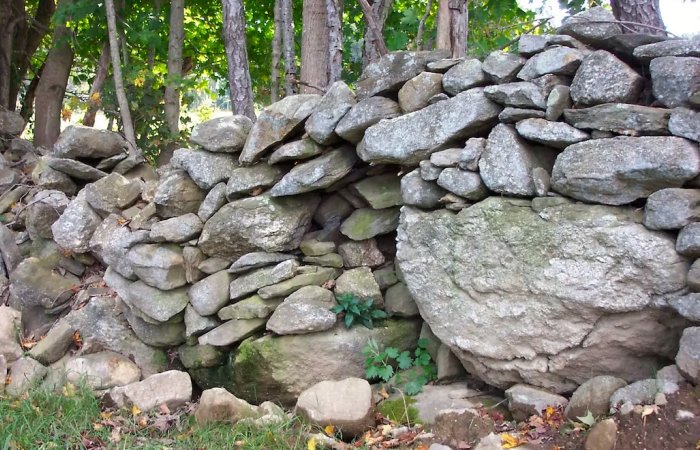
A typical New England stone wall in Hebron, Conn. Robert M. Thorson, CC BY-ND
Nearly all were built by European settlers and their draft animals, who scuttled glacial stones from agricultural fields and pastures outward to fence lines and boundaries, then tossed or stacked them as lines. Though the oldest walls date to 1607, most were built in the agrarian century between the American Revolution and the cultural shift toward cities and industry after the Civil War.
The mass of stone that farmers moved in that century staggers the mind—an estimated 240,000 miles (400,000 kilometers) of barricades, most stacked thigh-high and similarly wide. That's long enough to wrap our planet 10 times at the equator, or to reach the moon on its closest approach to Earth.
Natural scientists have been working to quantify this phenomenon, which is larger in volume than the Great Wall of China, Hadrian's Wall in Britain and the Egyptian pyramids at Giza combined. This work began in 1870 and generated the U.S. government's 1872 Census of Fences. Today, scientists are using a technique called LiDAR, or light detection and ranging, to measure and map stone walls across New England.
Being a geologist, I'm interested in walls as landforms that are distinctive to the region, created during the lead-up to the Anthropocene epoch—a time when human agency dominates all others. I've written about the history of stone walls and how to interpret them in the field, and developed the Stone Wall Initiative to draw public attention to their importance in New England. Now, I'm working with students and colleagues to develop a formal interdisciplinary science of stone walls that will help researchers understand and preserve them.
Dens and pathways
My brother-in-law enjoys his backyard wall in Lee, New Hampshire, mainly for its aesthetic, historic and literary ambiance. The wild things living in his neighborhood depend on it as unique habitat.
To lichens and moss, the wall's dry stones are surfaces where plants can't compete. For plants, such walls are edges that separate patches of ground into zones that are sunny or shady, windward or leeward, uphill or downhill, wetter or drier. Stone walls offer small mammals porous volumes in which to live their furtive lives. Predators use the walls as hunting blinds and travel corridors.
Just for fun, my brother-in-law installed a motion-activated, infrared video camera on his backyard wall to see who was using the wall and how. On June 21, 2023, the summer solstice, he filmed a bobcat (Lynx rufus) hiding behind it and then using it as an elevated pathway.
The more we researchers learn about New England's abandoned stone walls, the more we realize that they transcend and obliterate the narrow treatments of our scholarly disciplines. These archaeological artifacts are so ubiquitous that they have become a geological landform that in turn creates a novel ecological habitat. These walls also are literary icons, historic sites and spiritual oracles, as Robert Frost recognized when he penned "Mending Wall," on an old farm in Derry, New Hampshire.
But despite their importance, never have the stone walls of New England been technically defined, classified and given a common terminology in a peer-reviewed journal. They fell, it seems, through disciplinary cracks.
My initial step toward changing this situation was writing a mini-monograph in 2003 for the journal Historical Archaeology on the "Taxonomy and Nomenclature for the Stone Domain in New England." Its goal is to coalesce the study of these stone walls into an interdisciplinary science by following the precedents of other disciplines—most notably, the 18th-century Linnaean taxonomy that biologists still use today. Here's how that approach works:
Defining and classifying
Understanding the stone walls of greater New England scientifically requires starting with a technical definition that is based on field criteria rather than tradition or inference. There are many kinds of historical stone features—waste piles, cairns, scatters, lines, kilns, gravestones, cobbles, patios and more. The goal is to isolate walls as a set of objects within this larger domain.
It's nice when descriptions and classifications can be loose and flexible, as with genres of music, styles of fashion, and disciplines within academia. These are typologies, bins, pigeonholes. But to make scientific sense of the world, researchers need to convert descriptions into precise definitions and use them in binary, rule-driven classifications. These are taxonomies.
Every field of science requires its own language. Chemists group elements with similar properties, like halogens and noble gases. Biologists divide life forms into domains, kingdoms, phyla and smaller groups with shared characteristics.
Terms in stone wall science involve the size, shape, composition, source and arrangement of stones; the vertical and horizontal structures of tiers, courses and terminations; and their topographic settings on the landscape.
Stone wall classification begins with the stone domain—the entire constellation of historical stone objects. From there, we carve out a distinct class of stone walls that's separate from other rock assemblies, like concentrations and lines, as well as notable individual stones, like Plymouth Rock. Then, using diagnostic criteria, we divide the class walls into five families—free-standing, flanking, supporting, enclosing and blocking—and break them down further into types, subtypes and variants within a new taxonomy.
What stone walls can tell us
At this stage, my students, colleagues and I are just beginning to pair stone wall science with LiDAR techniques at the scale of villages. Tantalizing spatial patterns are emerging.
Different types of walls occur in predictable arrangements. For example, we commonly find well-built double walls near cellar holes, with simpler single walls at further distance and waste piles beyond those. Such patterns provide an independent source of primary documentary evidence that researchers can use to interpret past cultural behaviors, above and beyond the written documents of history and the much smaller artifacts of excavation-based archaeology.
Such spatial patterns can also be used for ecological interpretations. For example, a bobcat is more likely to hunt along a normal single wall than other subtypes because it has the required stability and height to support the cat and sufficient void space for prey to live in.
Visa detta inlägg på Instagram
These structures—these elevated drylands—are in some ways analogous to the region's wetlands, which also are landforms that farmers created or significantly modified as they settled the land in the 18th and 19th centuries. However, since the 1990s, wetlands have earned a robust science, a solid legal framework and excellent management protocols.
In my view, the time has come to do the same for New England's stone walls. These dryland structures are so ubiquitous, massive and unique relative to other habitats that it's high time for natural scientists to give them the respect they deserve.
Written by Robert M. Thorson, Professor of Earth Science, University of Connecticut
Provided by The Conversation
This article is republished from The Conversation under a Creative Commons license. Read the original article.
More From Ancient Pages
-
 Something Unexplained Is Happening In Ancient English Caves – Reports From Numerous People
-
 Unique 2,700-Year-Old Seal That Belonged To ‘Governor Of The City’ Of Jerusalem Discovered
-
 Nova Anglia: The Anglo-Saxon New England In The East
-
 On This Day In History: The Gregorian Calendar Implemented – On Oct 5, 1582
-
 On This Day In History: Agatha Christie Known As ‘Queen Of Crime’ Died – On Jan 12, 1976
-
 Gnomon: Ancient Time Measuring Instrument Used By Babylonians, Egyptians And Chinese
-
 Mystery Of The Beautiful Viking Uig Chessmen Found On The Isle Of Lewis, Scotland
-
 Beavers Had A Big Influence On How Stone Age People Lived
-
 Oldest Canoe Ever Discovered In Maine – It Dates To 1280-1380 A.D
-
 Mysterious Skeletons Of A Tall Unknown Race Discovered In California – Who Were These Beings?
-
 Ancient History Of The Christmas Tree And Its Pagan Roots – How The ‘Forbidden’ Tree Survived Against All Odds
-
 Ancient Roman Women Wore Bikini In 1400 B.C.
-
 Unexplained Historical Sighting And Archaeological Discovery Reported In Alberta By Police Officer
-
 Munkholmen: Island With Intriguing Yet Dark And Scary History
-
 Huge Ancient Mesoamerican Scorpion-Shaped Mound Served As An Astronomical Observatory – Not Just For The Elite But Farmers Too
-
 Caribbean Cannibalism Theory – Debunked By Researchers
-
 Vatican Secrets – Extraterrestrial Life And Genetically Engineering Of Humans By Advanced Alien Species
-
 Legend Of Bochica And Mysterious Ancient Stone Structures In Colombia
-
 Reconstructed Roman Gateway Tells The Story Of Britain’s Invasion
-
 British Museum Is World’s Largest Receiver Of Stolen Goods – Says QC

