
15,000-Year-Old Shell Beads Found Kebara Cave Are The Oldest Known Use Of Organic Red Pigments
Conny Waters - AncientPages.com - Located on Mount Carmel in northern Israel, the prehistoric Kebara Cave is a tremendous paleoanthropological and archaeological site. Evidence shows that the cave was occupied by humans and animals as far back as 200,000 years ago.
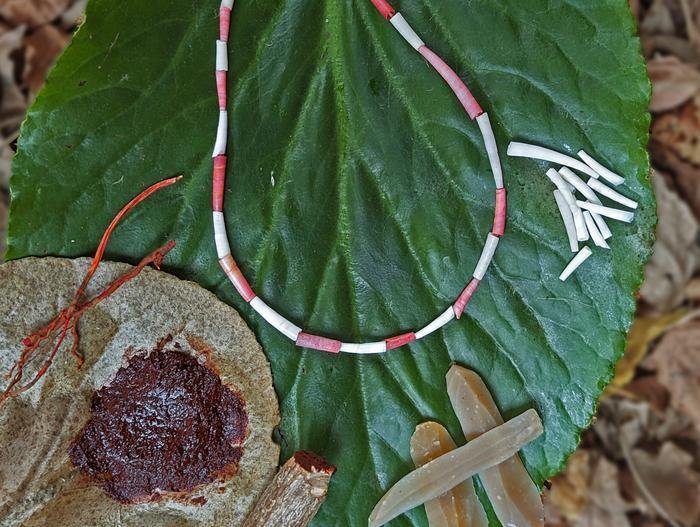
Experimental replica of shell beads with Natufian red organic colorant made of roots of Rubiaceae plant. Credit: Laurent Davin, CC-BY 4.0
One of the most famous finds in the cave is the discovery of a young skeleton known as Kebara 2 that dates to about 60,000 years ago. The find has provided scientists with valuable information about several debated aspects of Neanderthal biology.
Still, the Kebara Cave has much more to offer.
Natufian Culture Colored Shells Beads Red 15,000 Years Ago
A recent study published in PLOS ONE reports on discovering 15,000-year-old shell beads. According to scientists, the ancient shells are the oldest example of the use of organic red pigments.
"Decorating the living space, objects, body and clothes with color is a widespread human practice. While the habitual use of red mineral pigments (such as iron-oxide, e.g., ochre) by anatomically modern humans started in Africa about 140,000 years ago, the earliest documentation of the use of organic plant or animal-based red pigments is known from only 6,000 years ago," the science team writes in their study.
The color used by hunter-gatherers 15,000 years ago in the Levant is of special interest. "Humans’ perception of the red color greatly influences their affective, cognitive, and behavioral responses in achievement, affiliation and attraction contexts, researchers explain.
Based on previous findings, scientists discovered the "red effect" found to be most prominent in males, which states that wearing red enhances one’s dominance, aggressiveness, and testosterone level, facilitating competitive positive outcomes.
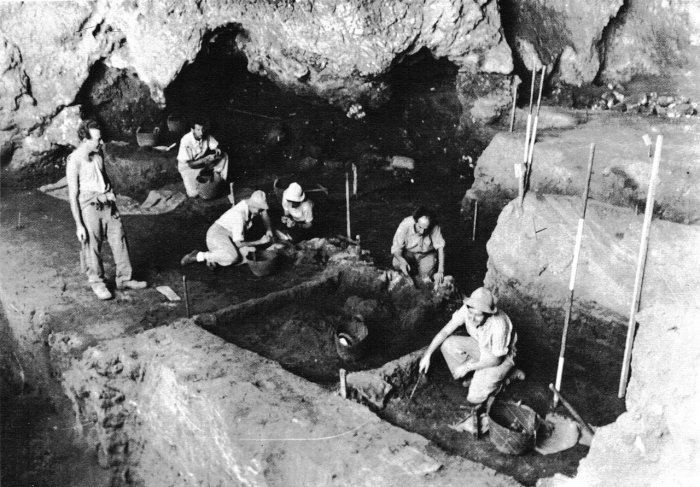
Excavation at Kebara Cave. Credit: Wikipedia
This influence of red color on the mind of anatomically modern humans probably explains, at least in part, why they started, about 140,000 years ago in Africa, to use habitually red mineral pigments, such as iron-oxide (commonly called ochre) in order to decorate their living space, objects, body, and clothes. The use of red organic pigments of plant or animal origin, which are brighter, ‘purer’, and stronger in tinting power than inorganic pigments (and therefore more attractive to human eyes), appeared only much later, ca. 6,000 years ago."
The Natufian culture lived in the region from 11,650 to 15,000 years ago. Some of the people lived in villages but some groups inhabited caves. There is evidence the Natufians appreciated artwork and enjoyed carving bones and stones. Their dead were buried in cemeteries and ornaments were placed in the burials. As time passed the Natufian culture left the hunter-gatherer lifestyle behind and focused on agriculture.
Personal Adornments From Kebara Cave
Scientists have previously unearthed 400 oval bone pendants and perforated teeth and shells in the Kebara Cave.
"However, the dispersal of these hundreds of bone, tooth and shell beads and pendants to various museums in the United Kingdom and North America immediately after the excavation has considerably limited the understanding of these adornments, of which only a small sample has been studied and published to date.

Selected bone zoomorphic figurations and oval bone pendants from the Early Natufian of Kebara Cave. Credit: PLOS ONE
It demonstrated, for the first time in a Natufian context, a sophisticated coloration of the oval bone pendants by controlled heating producing a rich variation of shades from white, grey, brown to black.
Our study of the only remaining collections in the Levant, stored at the Rockefeller Museum in Jerusalem (which represent only a small proportion of the original adornments assemblage), has allowed us to assess the considerable importance of Kebara cave in understanding the ornamental practices of the Early Natufians. T
his is notably the case for shell adornments, particularly for Kebara scaphopod beads. While, in other Natufian sites in the Mediterranean zone, the majority of the recovered shells originate from the nearby Mediterranean Sea, in Kebara, we note the existence of acquisition patterns over very long distances and in an intensity that has no equal in other Early Natufian sites in the same geographic zone," the scientists write in the study.
See also: More Archaeology News
Ancient humans colored rocks and objects red 500,000 years ago, but the use of plant-based materials to redden objects came much later. The earliest known example was from 6,000 years ago, but the current discovery in the Early Natufian site of Kebara Cave pushes the date much farther back in time.
The study was published in the journal PLOS ONE
Written by Conny Waters - AncientPages.com Staff Writer
More From Ancient Pages
-
 Beautiful Gold ‘Lynx’ Earrings Discovered In The Ruins Of The Ancient Lost City Of Ani Go On Display In 2023
-
 Knights Templar’s Legendary Sword In Stone In Terminillo Mysteriously Disappeared – Where Is It Hidden?
-
 Giant Solar Mirrors And Sophisticated Lenses – Advanced Ancient Technology Used By Our Ancestors
-
 Fascinating Ancient Artifact Discovered In Georgia Confirms Native American Legend Of A Great Catastrophe And Contact With Pre-Columbian Visitors
-
 900-Year-Old Coins And Jewelry Unearthed In Polish Village – Could They Belong To A Ruthenian Princess?
-
 Unique Find: Sacred Gate Found At The Minoan Palace Of Archanes In Crete
-
 Mystery Of The Kusanagi Treasure: The Legendary Sword
-
 Wreckage of The French Steamship That Sank In Atlantic In 1856 Found Off The Coast Of Massachusetts
-
 On This Day In History: British Forces Captured Gibraltar – On August 3, 1704
-
 Engraved Trees Are Living Records Capturing The Rich History And Traditions Of The Sámi People
-
 Acta Diurna: World’s First Newspaper Appeared In 131 B.C
-
 Huge Ancient Underground Stone Circle Discovered Inside Cornwall Neolithic Henge
-
 Enigma Of Giant Statue Of Kouros Of Apollonas
-
 Ancient Lost Empires And Treasures Discovered In Afghanistan By Spy Satellites
-
 Chromium Steel Was First Produced In Ancient Persia
-
 Strange Mist, Unexplained Vanishings And Other Bizarre Incidents – What Is The Connection?
-
 Ancient Mystery Of The Oghars – An Unusual And Little-Known Lost Race
-
 The Sumerian King Who Received A Divine Tablet With Secrets Of The Gods And Changed History Of Mesopotamia
-
 Middle Iron Age And Roman Period Buildings And Relics Discovered In Bedfordshire, UK
-
 London’s Underground Rivers Were Deliberately Hidden

