
Five Witchcraft Myths Debunked By An Expert
AncientPages.com - About 400 years ago, the European witch hunts were at their peak. Between the 15th and 18th centuries, an estimated 50,000 people, mostly women, were executed for witchcraft across Europe.

Witches on broomsticks, featured in The History of Witches and Wizards (1720) The Wellcome Library
They were accused of devil-worship, heresy and harming their neighbours by using witchcraft. The 1620s was the most intense phase of persecution in places like Eichstätt in Germany, where almost 300 witches were executed between 1617 and 1631.
The witchcraft trials have endured as a matter of curiosity, entertainment and debate. But despite this interest, popular understandings of the European witch-hunts are riddled with error and misconceptions. So, given it’s the season of the witch, it’s time to dispel some myths.
1. Witchcraft is a medieval idea
It isn’t – it’s modern. The Christian church was sceptical about the reality of witchcraft until the 15th century. Even then, many theologians and clergymen did not believe that witchcraft was a threat.
The first trials of people who were believed to be malevolent worshippers of the Devil who actively caused harm happened in the 15th century. The most intense period of witch hunting ran from about 1560 to about 1630.
Before that there were very few witchcraft trials, because acts of witchcraft were believed to be an illusion caused by the Devil with the permission of God.
2. Witchcraft trials occurred everywhere
Most witchcraft trials happened in central, western, or northern Europe. These were the areas which were the cradle of the Protestant and Catholic Reformations, which saw the transformation of the religious geography of Europe. And the northern Renaissance and the scientific revolution had transformed how the world was understood.
More than 50% of all trials in Europe happened in Germany. But even there, witch persecution was limited to a few of the very many autonomous and semi-autonomous territories of which it was comprised.
In places like Iceland and Wales, there were very few witchcraft trials at all. It seems that local beliefs about magic and witchcraft, alongside the attitudes of clergymen and judges, may be the reasons for this.
3. The Inquisition tried and executed most witches
The Roman, Spanish and Portuguese Inquisitions, established in the 16th century, were responsible for dealing with matters of heresy. They have become notorious for their rigour in rooting out opposition to Catholic orthodoxy. Yet, they burned very few witch suspects. Across the whole of the Iberian and Italian peninsulas, the inquisitions executed fewer suspects than were hanged in England.
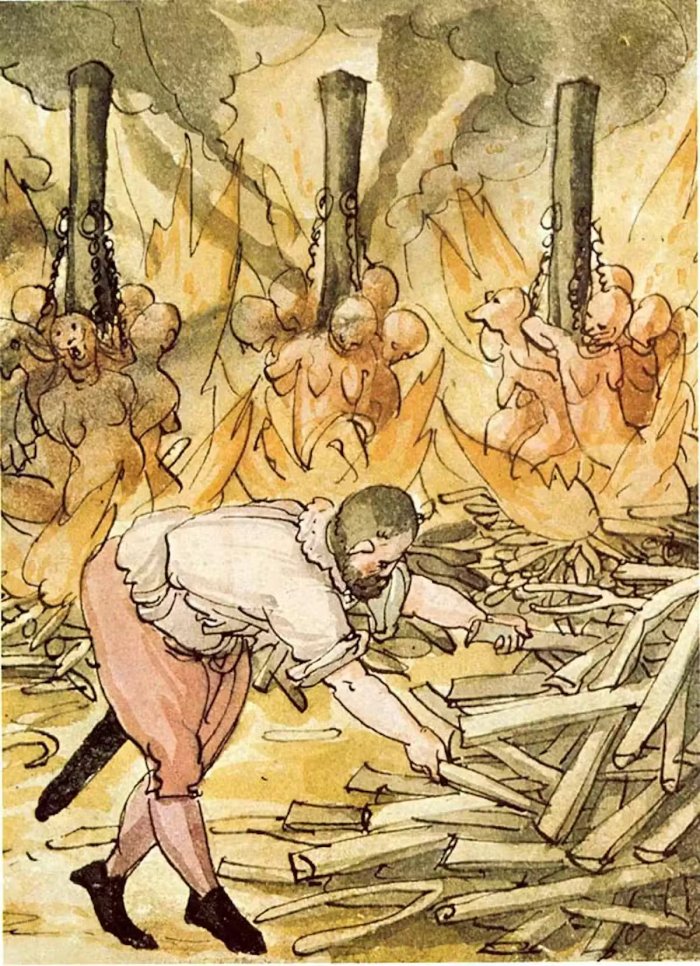
The execution of alleged witches in central Europe, 1587. Zurich Central Library/Wikimedia
The Spanish Inquisition put a stop to the witchcraft trials that had spilled over from France in the early 17th century by assuming jurisdiction over
witchcraft accusations.
4. Only women were tried for witchcraft
It’s true that 80% of those tried and executed for witchcraft were women. Many witch hunters, like those in Eichstätt, also selected female suspects over male ones, even though the evidence could be very similar.
However, in some places, like Russia, it was men who formed the majority of witch suspects. This was primarily because Russians conceptualised gender very differently to people in western Europe.
Regardless of whether the witch suspects were accused before magistrates or denounced under torture, their female neighbours were the ones most likely to accuse them.
In England, women on the margins of society were more vulnerable to accusations of witchcraft when things went wrong for their neighbours, such as inexplicable deaths or harm. This was the case with Ursley Kemp, one of the two witch suspects of St Osyth, Essex, who were hanged in 1582. Kemp was a marginal figure in the town, a woman with an illegitimate son making ends meet through her healing skills.
In Eichstatt, it was a product of the processes of torture. When the suspects (more than 90% of whom were women) had to name names under torture, they gave those of their neighbours. The suspects’ networks were founded on their sex; women named women and the few male suspects named men.
5. Witches were really the followers of a pagan fertility cult
This myth was promoted by the Egyptologist Margaret Murray in the early 20th century and was then debunked by the historian C. L'Estrange Ewen almost as soon as it appeared. It was founded on a partial reading of the available witchcraft evidence.
It persisted because Murray wrote the Encyclopaedia Britannica article on witchcraft that remained in print for 40 years, until 1969, and actively supported the new Wiccan religion in print in the 1950s. This new religion was founded by Gerald Gardner who revived what he believed to be ancient pagan witchcraft in the 1930s. But it has no material connection to any form of historic witchcraft.
Most witches were ordinary Christian women who found themselves accused of witchcraft by their neighbours, or denounced by other suspects under torture.
Written by Jonathan Durrant Principal Lecturer in History, University of South Wales
Provided by The Conversation
This article is republished from The Conversation under a Creative Commons license. Read the original article.
More From Ancient Pages
-
 Ghostly Appearance Of Weird Ancient City Suspended In The Sky Witnessed By Many People
-
 Mysterious And Feared Underground World That No One Can Visit And Return To Tell About – Cherokee Reveal A Secret
-
 Ancient Expensive Roman Domus With Beautiful Mosaic Unearthed In Rome
-
 Extraordinary Biblical Frescos Uncovered In Domitilla Catacombs
-
 Surprising Discovery Of Rare Turtle Statue Under Bayon Temple In Angkor, Cambodia
-
 Arrival Of A Mysterious Figure Triggers Unexplained Phenomena In Iceland – Strange Story From A Norse Saga
-
 ‘Golden Man’ – Sak Warrior Covered With Thousands Of Pieces Of Gold – More Light On Gold Techniques Used In Kazakhstan
-
 Legendary Pirate Black Sam And His Ship Discovered Off The Coast Of Cape Cod
-
 On This Day In History: The U.K.’s First Murder Case Solved By A Fingerprint – On March 27, 1905
-
 Peru’s Mysterious Monte Sierpe (Band Of Holes) May Have Been An Ancient Inca Accounting System
-
 Unraveling the mystery of the Rhynie Man
-
 Fragments Of Old City’s Fortifications And Carved Hand Imprint Unearthed In Jerusalem
-
 Why Did Modern Humans Replace The Neanderthals? The Key Might Lie In Our Social Structures
-
 Pre-Columbian People Of The Amazon Altered Their Landscape Thousands Of Years Earlier Than Previously Thought
-
 15,000-Year-Old Shell Beads Found Kebara Cave Are The Oldest Known Use Of Organic Red Pigments
-
 Unique Viking Age Runestone With A Cross And Animal Biting Its Own Tail Discovered By Farmer In Sweden
-
 On This Day In History: Battle Of Durnstein Was Fought On The River Danube – On Nov 11, 1805
-
 More Than 2,000 Seal Impressions Found In The Ancient City Of Doliche
-
 Beautiful Zeugma-Like Mosaics Unearthed In Sinop Province, Northern Turkey
-
 Long-Lost Ancient Maya Kingdom Unearthed In Mexico

