
Ruins Of 2,300-Year-Old City Of Jiaohe On The Silk Road
A. Sutherland - AncientPages.com - Jiaohe (in Chinese: 'where two rivers meet') is considered one of China's oldest, largest, and best-preserved earthen cities.
It was built 2,300 years ago, and its ruins are located along the Silk Road in the Yaernaizi Valley, 10 kilometers (6.2 miles) west of Turpan in Xinjiang Uygur Autonomous Region, China.
 Ruins of Jiaohe, a city where all the buildings were dug from earth and wood was rarely used. Credits: China Tour Guide
As wood was rarely used, all its buildings were constructed from the earth. People dug houses and rooms downward from the ground and built them with dried bricks.
Jiaohe's main street was long and went down to the center of the islet (1650 m in length, 300 m wide), dividing the city into two parts. The western part was for ordinary people, and the rulers lived in the east. In the northwestern part of the city is a Buddhist monastery, and around China's oldest Buddhist stupa, there are 25 smaller stupas built in all directions.
 Buddhist stupa at Jiaohe Ruins. Photo: commons.Wikimedia
Jiaohe, which covered 220,000 square meters (2,368,168 square feet), was not like many other ancient cities.
First, it had only two city gates; the South Gate was the main one and vanished long ago, and the East Gate was cut from the side of the cliff, and a few remnants are still recognizable today.
No house gates faced the streets; military defense was seemingly the highest priority for this desert military town with a stronghold from 1,600 years ago.
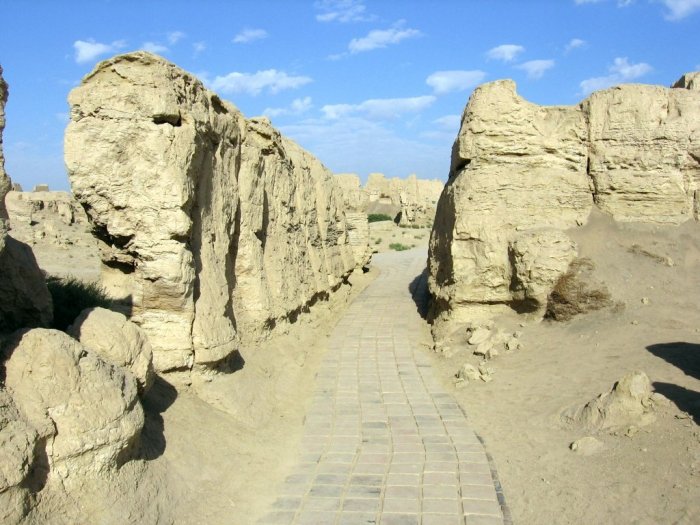
Turfán (Turpan/Tulufán) es una ciudad-oasis en la Región Autónoma Uigur de Xinjiang en la República Popular China. Ruinas de la antigua ciudad de Jiaohe. Image credit: Colegota - CC BY-SA 2.5 ES
According to Tang dynasty records, Jiaohe had a population of 7,000. Second, typical city walls that usually surround other ancient cities were never found in the town; instead, Jiaohe faced cliffs on three sides.
Both excavations and historical records reveal evidence that Jiaohe (or 'Yarkhoto') was a flourishing ancient trading center and Jiaohe's military importance.
Sir Marc Aurel Stein (1862 - 1943) was a British archeologist and explorer of the Silk Road who traversed 25,000 miles of central Asia and western China. He suggested that the name 'Yarkhoto' is a combination of Turkic and Mongolian words.

The ancient city of Yar?ol near Turpan in the Xinjiang Uyghur Autonomous Region of the People’s Republic of China Image credit: Gregor Kneussel - CC BY-SA 3.0
With a history of more than 2,000 years, Jiaohe Ancient City stands isolated on a 30-meter-high plateau in the Ya'ernaizi Valley, 10 kilometers east of Turpan. The whole city of Jiaohe Ancient City stretches about 1650 meters from south to north and 300 meters from east to west.
The relics, still identifiable in this unique city, originated from Tang Dynasty (618-907) architectural style. According to Tang Dynasty historical records, Jiaohe was the capital of the Jushi Kingdom in 108 BC and remained until 450 AD.
Archaeological excavations revealed traces of the Jushi Kingdom at Jiaohe Valley, shedding more light on the early period of the region.
Later, Jiaohe continued to be an essential site for the Silk Road until it lost importance and was eventually destroyed by Genghis Khan.
Written by – A. Sutherland AncientPages.com Staff Writer
Updated on April 25, 2023
Copyright © AncientPages.com All rights reserved. This material may not be published, broadcast, rewritten or redistributed in whole or part without the express written permission of AncientPages.com
Expand for referencesMore From Ancient Pages
-
 King Ur-Nammu – King Of Ur, King Of Sumer And Akkad – The One Who Built The Temple Of God Enlil
-
 Enigmatic ‘Stone Sleepers’ – Megalithic Tombstones ‘Stecci’ In The Western Balkans
-
 Oldest Known Spearthrowers Found At 31,000-Year-Old Archaeological Site Of Maisières-Canal
-
 Hidden Details Discovered In Picasso’s Painting The Crouching Woman
-
 Newly Discovered Papyrus Reveals An Intriguing And Gripping Criminal Case From The Roman Empire
-
 Roman-Byzantine Grave Unearthed In Turkey
-
 Restoration Of Valuable 4th Century Silk Tunics Attributed To St. Ambrose Takes Place In Milan
-
 Amazing Artifacts Found In Viking Double Grave In Norwegian Garden
-
 Cryptic Ice Age Markings In European Caves Deciphered – Proto-Writing Discovered By Amateur Archaeologist
-
 Coricancha – Stunning Golden Garden And Lost Treasures Of The Inca
-
 Mystery Of The Langeid Viking Sword And Its Undeciphered ‘Magical’ Inscriptions
-
 Secret Ancient Powers Of Jade: Sacred Green Healing Stone That Can Conquer Time And Guarantee Immortality
-
 Amazing Time Capsule – La Roche-Cotard Cave Sealed For 50,000-Years Offers Evidence Neanderthals Were The World’s First Artists
-
 Afterlife Of Egyptian Religious Statues Intentionally Hidden In The Temple Of Ptah At Karnak
-
 Ancient Secrets Of Mankind And The Anunnaki Revealed On The 14 Tablets of Enki
-
 Study Of Ancient Skulls Sheds Light On Human Interbreeding With Neandertals
-
 Who Was “Shimon”, Whose Name Appears On A 2,000-Year-old Hebrew Inscription?
-
 Beehive’ Adobe Houses Of Ancient City Of Harran, Upper Mesopotamia
-
 Aboriginal Australians Were World’s First Astronomers Who Discovered Variable Stars – Astrophysicist Says
-
 What Was The True Meaning Of Pankration And Other Ancient Games

