
Hidden Details In Ancient Egyptian Tomb Paintings Revealed By Chemical Imaging
AncientPages.com - The walls of ancient Egyptian tombs can teach us much about the lives of the pharaohs and their entourages. Tomb paintings showed the deceased and their immediate family members involved in religious activities, the burial itself, or feasting at banquets and hunting in the Nile marshes.
But many such tombs were looted in antiquity and later on, or roughly excavated by foreign treasure hunters and early archaeologists. As a result, much of the painted decoration has suffered damage, despite being well-preserved by the arid environment.

XRF study of the painting of Ramesses II. Credit: Martinez et al., 2023, PLOS ONE., CC BY-SA
Reconstructing those damaged sections of painted decoration has largely been done through educated guesswork, but a new study reveals how a technique called portable X-ray fluorescence (pXRF) is being used to study ancient materials and identify remnants of decoration which are either faint or entirely invisible to the eye.
Elaborate tomb decoration, designed to reflect the status and esteem of the deceased person within, reached its zenith during Egypt’s 18th and 19th dynasties (1550-1189 BCE) in ancient Thebes (modern Luxor). Royals were buried in the Valley of the Kings and the Valley of the Queens.
Members of the court and other high-ranking officials were laid to rest in several locations on the western bank of the Nile, close to the mortuary temples of the kings they served in life. Their tombs were cut into the rock, the rough-hewn walls of the chambers covered in plaster to provide a smooth surface for teams of artists and draughtspeople.
The decorative motifs they painted were not static, but changed from the 18th to the 19th dynasties. The former focused on vibrant scenes of the natural landscape and daily life, while more austere religious scenes were preferred during the later period.
The paints and pigments used by the ancient Egyptians were made from minerals and as such, have specific chemical markers. Yellow, as an example, was achieved by grinding up the arsenic sulfide orpiment, whereas blue pigment could be created using hydrated copper chloride, and red with iron oxide. By using portable X-ray fluorescence, scientists can use these chemical markers in the pigments to create a map of damaged areas.
Physics and Egyptology
The fields of archaeology and Egyptology have a long history of using tools and techniques developed by other disciplines. Developed in the early 20th century by physicist Henry Moseley, XRF and pXRF measure secondary X-rays given off by a material when bombarded with primary X-rays. These signals can then be used to determine the material’s elemental composition.
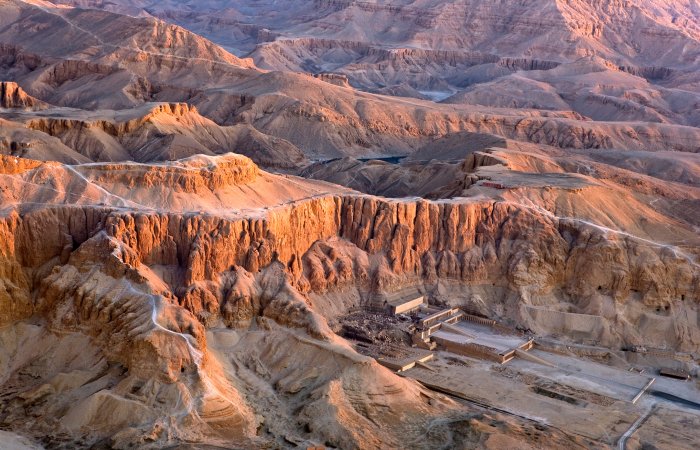
Valley of the Kings. Credit: Adobe Stock - WitR
Rather than the bulky (and immobile) analytical equipment frequently used to study archaeological artefacts in labs, the equipment needed to conduct a pXRF analysis weighs only a couple of kilogrammes and can easily be taken into the field.
While pXRF has been used in the past to determine the chemical composition of ceramics and metals, a new international research project headed by Philippe Martinez from Sorbonne University has recently used it to analyse the complex and beautiful paintings found in the tombs of Egyptian nobles.
Reconstructing ancient art
The process is not useful only for reconstructing damaged sections, it also has the potential to illuminate elements of artistic technique. In the 18th dynasty tomb chapel belonging to the Overseer of the Fields of Amun, Menna (TT69), the team identified a phantom arm on the portrait of the tomb owner.
This third arm, which would have been invisible when the tomb was first finished, is the result of an alteration to the stance of the subject, made for unknown reasons by the painters. In this way, the technique can show stages of decoration and technical or aesthetic choices made by artists many thousands of years in the past.
In addition to the tomb of Menna, the team also analysed a portrait of Ramesses II found in the tomb of Nakhtamun, which has traditionally been dated to the 19th dynasty.
The painting contained several subtle alterations, including to the shape of the royal sceptre held by the ruler (maybe to avoid it colliding with the figure’s face). The necklace worn by the king may also have been changed, and this change, the team behind the project claims, may have significance for the dating of the tomb.
They suggest that the king was first depicted wearing a type of necklace known as a shebyu, which was popular during the 20th dynasty, some years after Ramesses II’s death.
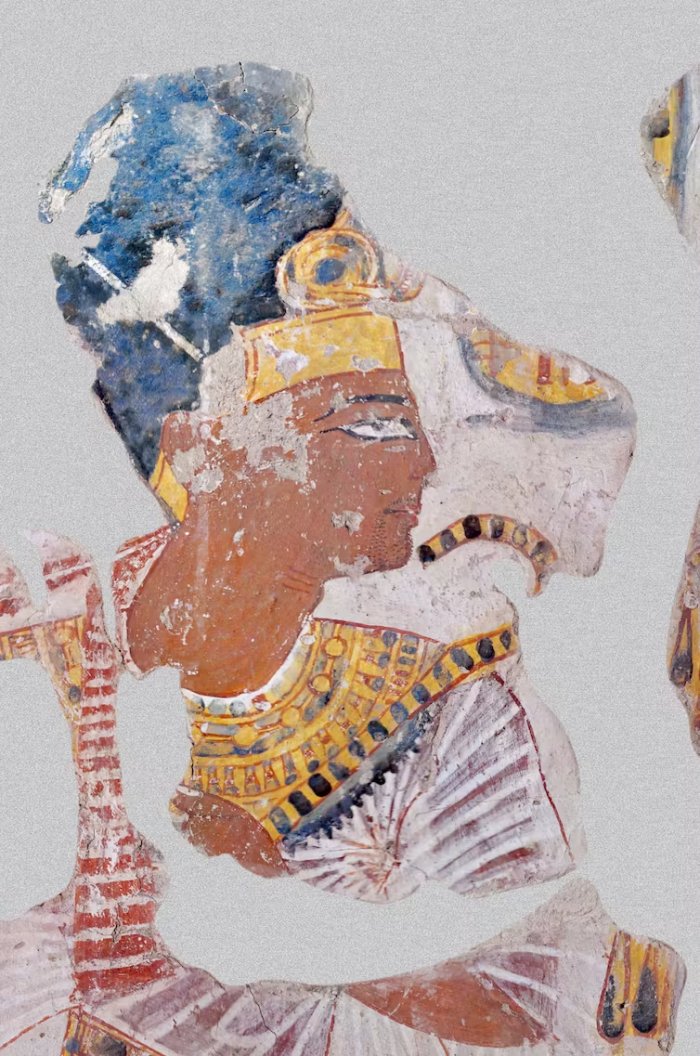
Portrait of Ramses II in Nakhtamun tomb, Chief of the Altar in the Ramesseum (tomb TT 341, possibly 20th Dynasty, circa 1100 BCE). Martinez et al
This original necklace seems to have been altered to another type, known as a wesekh, which was more popularly used in royal depictions during his lifetime. It seems that the tomb painters originally depicted this 19th-dynasty ruler wearing 20th-dynasty jewellery, realised their error and then made the necessary alterations.
This in turn, may then suggest that the tomb owner, Nakhtamun, actually lived and worked during the 20th rather than the 19th Dynasty, and that the portrait of Ramesses II is not the portrait of the living king, but rather of the deceased and deified ruler.
Scientific analysis is increasingly being incorporated into most facets of Egyptological research from material analysis of pigments, ceramics, metals and wood, to spectroscopic analysis of ancient Egyptian papyrus.
These techniques not only allow minimally or non-invasive investigations which help to preserve artefacts and prevent further damage, they also illuminate crucial details about the technological and artistic achievements of the ancient Egyptians.
Written by Nicky Nielsen, Senior Lecturer in Egyptology, University of Manchester
Provided by The Conversation
This article is republished from The Conversation under a Creative Commons license. Read the original article.
More From Ancient Pages
-
 Scientists Question Whether Meat Eating Really Changed Human Evolution
-
 41,500-Year-Old Ivory Pendant Is The Oldest Evidence Of Humans Decorating Jewelery In Eurasia
-
 Who Was The Mysterious Spitalfields Roman Noblewoman Dressed In Silk Found In A Sarcophagus In London?
-
 Mythical Shield-Maidens Did Exist – Evidence Of Female Viking Warriors Discovered
-
 1,200-Year-Old Rock-Cut Temple Found On Banks Of Arjuna River,Tamil Nadu, India
-
 First Book Of Breathing: Egyptian Papyrus Sheds Light On Funerary Text Helping The Deceased In Afterlife
-
 Tomb Of Te K’ab Chaak, First Ruler Of Ancient Maya City Caracol – Discovered
-
 Why Did Neanderthals Visit A Special Cave In Jersey For Over 100,000 Years?
-
 On This Day In History: Vädersol Painting Depicting ‘Sun Dog’ Phenomenon Observed Over Stockholm – On Apr 20, 1535
-
 Diet And Social Changes In Central Europe Around 1500 BC
-
 Ancient Disc-Shaped Copper Ingots Found In Shipwreck At Bulgaria’s Sea Coast
-
 Viking House The Size Of Two Tennis Courts Discovered In Norway
-
 The Americas Were Not Populated Via The Ice-Free Corridor More Than 15,600 Years Ago – New Study Of Boulders Reveals
-
 Remarkable Discovery Of A 19th-Century Boat Buried Under A Road In St. Augustine, Florida
-
 Archaeologists to revisit Fort Rock Cave, Oregon – site of the world’s oldest sandals
-
 Neanderthals Had More Children And Lived In Smaller Groups Than Was Previously Thought
-
 Ancient Coffin Of Priest Psamtik, Son Of Osiris And Five Replicas Of Goddess Maat Sent On Upcoming Expo
-
 New Archaeological Discoveries In The Temple Of Khnum At Esna, Luxor
-
 Chilling Graffiti Found In 1,600-Year-Old Roman Prison In Corinth, Greece
-
 Frey: Vanir God Of Fertility And Lord Of The Elves In Norse Beliefs

