
Yazılıkaya: One Of The Most Striking Religious Shrines Of The Hittite Empire
A. Sutherland - AncientPages.com - The fascinating ancient Hittite sanctuary of Yazilikaya ('rock with writing') lies between rock outcroppings at the foot of the high ridge east of Hattusha, 170 kilometers east of Ankara and near the small town Boğazköy (Turkish: "Gorge Village") modern Boğazkale, Turkey.

Lion Gate, Hattusa, Turkey. Image credit: Bernard Gagnon - CC BY-SA 3.0
Archaeologists date the earliest settlement in the city of Boğazköy, which was discovered in 1834, to 3000 BC. Still, nothing is known about the identity of the first settlers of Boğazköy because there are no written documents that could shed light on the local history of this region.
However, remains of the ancient 'Great Fortress' (Büyükkale) on the east side of Boğazköy confirmed that it later became the acropolis of the Hittite kings.
The earliest written sources found at Boğazköy are clay tablets inscribed in cuneiform writing in the Old Assyrian language.
An open-air Hittite sanctuary, Yazilikaya, is one of the most striking religious shrines of the Hittite Empire (1400-1200 BC), and many gods and goddesses were worshiped there during this time.
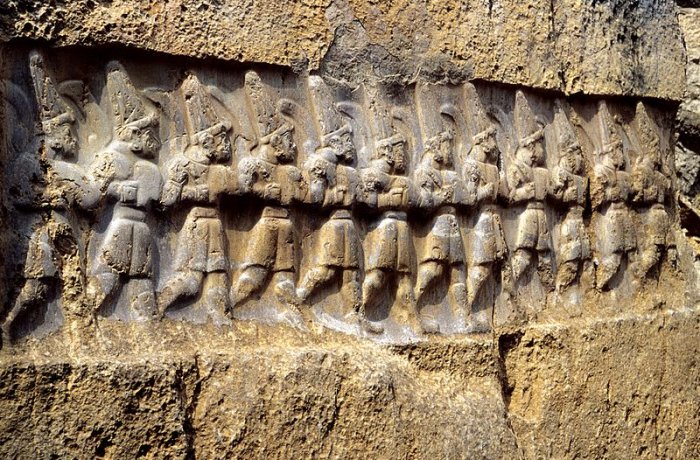
Yazilikaya, Hittite sanctuary near Hattusa, Turkey, Chamber B Procession of the 12 Underworld Gods. Image credit: Klaus-Peter Simon - CC BY 3.0
Worshippers would pass through the temple and find themselves in the rock sanctuary with walls richly decorated with bas-reliefs depicting Hittite deities in pointed caps or magnificent tiaras on their heads.
Many rock reliefs exist in other Hittite sites, but they are smaller and more impressive than the galleries of gods at Yazilikaya. The reliefs in the shrine's main chamber include two long processions of gods that converge on a large rock face at center stage, where the famous Weather God of Heaven, Teshub, faces his consort.
Teshub was worshipped as the "King of Heaven, Lord of The Land of the Hatti." He is depicted as a bearded man, dressed in a kilt, with an ax in his belt, holding a spear in one hand and a symbolic flash of lightning in the other.
The gods are depicted on the west, and the goddesses on the east side of the gallery. Unfortunately, archaeologists have been able to identify only a few of these prominent figures.
Sharruma, the son of the two great gods renewing their marriage vows, stands right behind his mother and leads the line of divine ladies. On the west wall of the sanctuary, Shaushga, the Hittite version of the planet Venus as the goddess of war, marches with the men.
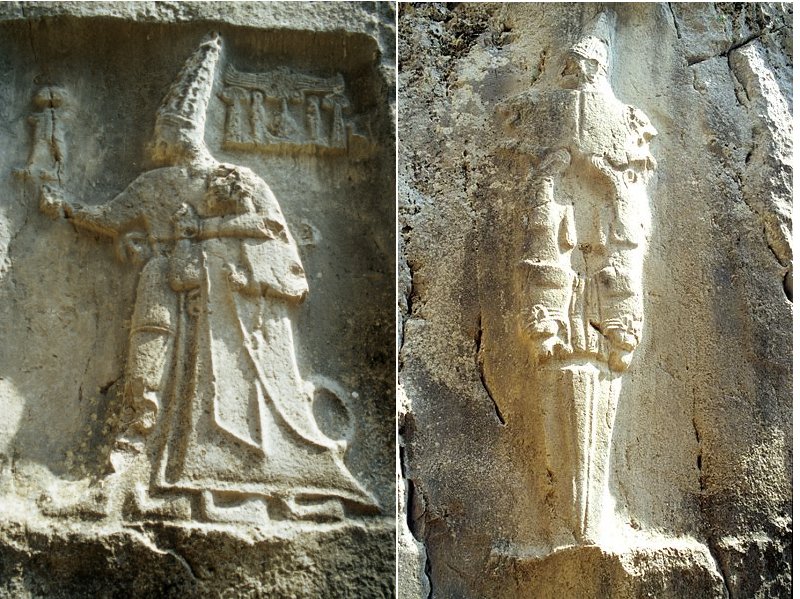 Left: Rock carving in Chamber B depicting god Sharruma and King Tudhaliya dated to around 1250 - 1220 BC. Image credit: - CC BY 3.0; Right: Nergal, the underworld god in the era of Old Assyria and Old Babylonia. Image credit: - CC BY 3.0.
Archaeologists also recognized Telipinu, the son of the weather god and the patron god of vegetation, holding a twig or an ear of corn. The procession has many different winged figures, but only the Moon-god from Mesopotamia is recognizable. Interestingly, the carved hieroglyphics accompanying the gods at Yazilikaya identify the gods with Hurrian names. The Hurrians founded the kingdom of Mitanni southeast of the Anatolian plateau in northern Mesopotamia and eastern Syria.
Their language was not related to the Semitic peoples of Babylon or the Hittites.
Interestingly, the carved hieroglyphics accompanying the gods at Yazilikaya identify the gods with Hurrian names. The Hurrians founded the kingdom of Mitanni southeast of the Anatolian plateau in northern Mesopotamia and eastern Syria. Their language was not related to the Semitic peoples of Babylon or the Hittites.
Puduhepa, for example, the Hittite queen, came from Kizzuwatna, a Hurrian province in the southern lands of the Hittite empire, later known as Cilicia. The daughter of a priest and as a priestess herself, she brought tablets inscribed with the names of the gods to her Hittite husband. She was married to Hattushili III (1275— 1250 B.C.), who, along with their son, Tudhaliya IV (1250— 1220 B.C.), was ordered to carve the sculptures at Yazilikaya.

Yazilikaya Chamber B, Name Cartouche Tudhalija IV. Image credit: Klaus-Peter Simon - CC BY 3.0
His carved depiction is seen at the entrance to the sanctuary. He is dressed in the traditional long robes of the Hittite kings; he wears a curved sword and carries his pictograph symbol in his right hand.
Among other identified gods depicted in the wedding procession at Yazilikaya, there is Hepat, Teshub's bride and the goddess of cyclical renewal. Hepat was the great Hurrian Mother Goddess, and at the same, to Hittites, she was the Sun Goddess affiliated with the city of Arinna, the major cult center of this Hittite sun-goddess, also known as UTU Arinna or "Sun-Goddess of Arinna."
The great shrine at Yazilikaya and its marvelous sculptures, along with an ancient text: 'All the gods assembled and entered into the House of the Weather God,' prove that the Hittite kings celebrated a great festival of Heaven and Earth at the beginning of the year.
The Hittite New Year, which occurred in spring and probably coincided with the vernal equinox, was very important and widely celebrated, by the people of Mesopotamia.
Yazilikaya remains a vital historical moment at the height of the Hittite civilization.
Written by – A. Sutherland AncientPages.com Senior Staff Writer
Updated on Oct 1, 2023
Copyright © AncientPages.com All rights reserved. This material may not be published, broadcast, rewritten or redistributed in whole or part without the express written permission of AncientPages.com
Expand for referencesReferences:
M. Chase, Hebrew, Phoenicians, Hittites
E.C. Krupp, Skywatchers, Shamans, Kings
More From Ancient Pages
-
 2,000-Year-Old Celtic Dice Discovered In Poland
-
 Enigma Of The Chime Hours And People Who Can See Beyond The Visible Realm
-
 Impressive Complex Of 4,000-Year-Old Walled Oases Discovered In The Arabian Desert
-
 Agathocles Of Syracuse: Sicilian Ruler Who Committed Numerous Crimes Saved And Extended Sovereignty Of Sicily
-
 Underwater City: Unveiling The Secrets At The Bottom Of Fuxian Lake
-
 Legacy Of The Ancients: Cyrus The Great Cylinder – The Charter Of Human Rights
-
 Why Were The Jews Exiled To Babylon?
-
 Rare Medieval Chess Piece And Game Collection Unearthed At A Forgotten Castle
-
 On This Day In History: First Battle Of Reading Took Place – On Jan 4, 871 AD
-
 Mystery Surrounds Newly Discovered Bronze Age Burial In Southwest England
-
 Ancient Ruins Of Nero’s Theater Discovered Under Garden Near Vatican
-
 Guardians Of The Mounds – Battle To Save Scythian Burial Mounds From Destruction Continues
-
 Mystery Of The Silver Hands Discovered In An Etruscan Tomb Full Of Secrets
-
 Famous Ancient Hittite Figures And Symbols Engraved In Stone By A Local Artist From Çorum Province, Anatolia
-
 8-Million-Year-Old Jaw May Offer Evidence Humans Evolved In Europe Instead Of Africa – Controversial Theory Suggests
-
 Strange Case Of 17th-Century Child Mummy Hidden From The Sun – What Does Virtual Autopsy Reveal?
-
 Secrets Of The Two Half Crescent Moons And The Serpent People
-
 Wolstenholme Towne: Lost Virginia Settlement – Destroyed, Abandoned And Forgotten
-
 Mysterious Ancient Danube Stone Faces And The Fish Goddess Connection
-
 Ancient Figure Carved From Volcanic Tuff Unearthed In Argishtikhinili, The Fortified City Of The Kingdom Of Urartu

