
Amage: Sarmatian Warrior Queen/Regent Who Impressed With Remarkable Military Skills
A. Sutherland - AncientPages.com - Multiple burials of possible women warriors have been unearthed in sites associated with the Scythians, Sauromatians (a tribe nation ruled by women), and Sarmatians.
These ancient cultures from the late seventh through the second centuries BC had many female warriors.
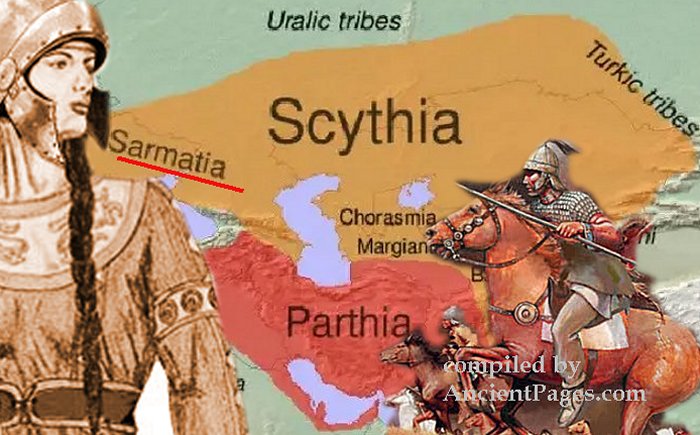 Among many women who lived in this part of the world, and roamed wild Scythian steppes, was Amage, a Sarmatian warrior queen who lived at the end of the 2nd century BC.
Many excavated Sarmatian military burials include the remains of armed Sarmatian women. The remains reveal clear signs of severe battle injuries, including stabs to their skulls and blows, similar to those observed on the remains of male warriors.
These findings, along with spears, axes, lances, and even double-edged short-swords (akinakes), found in the graves, strongly suggest that they all died in battle. The Sarmatian women, as were their husbands, brothers, and other relatives, were brave and skilled.
Among many women who lived in this part of the world, and roamed wild Scythian steppes, was Amage, a Sarmatian warrior queen who lived at the end of the 2nd century BC. She was the wife and co-ruler of the Sarmatian king Medosacus. Otherwise, very little is known about this Sarmatian queen and her rule. However, Sarmatian women became famous for having a prominent role in wars.
According to Hippocrates (c. 460 – c. 370 BC), Sarmatian women participated in warfare, and Herodotus (c. 484 – c. 425 BC), a Greek historian, described them as fighting in the same clothing as men. Some believe that the deeds of Amage's and other Sarmatian female warriors inspired those who created the Greek myths of the Amazons.
According to one source, her husband was a notorious drunkard who abused his power as a monarch for personal luxury. At the same time, another version points to the king's mental incompetence.
Amage Made An Important Decision In Difficult Times
From now on, the brave queen-warrior acted as regent; she took over the government into her own hands.
Polyaenus, a 2nd-century AD Macedonian author, writes in "Stratagems:
"She judged causes, stationed garrisons, repulsed the invasions of enemies, and directed everything with such a great ability that her fame extended through all Scythia."
She Was A Successful Ruler
Amage was impressed with the extraordinary military achievements - in the era of big but sluggish armies which depended more on size than strategy and tactics.
Instead, she organized a rally reminiscent of the actions of modern commandos. Her fame as a successful leader reached neighboring tribes and even far beyond the borders of her territories.
The inhabitants of the Chersonesus (once an ancient Greek colony founded about 2,500 years ago in the southwestern part of the Crimean Peninsula) also learned about her achievements. A king of the neighboring Scythians had systematically harassed these people. At last, they requested an alliance with her.
Polyaenus narrates that "in consequence of a treaty formed between the two nations, she wrote to the Scythian prince, requesting him not to repeat his ravages in the Chersonesus. When he treated her prohibition with disrespect, she marched against him with a hundred and twenty men of tried courage, and extraordinary strength, each of them provided with three horses."
In one night and day, she covered about two hundred kilometers (versions vary) and reached the enemy's palace.
In an unexpected attack, her troops captured the prince's palace, slew the guards, his friends, and his family, and ultimately killed the ruler.
Then "she put the inhabitants of Chersonesus back in free possession of their country, and gave his hereditary dominions to the son of the Scythian prince."
She allowed his son to live on the condition that he obeys her. She also warned him to be careful and take "a warning from his father's death, and not to invade the territories of the neighboring Greeks and barbarians."
Written by - A. Sutherland - AncientPages.com Senior Staff Writer
Updated on May 20, 2023
Copyright © AncientPages.com All rights reserved. This material may not be published, broadcast, rewritten or redistributed in whole or part without the express written permission of AncientPages.com
Expand for referencesMore From Ancient Pages
-
 Ancient Roman Portable Toilets Studied By Scientists
-
 Rare Upper Paleolithic Human Remains Discovered In The Iberian Peninsula
-
 7,800-Year-Old Clay Female Figurine Unearthed In Ulucak Mound, Turkey’s Izmir
-
 Ancient Greek Goddesses Aphrodite And Artemis – Rivalry And Conflict Over Prestige Illustrated In Hippolytus By Euripides
-
 On This Day In History: William Laud Archbishop Of Canterbury Beheaded – On Jan 10, 1645
-
 Intriguing Ptolemaic And Roman Treasures Unearthed In Al Bahnasa, Egypt
-
 Stonehenge May Have Aligned With The Moon As Well As The Sun
-
 On This Day In History: American General Benedict Arnold Commits Treason – On Sep 21, 1780
-
 Baltinglass Hills: Prehistoric Irish Monuments May Have Served As Pathways For The Deceased – New Evidence
-
 Did Ancient Romans Use Four-Meter Deep Shafts As Refrigerators During Summer?
-
 13th Century Black Book Of Carmarthen: Erased Poetry And Ghostly Faces Revealed By UV Light
-
 Depictions Of Two Biblical Heroines Unearthed In Ancient Synagogue, Huqoq In Galilee, Israel
-
 Cerne Abbas Giant: Researchers Attempt To Determine Age Of Giant Figure
-
 New Archaeological Discoveries In The Temple Of Khnum At Esna, Luxor
-
 ‘Saimaluu-Tash’ Time Capsule: Largest Millennia-Old Collection Of Petroglyphs In Central Asia
-
 How Did A Piece Of An ‘Epic’ Viking Sword End Up In The Netherlands?
-
 Mystery Of Ancient Sarcophagi In Egypt
-
 Tombstone With Ancient Greek Inscription Unearthed Near Nitzana In The Negev, Israel
-
 Lost Maya City Hidden In The Volcanic Lake Atitlán Explored By Underwater Archaeologists
-
 On This Day In History: Comet Donati First Observed By Italian Astronomer – On June 2, 1858

