
Dark And Light Sides Of Pax Romana: Great Political Slogan Introduced After Civil Wars
A. Sutherland - AncientPages.com - The Pax Romana ("Roman Peace") was a political slogan of great importance. It was introduced after the civil wars but not immediately after the Battle of Actium in 31 BC.
 The map depicts the Roman Empire in 117 C.E., at the height of the Pax Romana. Image credit: ushistory.org
The "Roman Peace" was delayed and could start in 27 BC. The continued fighting occurred in Hispania (the Roman name for the Iberian Peninsula) and the Alps region. It ended when Emperor Marcus Aurelius died in 180 CE.
The Empire, which during the first and second centuries AD had a considerable territorial extent, was prosperous and peaceful. Its power was stable, military expansion of Rome was limited to a minimum, warfare was banished to the frontiers protected by the army, and the war was banished.
During the Pax Romana, the Empire was inhabited by approx. 70 million people.
Monuments of the Empire's prosperity, such as influential buildings, aqueducts that survived to modern times, roads, and archaeological finds, show the people's technical skills in the Roman Empire.
The Pax Romana contributed to the Empire's prosperity; it was a time, when the army and warfare protected the frontiers were banished. The Roman roads were full of merchants and traders on their way to new markets. Rome traded with the Han Dynasty through the Silk Road, and economic expansion increased the Empire's wealth through taxes and duties.

This first Roman Emperor Augustus proved to be an effective leader. The image depicts Augustus in a victory pose. Possibly on the occasion of the Battle of Actium. Image's current location: Chiaramonti Museum, Braccio Nuovo (New Wing); credit: Till Niermann - Public Domain
But another aspect also cast a negative light on this crucial historical era and the popularity of Rome. We can mention the cruelty of mass slavery, extremely brutal gladiatorial entertainments, and plenty of practices of evil (even mad) emperors such as mentally unstable Caligula, the Roman emperor in 37 AD who declared himself a god.
Eventually, Caligula's bizarre and cruel behavior resulted in his assassination by his guards only a few years later, in 41 AD. Another evil tyrant and controversial emperor during Pax Romana was Nero. He misused his political power, had his mother killed, and executed many Christians and all people who disagreed with him. This infamous ruler committed suicide in 68 AD.
Some "good Emperors" born outside Rome were Nerva, Trajan, Hadrian, Antoninus Pius, and Marcus Aurelius, who expanded Rome's borders and better controlled distant parts of the Empire.
The era of the Pax Romana did not change conditions for poor people who lived in poverty, despite all of the wealth of the Roman Empire. There was a vast gap between rich and poor, even if the Romans tried to hide poverty and unemployment.
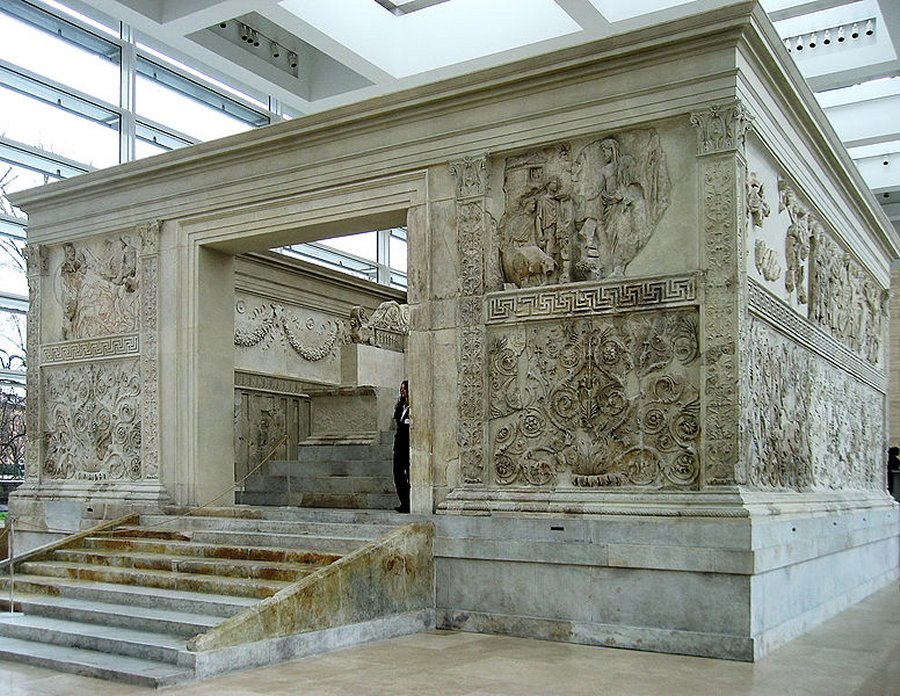 The 3 m tall altar stands on a 6 x 7 m podium is richly decorated and was consecrated on July 4, 13 BC and dedicated on January 30, 9 BC, the birthday of his wife, Livia. The U-shaped altar was inside a precinct, open to the sky with one staircase and double doors. Image credit: - CC BY-SA 3.0
People had no choice; they had to live under Roman rule whether they liked it or not. They were conquered, and "the conquered were given 'Roman Peace' whether they liked it or not, and the method was through the use or threat of military force, wielded ruthlessly and savagely – Tacitus' desolation called peace," writes Adrian Goldsworthy states in his book " Pax Romana: War, Peace, and Conquest in the Roman World. "
However, the fact remains that "when Rome collapsed, Europe sank into the Dark Ages, literacy and learning all but forgotten, and there was warfare and violence of every sort where once there had been peace, " continues Goldsworthy.
Written by – A. Sutherland AncientPages.com Staff Writer
Updated on January 14, 2024
Copyright © AncientPages.com All rights reserved. This material may not be published, broadcast, rewritten or redistributed in whole or part without the express written permission of AncientPages.com
Expand for referencesReferences:
A. Goldsworthy, Pax Romana: War, Peace, and Conquest in the Roman World
More From Ancient Pages
-
 Meskhenet: Egyptian Goddess Of Household And Childbirth Who Governed Over Fate And Destiny
-
 3,800-Year-Old Cuneiform Clay Tablet With Agreement To Purchase A City Discovered In An Ancient Tumulus In Turkey
-
 Table Manners And First Code Of Correct Behavior Were Introduced In Egypt 2,500 B.C. By Ptahhotep
-
 Mysterious Sumerian Star Tablet And Strange Divine Omens – Sacred Knowledge Of The Gods – Part 1
-
 Mysterious Ancient Artifacts Discovered In Virginia That We Were Never Meant To See
-
 Never-Before-Seen Frescoes From Hadrian’s Time Unveiled At Ancient Roman Baths
-
 How Early Farmers In Scandinavia Overcame Climate Change
-
 When Giants Ruled North America – Giant Skeletons ‘Erased’ From History – Part 2
-
 Antediluvian Time-Capsule Hidden In Forbidden Ancient Egyptian Crypts?
-
 Spectacular Anglo-Saxon Burial Uncovered – Here’s What It Tells Us About Women In Seventh-Century England
-
 Arachne – Spider Woman Who Challenged Goddess Athena And Was Punished
-
 Thousands Of Ancient Tools From A South African Cave Reveal Prehistoric Human Connections
-
 Men Are Slowly Losing Their Y Chromosome – Is The Future Of Humanity In Danger?
-
 On This Day In History: The Battle Of Actium Took Place On Sep 2, 31 BC
-
 Humans’ Evolutionary Relatives Butchered One Another 1.45 Million Years Ago
-
 Ancient Roman Laws Give Us A Window Into A World Of Abuse
-
 Lost Ancient Golden City Of Vineta – The Atlantis Of The North
-
 Amazing Victorian Time Capsule – 135-Year-Old Message In A Bottle Found In Edinburgh
-
 11,000-Year-Old Human Remains Found At Heaning Wood Bone Cave In Britain
-
 15,000-Year-Old Petroglyphs Discovered In The Gobi Desert May Be Evidence Ancient Turks Visited Mongolia – Expert Says

