AncientPages.com - When construction work began on a new arts center in Newport, south Wales, in 2002, the builders on site could scarcely have imagined what they would dig up. While excavating the foundations on the banks of the River Usk, a section of a medieval wooden ship was uncovered which had been perfectly preserved by the river's waterlogged silt. Archaeologists were called in and it soon became clear the vessel was extraordinary.

An artistic impression of how the Newport Medieval ship may have looked. Credit: David Jordan/Newport Museums and Heritage Service
This was not a coastal sailing boat that would have plied the Severn estuary up to the 19th century. Rather, it was a "great ship" by medieval standards, one that would have worked the long-distance routes of the Atlantic and Mediterranean. And yet, there it was, or at least a part of it, lying in an old slipway in what would have been a small Welsh port with a population of about 500 people during the Middle Ages.
The ship's remains quickly caught the public's imagination, with large numbers of local people visiting the wreck. It was a reminder that while Newport is best known historically as a 19th-century iron town, the city has a long history intimately connected to the sea.
So it was perhaps inevitable that locals were outraged when they learned "their" ship was simply going to be recorded where it sat, before being sampled and then bulldozed. The price tag just seemed too great; preserving the remains would take decades and cost millions.
Excavations of other ships, such as Henry VIII's Mary Rose, had shown how expensive it would be. But local passion and campaigning outweighed such considerations and plans eventually changed. The ship would be saved.
Twenty years later and the task of excavating, preserving and recording all the timbers and artifacts is nearly complete. Attention is now turning to the reconstruction of the remains and consideration of how best to display the ship in the future.

The Newport medieval ship as it looked in September 2002, months after construction workers made the discovery. Credit: Owain, CC BY-SA
Since its discovery, we have found out so much more about the Newport ship. It is not like the Mary Rose or the Vasa, a 17th-century Swedish warship recovered in 1961. Both are complete vessels, full of artifacts. The Newport ship is the surviving part of a vessel that was wrecked while undergoing maintenance in a dry dock.
Most of the contents, and almost all of the upper parts of the structure, were salvaged and removed before a medieval slipway was built on top. So, only part of the hull remains intact. However, that fragment is important both because it is wonderfully preserved and because is the largest and most complete section of a 15th-century European ship discovered to date.

The timbers of the Newport medieval ship undergo conservation in April 2008. Credit: Robin Drayton/Geograph, CC BY-SA
Also, dendrochronology (the scientific method of dating tree rings to the year they were formed), has made it possible to pinpoint that the ship was built in 1450 in the Basque country. The same techniques, when applied to the collapsed scaffolding used to hold the ship in place, can tell us when it was wrecked to within a year (1468). This has made it possible to situate the vessel within an eventful period, at the dawn of Europe's age of discovery and the Wars of the Roses.

A ‘petit blanc’ small French coin was found within the keel of the Newport Ship. Credit: Newport Museums and Heritage Service
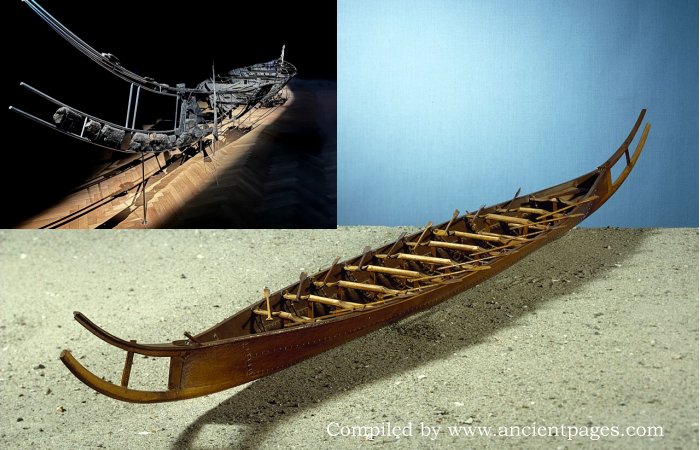
The Newport Medieval ship represents the final flourish of a shipbuilding tradition that stretched back centuries. This involved the construction of a shell, made from overlapping planks, into which a relatively light frame was fitted to provide stability.
It has more in common with Viking longships than it has with the skeleton-built ships of the early modern period. But the Newport ship is far bigger than Viking vessels. In its heyday it was capable of carrying 160 tuns (about 320,000 pints) of wine in its hold, on a voyage from Bordeaux.
One of the most positive aspects of the project has been the way archaeologists, curators, scientists and other experts have collaborated. A team of historians I gathered examined the context of the ship to better understand the world it came from.
Most recently, the project curator, Toby Jones, has worked with the Friends of the Newport Ship charity to produce complex visual reconstructions of the vessel. 3D animated films are being used to communicate the nature of the vessel to the public, as well as providing experts with fresh avenues of research to explore.
Written by Evan Jones, Associate professor, University of Bristol
Provided by The Conversation
This article is republished from The Conversation under a Creative Commons license. Read the original article.