
Rock Stars: How A Group Of Scientists In South Africa Rescued A Rare 500 Kg Chunk Of Human History
AncientPages.com - Scientific breakthroughs can happen in the strangest ways and places. Alexander Fleming discovered penicillin because of mold growing on a Petri dish left out while he was on holiday. Chinese monks in the 9th century wanted to make a potion for immortality: instead, they discovered gunpowder.
Our own remarkable discovery happened on a rugged, remote stretch of coastline east of Still Bay on South Africa's Cape south coast. It was low tide, and three members of our ichnology team (people who study tracks and traces) were in search of newly exposed Pleistocene vertebrate tracksites in aeolianites (cemented dunes).
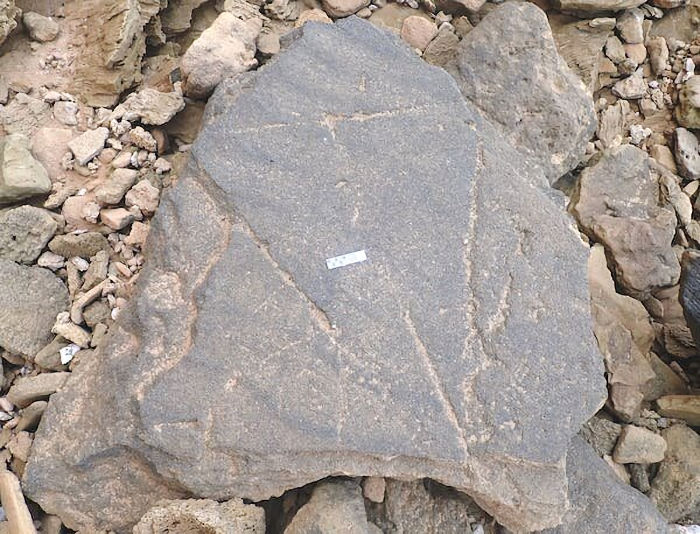
The larger of the two triangular geometric features (scale bar = 10 cm). Credit: Charles Helm
Ahead we saw a large rock that had tumbled down from the cliffs above. On its surface was a pattern of linear groove features in a large triangular shape, complete with an almost perfect bisecting groove. The sides of the triangle were close to a meter in length. After extensive research, we concluded that these grooves must have been made on a dune surface of unconsolidated sand by our human ancestors in the Middle Stone Age. The patterns are likely between 143,000 and 91,000 years old.
It was an important find in a significant place. Multiple lines of evidence on this coastline indicate that it's an area where our distant ancestors became truly modern, using fire as an engineering tool and creating abstract images.
But there was a problem. On a followup visit we found a smaller rock close by with a similar triangular feature. Subsequently, it was destroyed, likely by storm surges or high tides buffeting and overturning it. We knew that the larger rock inevitably awaited a similar fate if we did nothing. From our perspective this is one of the most important rocks in the world: it takes us back to our roots as a species and indicates the kind of "proto-art" we were capable of creating so long ago.
An unusual ‘rescue operation’ captured on video by Richard Webb.
The rock has subsequently been encased and placed on exhibit, with interpretive text panels. It joins similar exhibits in the museum; the grooves were an example of an ammoglyph, a term we had coined to describe a pattern created by humans in sand that is now evident in rock that has become cemented and then re-exposed.
Ascribing meaning to these geometric patterns made so long ago by our distant ancestors is not within our field of expertise. Still, we could not help but notice the resemblance of the triangular shape to a purported fertility symbol found in France and dated to around 38,000 years. Should the pattern on our rock represent the same motif, it would not be the first time that southern African discoveries had pushed back in time what has been viewed as an Upper Paleolithic Eurasian phenomenon.
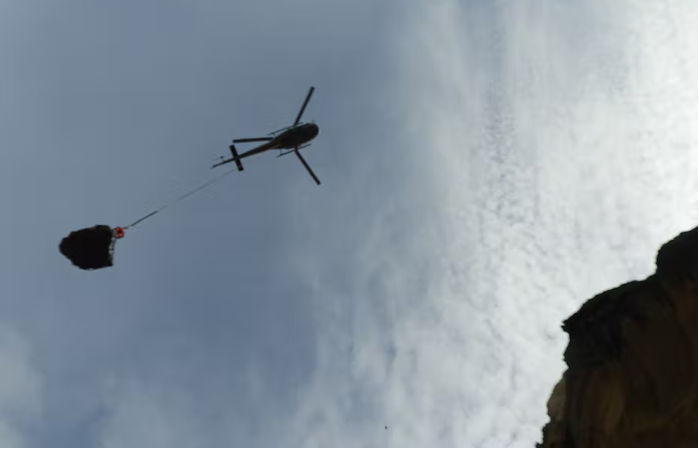
A helicopter, net and a long-line cable - as well as a skilled pilot - were key to the ‘rescue’ operation. Credit: Richard Webb
Our research team now sleeps better at night, knowing that this priceless piece of our human heritage has been recovered and is available for others to see, appreciate and critique.
More to discover
Happily, there was an unexpected bonus. Beside the eroded remains of the second rock our ground crew noted a third rock surface which had not been evident previously. Near one edge it contained a distinct pair of grooves that met at an angle of 69 degrees, forming what may have been part of another triangular feature.
This is clearly an area we will return to repeatedly, in the hope that tidal forces may turn over other rocks before destroying them, and may give us an opportunity to glimpse—and perhaps recover—more ammoglyphs.
Written by Charles Helm, Research Associate, African Centre for Coastal Palaeoscience, Nelson Mandela University
and Jan Carlo De Vynck, Director and research fellow, African Centre for Coastal Palaeoscience, Nelson Mandela University, Nelson Mandela University
This article is republished from The Conversation under a Creative Commons license. Read the original article.
More From Ancient Pages
-
 Odeuropa – Unusual Project Will Recreate The Smells Of Old Europe And Store The Scents In A Library
-
 Katanga Cross: Symbol Of Secrets, Power And Valuable Currency Of The Congolese People
-
 Large 3,400-Year-Old Mittani Empire-Era City Emerges From The Tigris River In Iraq
-
 1.5-Million-Year-Old Hominin Fossil Reveals Missing Link In Human Evolution
-
 Why Did Ancient Egyptians Use Pillows Made Of Stone?
-
 Neanderthals Changed Ecosystems 125,000 Years Ago
-
 1,800-Year-Old Legio VI Ferrata Military Camp Uncovered In Israel
-
 10 Ancient Shipwrecks And Several Underwater Artifacts Found Around The Island Of Kasos
-
 Are Climate-Related Calamities Erasing Illinois’ Cultural History? An Archaeologist Explains
-
 Ancient Manuscripts Of Mythical City Of Timbuktu
-
 On This Day In History: 4000 Defenders Of Pilėnai Commit Mass Suicide When Attacked By Teutonic Knights – On Feb 25, 1336
-
 Hidden 2,000-Year-Old Roman Road Uncovered In Worcestershire Could Be Of ‘Global Importance’
-
 African Kingdom Of Axum – Ancient Ruins Of Early Churches Unearthed
-
 Humans Used Northern Migration Routes To Reach Eastern Asia
-
 Hundreds Of Rock Paintings Found In Tanzania By Polish Archaeologist
-
 Mysterious Unknown Caves And Tunnels Discovered Beneath The Olsztyn Castle
-
 Ancient Stone Cylinders Shed New Light On The Invention Of Writing In Mesopotamia
-
 Controversial Atacama Skeleton Is Not An Alien – DNA Study Reveals
-
 Mysterious Ancient Mushrooms In Myths And Legends: Sacred, Feared And Worshiped Among Ancient Civilizations
-
 Bizarre Parthian Tomb Sheds Light On Ancient Life In Isfahan, Central Iran

