
Battle Of Visby – Death Came With King Atterdag’s Ships
A. Sutherland - AncientPages.com - Once upon a time, there was an important commercial center on Gotland, the island located in the Baltic Sea, approximately 90 kilometers east of mainland Sweden.
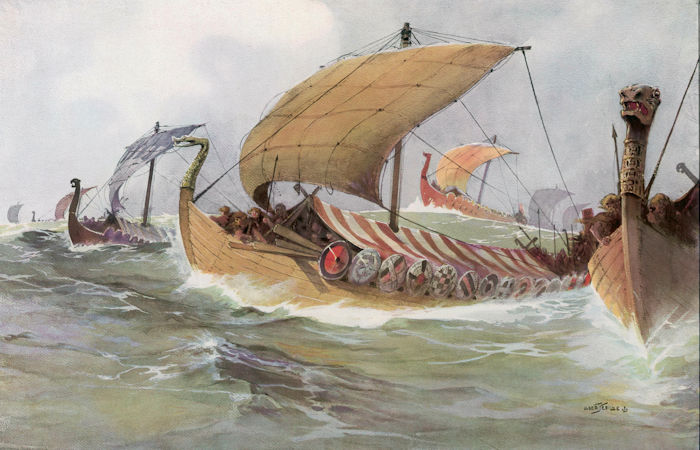
Credit: Adobe Stock - Archivist
Gotland's center of an extensive trading network stretched from Karelia in northern Finland down to the Caspian Sea in the south. The island flourished during Antiquity and Middle Ages, and its wealth in medieval times led to impressive architecture and local art development.
The death came in the summer of 1361. When a Danish army sailed eastward summer of 1361, the Swedish king Magnus Eriksson knew Gotland was in danger.
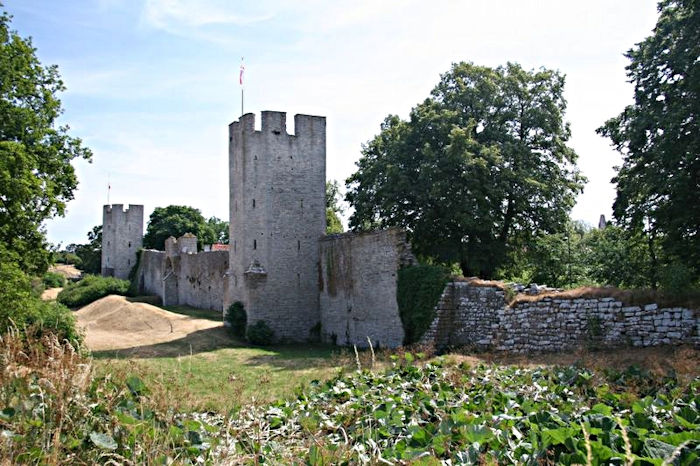
Picture of the Visby city wall, near the north gate. The main battle was fought within 300 meters of the city's fortifications. Credit: Benranton - Public Domain
He did what he could; he had issued a warning letter to the citizens of Gotland about a dangerous attack approaching the island of Gotland. The population of Gotland was preparing for the worst.
Early on the morning of Thursday, July 22, the enemy fleet was seen. The armada consisted of thirty ships, massive cogs, and smaller shells.
The rumor of the Danish attack spread rapidly across the island; soon, all church bells rang across the island – the danger was imminent.
Soon, the Danish king, Valdemar IV Atterdag, and his soldiers appeared on the horizon outside Visby's thick city walls.
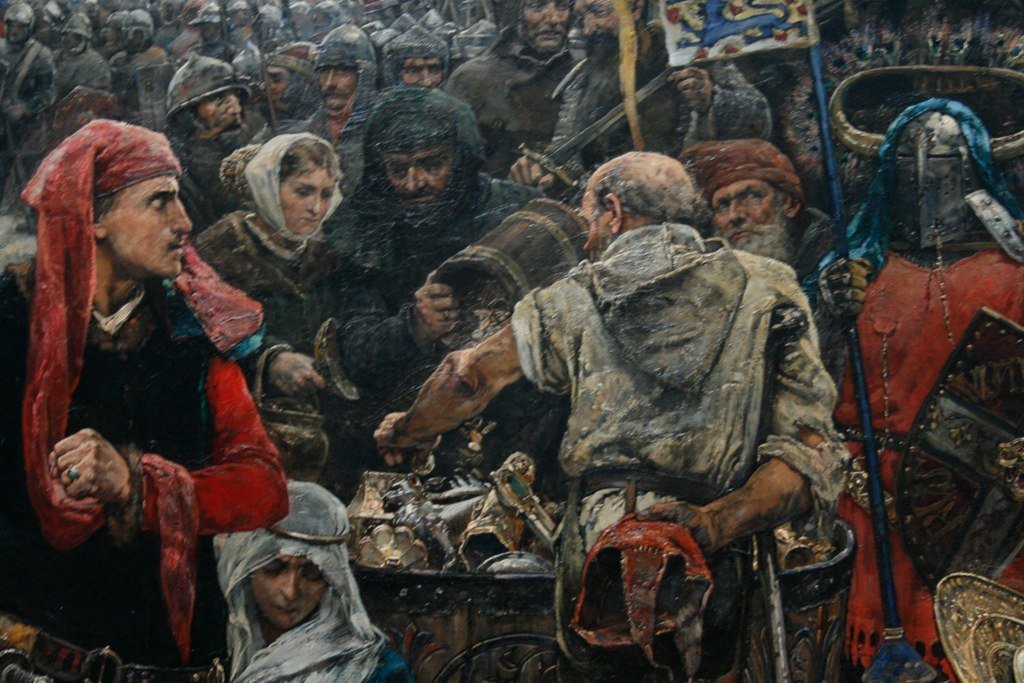
The cruel plundering of the island by King Valdemar definitely ended the island's prosperity. Credit: Carl Gustaf Hellqvist - Public Domain
They landed on the coast of Eksta Parish, Gotland, and the Danish troops moved towards Visby. The clashes began and culminated on July 27, just outside the city walls.
The main battle was fought within 300 meters of the city of Visby's fortifications. Roughly 1,800 Gotlanders had been killed, up to half of the participants - an exceptionally high loss ratio.
Following the devastating battle, the citizens of Visby decided to surrender to avoid further losses.
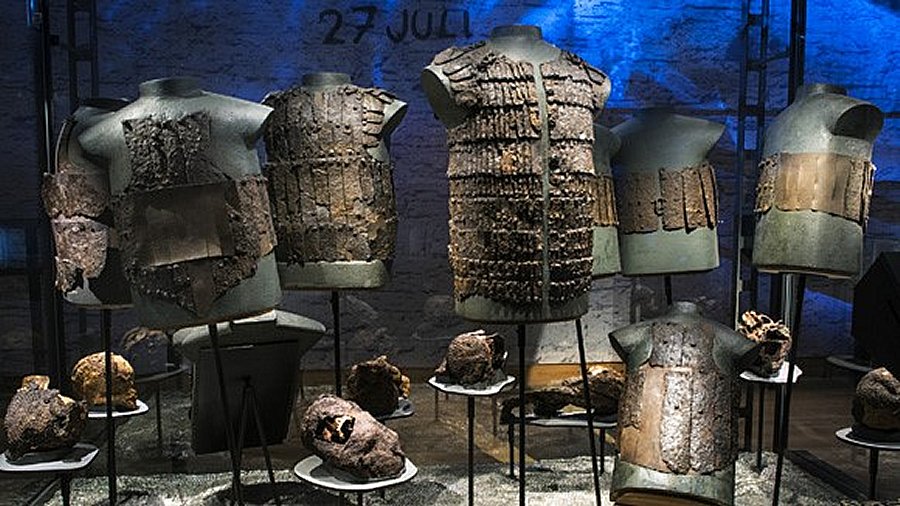
The exhibition "The massacre at the Great Wall, the Battle of Gotland in 1361" at the Historical Museum in Stockholm. "These findings are unique in the world, it is like a keyhole back to 1361. Photo: gotland.net/Historiska Museet Stockholm
Visby opened its gates to the victorious Danish army. Without outside help from fighting farmers, Visby would never be able to keep out Valdemar's forces.
Negotiations began. The inhabitants paid much of their wealth to King Valdemar to save the city from sacking. Despite the payment, the Danes still plundered several of the town's churches and monasteries on the island before they left. King Valdemar appointed sheriffs to govern Visby and then set sail again. It would take another year before Valdemar officially added "King of Gotland" to his many titles.
The cruel plundering of the island by King Valdemar definitely ended the island's prosperity.
However, one of Atterdag's ships carrying all the island's treasures sunk off the Carl islands west of Gotland.
Not long ago, a wood wreck was found outside the island Gotland, at a depth of 100 meters in a secret location between the two Baltic isles. Based on the sonar pictures, experts estimated that a small vessel was 28 meters long and 7 meters wide.
No cogs have ever been found in the area despite the extent of their use and the perfect conditions of the Baltic Sea for wreck preservation.
The seabed of the Baltic is flat, and the oxygen levels in the water are low enough to make it an ideal environment for wrecks to remain intact. Many shipwrecks were found in the Baltic Sea, according to researchers.

None of them, however, has been recognized as King Atterdag's lost ship with Gotland's treasures. The loot is resting somewhere in the underwater realm of the Baltic Sea near Gotland.
Only a few ancient written sources can tell about the Battle of Visby, Gotland. On the other hand, archaeological excavations have found out what happened on these tragic days of July 1361.
Outside Visby's city walls, archaeologists have unearthed five mass graves related to the tragic medieval battle.
The first grave was excavated in 1905, and each grave contained hundreds of victims; two more mass graves the research team investigated between 1909 and 1928.
One-third of the Gotland army were children, older men, and cripples. While the farmers were dying, the citizens of Visby just watched helplessly from the ramparts.
A few decades later, the memorial cross was erected on the mass graves.
Oral tradition is that the Danish king and his army raided southern Gotland for a month. On the return journey, some Danish ships with treasures are said to have been wrecked in a storm at the Karlsö islands - a group of islands off the west coast of Gotland that consists of Stora Karlsö and Lilla Karlsö.
People say that even today, when the weather is calm, you can see the treasures gleaming at the bottom of the sea. Is it symbolic revenge on the king, responsible for so much damage to the island and pain to the people of Gotland?
Written by – A. Sutherland AncientPages.com Staff Writer
Copyright © AncientPages.com All rights reserved. This material may not be published, broadcast, rewritten or redistributed in whole or part without the express written permission of AncientPages.com
Expand for referencesReferences:
Lingström, Maria (2007). Mästerby 1361- gutarnas strid mot Valdemar Atterdag.
More From Ancient Pages
-
 Eccentric Holy Roman Emperor Rudolf II Whose Occult Interest And Mistakes Led To The Thirty Years’ War
-
 How Was The 3,600-Year-Old Nebra Sky Disc Made? New Clues
-
 Ancient Oil Lamp Shop Discovered In Aizanoi, The Second Ephesus
-
 Dionysus – Greek God Of Wine, Music, Ritual Madness And Ecstasy Was Born Twice
-
 Disgusting Vandalism And Looting Of Viking Graves In Norway
-
 Pyramid Texts Of Ancient Egypt That Charted Journey Of Pharaohs Into Afterlife
-
 Ancient Maya Built Sophisticated Water Filters To Obtain Drinking Water
-
 Was The Mysterious Powerful Viking Warrior Buried In A Ship In Scottish Highlands A Woman?
-
 Cooking Gear Found In Graves Of Viking Men And Women
-
 Unusual Old Stone Map Found In The American Southwest
-
 Mysterious 70-Million-Year-Old Underground Village And Magnificent Tower Of Eben-Ezer In Belgium
-
 15,000-Year-Old Petroglyphs Discovered In The Gobi Desert May Be Evidence Ancient Turks Visited Mongolia – Expert Says
-
 Interbreeding With Modern Humans Wiped Out Neanderthals’ Y Chromosomes 100,000 Years Ago
-
 Marvelous Juglet With Four Pure Gold Coins Found In Jerusalem – Someone’s Piggy Bank?
-
 Aboriginal ‘Memories’ Of Australia’s Coastline Go Back More Than 7,000 Years
-
 Mysterious 2000-Year-Old Carved Vishap Stone Monuments Of Armenia
-
 16 Dead Sea Scrolls Fragments Are Forgeries – U.S. Bible Museum Says
-
 Three Ancient Tombs Of High-Ranking Officials Discovered In Luxor, Egypt
-
 Unexpected Archeogenetic Study Results Obtained In Graves Of Mödling And Leobersdorf, Lower Austria
-
 Extraordinary Collection Of Ivory Plaques Dated To The First Temple Period Unearthed In Jerusalem

