
Ancient Egyptians Invented World’s Oldest Egg Ovens And They Are Still In Use
Jan Bartek - AncientPages.com - The ancient Egyptian egg ovens are an excellent example demonstrating one should not underestimate how clever our ancestors were.
About 2,000 years ago, Egyptians came up with the incredible idea of producing enormous eggs. They constructed an egg incubator that could produce as many as 4,500 fertilized eggs in just two or three weeks!
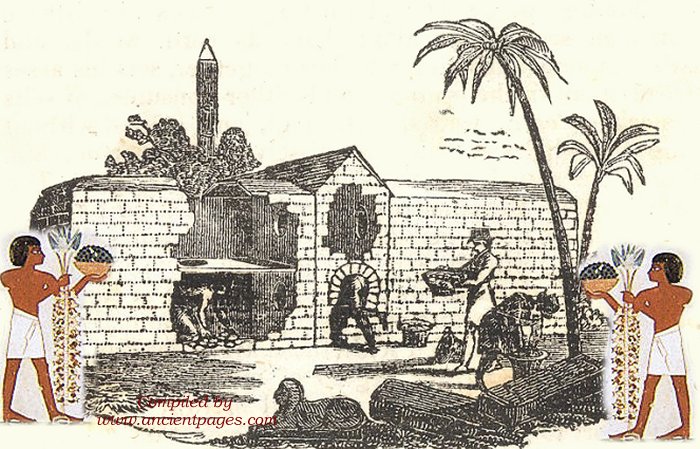
The ancient Egyptian mud ovens were designed to replicate the conditions under a broody hen, and the invention worked perfectly. Today, considered the world's oldest man-made incubators, this ancient hatching system was using artificial heat. The largest egg oven had a capacity of 80,000 eggs.
Ancient Egyptians were very secretive with their egg ovens, but the technology was long kept secret. Still, knowledge of this invention spread to neighboring lands. Some curious scholars wanted to see whether the ancient Egyptian egg incubators were as incredible as they were said to be.
Diodorus Siculus ( 90 B.C – 30 B.C), a Greek historian known for his universal history Bibliotheca Historica was so impressed with the Egyptian egg ovens that he described the technology in his compendium Library of History.
"The most astonishing fact is that, because of their unusual application to such matters, the men [in Egypt] who have charge of poultry and geese, in addition to producing them in the natural way known to all mankind, raise them by their own hands, by virtue of a skill peculiar to them, in numbers beyond telling," Diodorus Siculus stated in his ancient work.
Aristotle and Diodorus were equally impressed with the egg incubators and described them as ingenious.

"Traverse section and perspective elevation of an Egyptian Egg-oven." Published in "The Penny Magazine", Volume II, Number 87, August 10, 1833. Credit: Public Domain
The Irish friar Simon Fitzsimons who visited Egypt, said the egg ovens were supernatural.
"Also in Cairo, outside the Gate and almost immediately to the right … there is a long narrow house in which chickens are generated by fire from hen eggs, without cocks and hens, and in such numbers that they cannot be numbered,"
Fitzsimons said, referring to the Egyptian egg incubators.
The fact that ancient Egyptians were unwilling to share their technological secrets made it challenging to create a similar egg incubator, but many tried.
One of the best accurate descriptions of the Egyptian egg ovens comes from the Frenchman René-Antoine Ferchault de Réamur who visited the country in 1750 and described the mega incubators in his book “Art de faire éclorre et d’élever en toute saison des oisseaux” (1751).
Réaumur wrote that the people working in the ovens were almost like a caste and came from the same village and region: Bermé in the Nile Delta. One man was enough to operate a hatchery, which was active for six months in succession, for eight hatching rounds of incubated chicken eggs. The workers from Bermé learned this art handed down from father to son.
It was a heated brick structure, formed by a central corridor with openings, which gave access on both sides to many compartments in two tiers – an average of 5 per side –each of which was laying 4500 eggs on the ground floor. The upper and lower chambers communicated with the corridor through an opening that allowed access to a man.
In the lower chamber were the eggs, arranged on mats or tow, and communicated with the upper chamber through a central opening whose dimensions are such as to allow the heat from above to reach the eggs in the incubation chamber. In the upper room, in a peripheral groove, cow dung or dromedary dung was burnt, dried, mixed with straw, and then compressed. Thus, a smoldering fire was obtained, which was lit twice daily, morning and evening, and mats were applied to half of the vent hole of the upper chamber. As a result, the hot air was forced to pass through the corridor.
Every day the eggs were turned, transferred to any other point warmer or cooler when needed, and partly transferred into the upper chamber when the fire was no longer lit. The man in charge of the incubator was such an expert that he did not need a thermometer – although they were nonexistent. The temperature of the eggs was checked by the egg against the cheek or against an eyelid. Two-thirds of the incubated eggs hatched." 1
Today, there are about 200 such egg ovens used in Egyptian rural areas. Incredibly, the technology invented 2,000 years ago has passed the test of time!
Written by Jan Bartek - AncientPages.com Staff Writer
Updated on December 28, 2022
Copyright © AncientPages.com All rights reserved. This material may not be published, broadcast, rewritten or redistributed in whole or part without the express written permission of AncientPages.com
Expand for references- Elio Corti, Elly Vogelaar – The Oldest Hatcheries Are Still In Use - aviculture-europe.nl
- Wikipedia
More From Ancient Pages
-
 New Large Sphinx Still Embedded In Soil Discovered In Luxor, Egypt
-
 On This Day In History: The Name Of America Used For The First Time On World Map – On Apr 25, 1507
-
 When And What Was The Golden Age Of Piracy?
-
 Ancient Cities Built By Biblical Giants – Archaeological Evidence
-
 Bizarre And Rare Finds In Viking Houses – What Was Behind This Mysterious Practice?
-
 Medieval Paradise Cockaigne – Land Of Extreme Pleasure And Luxury
-
 New Fossil Ape Challenges The Story Of Human Evolution
-
 Ancient Mystery Of The Oghars – An Unusual And Little-Known Lost Race
-
 20 Mummies Discovered In Greco-Roman Tombs In Aswan, Egypt
-
 Mysterious Inca Citadel With Platforms, Passages And Walls Discovered In Peru’s Rainforest
-
 Nomenclator: Ancient Living-Human Calendar And Address Book
-
 Controversial Davenport And Pontotoc Stele Reveal Ancient Egyptians And Black Africans Visited North America
-
 Neanderthals Weaned And Raised Their Children Similarly To Modern Humans
-
 Slovenia’s Unique Discovery Of Masts, Sails And Small Harbor Found At The Bottom Of The Adriatic Sea
-
 Adventurous Viking Woman Who Challenged Social Norms And Whose Fate Was Foretold By A Völva
-
 Fragments Of Old City’s Fortifications And Carved Hand Imprint Unearthed In Jerusalem
-
 Oldest Case Of A Rare Genetic Condition Discovered
-
 Ancient Andean People Had A Plant-Based Diet And Were Not Hunter-Gatherers
-
 What Happened To The Staircase In The Temple Of The Goddess Hathor?
-
 Disappearance Of The El Argar Civilization – Why Has No One Lived In The La Almoloya Region Again?

