
Inghirami Tomb – Spectacular Etruscan Burial With 53 Alabaster Urns In Ancient City Of Volterra, Italy
A. Sutherland - AncientPages.com - Many secrets of the ancient Etruscans, who represent one of the most enigmatic civilizations in Europe, are still to be discovered.
Etruscan cemeteries contain different burial practices dated from the 9th to the 1st century BC and bear witness to the achievements of Etruscan culture, which, over nine centuries, developed the earliest urban civilization in the northern Mediterranean.

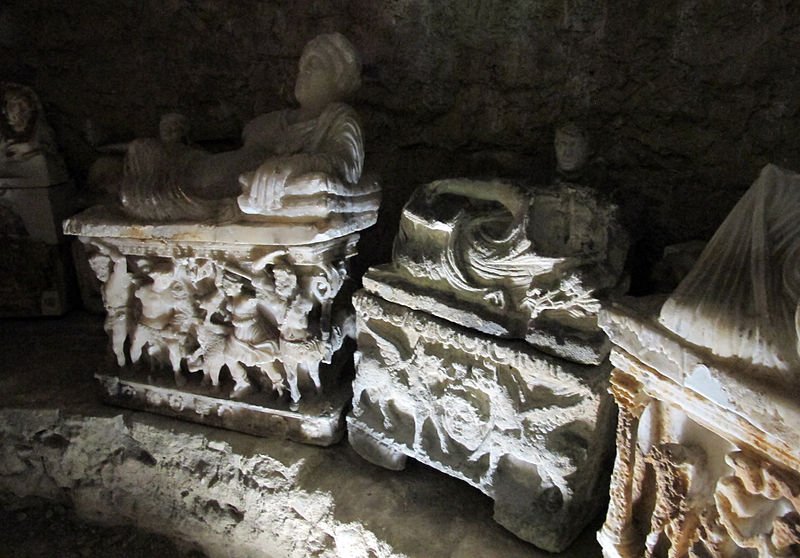
Inghirami Tomb in ancient Ccity of Volterra, Italy. Image credit: Sailko - CC BY-SA 3.0
Some tombs are monumental, cut in the rock, and decorated by impressive tumuli (burial mounds) and carvings. In contrast, others have wall paintings that successfully survived until now. However, many Etruscan tombs have been looted over the centuries.
Among those still preserved is the Inghirami Tomb, which belonged to the Atia family and is one of the most impressive tombs from the Etruscans' Ulimeto necropolis.
It contained fifty-three urns dating from the first half of the second to the middle of the first century.
The 'Inghirami Tomb' is considered one of the best-known late Etruscan tomb complexes. Two Inghirami brothers discovered it and visited the Ulimeto necropolis outside Volterra, Italy, in 1861.
Etruscan City Of Volterra
A ring of defensive walls surrounds Volterra, an ancient fortress city with Etruscan roots, built by the Medici family in 1474 on the remains of older fortresses. The construction appeared two years after the city of Florence had conquered Volterra after a brutal war over the control of the alum mines.
Closed within mighty old walls and situated on a hill 545 meters above sea level, Volterra is far from the sea and the urban settlements. Over the centuries, it was the city's most favorable strategic position. However, the massive fortress ("Fortezza dei Medici") was not built to protect the area but to subjugate the whole community and discourage rebellion.
However, although the city was closed within its walls, it was repeatedly captured but maintained some independence until the Romans finally conquered it.
Thanks to rich history and culture, Volterra could preserve several monuments, including the 'Inghirami Tomb.' The two young brothers accidentally found the structure outside Volterra's wall circle, where they went to spend their holiday.
Beneath a grassy mound, the boys discovered a subterranean structure - a tomb constructed of a circular chamber roughly hewn in the bedrock, without any decorations, and enclosed by a false dome supported by a central pillar. An entrance passage leads to the room, cut into the tufa rock.
Inside the tomb's chamber are fifty-three spectacular, beautiful cinerary alabaster urns and round central pillars supporting the ceiling, all made from local alabaster stone. The tomb chamber was filled with sixty chests from five-six generations, placed in two rows on the bench and in front of the central pillar.
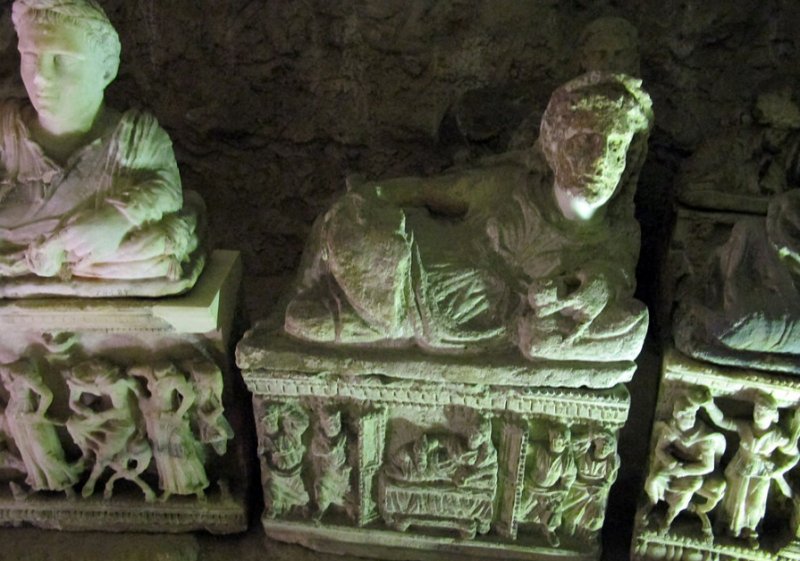
Inghirami Tomb - Volterra, Italy. Image credit: - CC BY-SA 3.0
Traditionally, the primary function of the urns was to hold a person's ashes after cremation. This funeral tradition was popular among both classical and prehistoric cultures. The structure represents a characteristic Volterran tomb dated to the 4th-1st century BC. Relief decorations and the reclining lid figures representing the deceased create an illusion of a banquet hall. However, these sculptural decorations were not intended to be public manifestations.
The Inghirami Tomb allows us to admire something from the distant past because there are not many valuable places to see. Almost all the Etruscan tombs were looted in antiquity a long time ago.
The Etruscan urns lack Latin inscriptions typically found on the ones dated to Roman times. Today, the jars that belonged to an Etruscan Volterranian family Ati (Atia), are stored in Florence, Italy. ¨
After the reconstruction, the tomb is now in the garden of the National Archaeological Museum of Florence.
Written by – A. Sutherland - AncientPages.com Senior Staff Writer
Updated on March 07, 2023
Copyright © AncientPages.com All rights reserved. This material may not be published, broadcast, rewritten or redistributed in whole or part without the express written permission of AncientPages.com
Expand for referencesReferences:
MacIntosh Turfa J, The Etruscan World
National Archaeological Museum of Florence
Haynes Sybille, Etruscan Civilization: A Cultural History
Banti, Etruscan Cities and Their Culture
More From Ancient Pages
-
 Walls Of Lugo: Finest Example Of Late Roman Fortifications – Stands The Test Of Time
-
 On This Day In History: Grote Reber, Great Amateur Astronomer And Ham Radio Operator Born – On Dec 22, 1911
-
 1,500-Year-Old Inscription ‘Christ, Born Of Mary’ Engraved On Magnificent Building Discovered In Israel
-
 On This Day In History: Battle Of Durnstein Was Fought On The River Danube – On Nov 11, 1805
-
 How Extensively Did Early Farmers Utilize Europe’s Rich Forests For Raising Their Livestock?
-
 Large Ancient Statues And Artifact With Foreign Inscription Found In A Swamp In Michigan
-
 Legendary Mount Penglai Where The Eight Immortals Reside
-
 Cheomseongdae “Star-Gazing Tower” Is The Oldest Observatory In East Asia
-
 Was A Statue Of Asherah Hidden In The Ark Of The Covenant?
-
 Tomb Of God Thoth’s High Priest Discovered In Ancient Egyptian Necropolis
-
 Underwater Stone Age Village Habonim North Found Off Israel’s Carmel Coast Thrived During Climate Change
-
 Papyri Was Still In Use After The Arab Invasion In Egypt
-
 Bryggen Inscriptions Reveal Viking Runes Were Used As Modern SMS – Short Message Service In The Norse World Was Popular
-
 Inscription Found In Ancient Thracian Tomb in Bulgaria’s Tatarevo Is A Verse from Solon’s ‘Prayer to the Muses’
-
 7,000-Year-Old Male Skeleton In Garment Decorated With Sea Shells, Red Deer Teeth Identified In France
-
 Climate In The Andes Has Driven 7,000 Years Of Dietary Changes – New Study Reveals
-
 Unique Pig-Shaped Figurine Found In East China Was Probably A Child’s Toy 6,000-Years Ago
-
 Large Mysterious 2,000-Year-Old Structure Discovered At The Center Of A Military Training Area In Israel
-
 Brilliant Prehistoric Cave Paintings Of Lascaux – Who Were Their Unknown Creators?
-
 The Long And Satisfying 28,000-Year History Of The Dildo

